
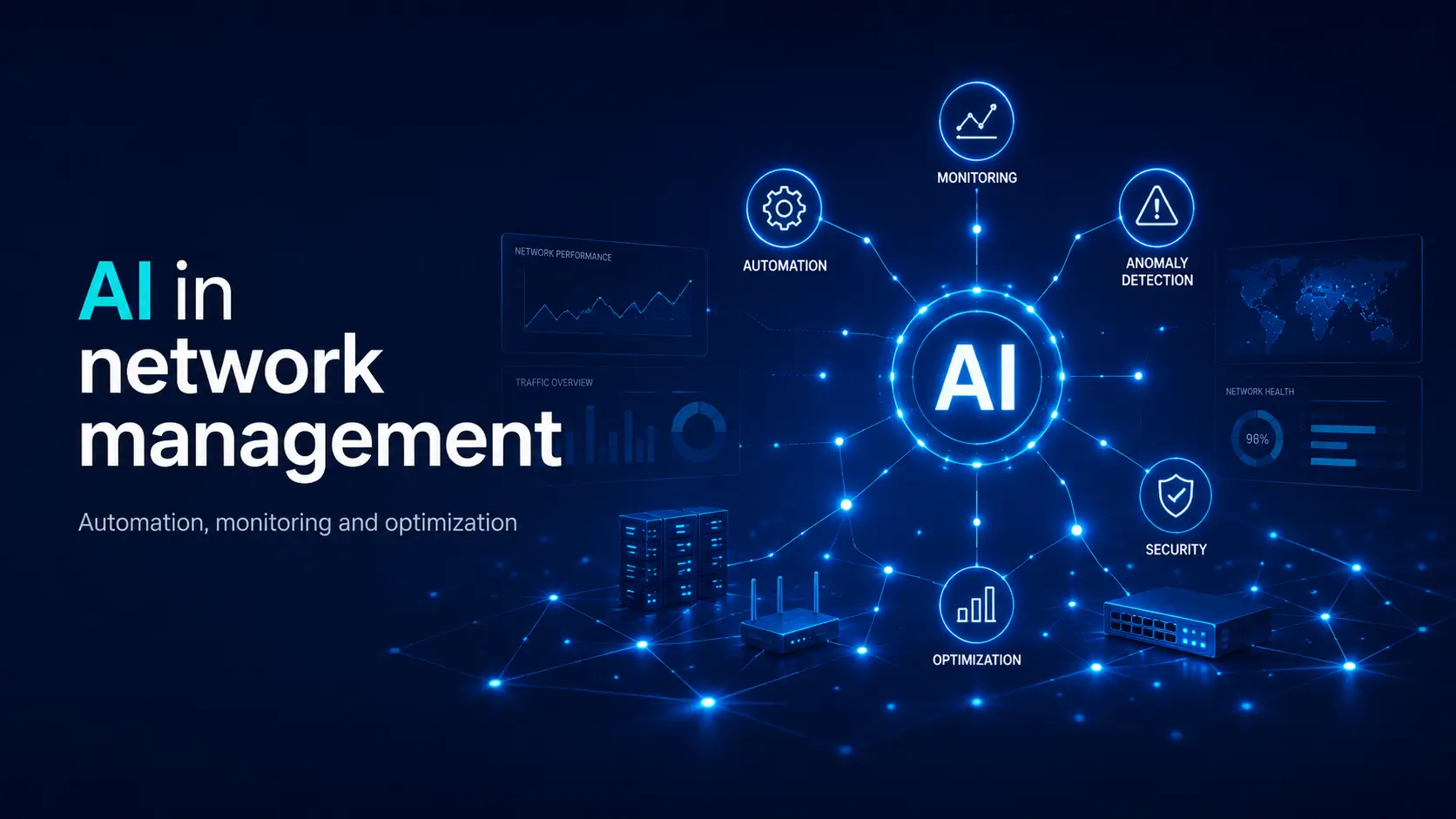
AI in network management: from reactive troubleshooting to self-healing enterprise networks
AI in network management applies machine learning to network telemetry, logs, events and traffic patterns to detect anomalies, predict failures and trigger automated remediation. For enterprises managing hybrid, multi-cloud and SD-WAN environments, this changes network operations from reactive troubleshooting to proactive network assurance. The result is faster incident response, better visibility and a more scalable operating model for the NOC.
What is AI in network management?
AI in network management is the use of machine learning, analytics and automation to monitor, analyze, optimize and remediate enterprise network infrastructure.
Traditional network management systems rely heavily on static thresholds, manual configuration and reactive troubleshooting. They can tell the NOC that a device is down, a link is saturated or latency is rising. AI-driven network management goes further. It learns normal behavior, detects unusual patterns, correlates events across domains and recommends or executes corrective actions.
This usually appears at three maturity levels:
- AI-assisted: the system improves alerts, dashboards and recommendations, but humans still make decisions.
- AI-augmented: the system correlates events, suggests root causes and proposes remediation steps.
- AI-autonomous: the system uses closed-loop automation to detect, decide, act and verify with limited human intervention.
AI does not replace the network management system. It adds an intelligence layer above monitoring, observability, ITSM and automation tools.
| Area | Traditional NMS | AI-driven network management |
| Alerting | Static thresholds | Dynamic anomaly detection |
| Troubleshooting | Manual investigation | Root cause analysis and correlation |
| Data collection | SNMP polling, logs | Streaming telemetry, logs, flows and events |
| Response | Human-led remediation | Suggested or automated remediation |
| Learning | Manual tuning | Self-learning baselines |
| Operating model | Reactive | Predictive and proactive |
The key prerequisite is data quality. AI models need reliable telemetry from routers, switches, firewalls, cloud networks, SD-WAN, applications and endpoints. Without clean data, AI in network management becomes another noisy dashboard.
For companies modernizing network architecture, Webellian’s Network as a Service offering can support secure, cloud-native and software-defined connectivity across branches, data centers and cloud environments. If you are comparing network operating models before introducing AI-driven automation, start with Webellian’s guide to NaaS vs MPLS, which explains when enterprises should replace private WAN, keep MPLS or build a hybrid network.
Key use cases of AI in enterprise network management
AI in network management creates the most value when it reduces manual diagnosis, shortens incident response and prevents outages before users notice them.
The most important use cases are anomaly detection, predictive failure analysis, automated remediation and traffic optimization.
Anomaly detection and real-time threat identification
Anomaly detection is one of the clearest use cases for AI in network management. Instead of relying only on fixed thresholds, AI builds a baseline of normal behavior for devices, users, applications and traffic flows.
It can detect:
- sudden traffic spikes
- unusual DNS behavior
- abnormal east-west traffic
- packet loss outside normal patterns
- unexpected configuration changes
- suspicious authentication behavior
- performance degradation on specific paths
This is valuable because many network incidents do not start as complete outages. They start as weak signals: rising error rates, interface flaps, unusual latency or changed traffic behavior. AI can surface these signals earlier than manual monitoring.
In a security context, network anomaly detection can also support SIEM and SOAR teams. For example, unusual DNS patterns or outbound connections can become an early warning before a threat is fully confirmed by known indicators of compromise.
Predictive failure analysis and capacity planning
Predictive analytics helps network teams understand what is likely to fail next.
AI models can analyze historical and real-time data such as interface errors, device temperature, power metrics, link utilization, dropped packets and configuration changes. Based on these patterns, the system can flag devices or links that are moving toward failure.
This supports two decisions:
- operational action, such as replacing hardware before an outage
- strategic planning, such as upgrading bandwidth before SLA degradation
Predictive capacity planning is especially useful in hybrid and cloud environments, where traffic patterns change quickly. A new SaaS rollout, cloud migration or branch expansion can change bandwidth needs faster than manual planning cycles can react.
Traffic optimization and QoS management
AI can also optimize network performance continuously. In SD-WAN and cloud-connected environments, AI can compare application performance across multiple paths and choose the best route based on latency, jitter, packet loss and business priority.
This is useful for applications such as Teams, Zoom, SAP, ERP systems, trading platforms, logistics systems or customer-facing portals.
Instead of relying only on static QoS policies, AI can adjust priorities based on real-time conditions. The business outcome is simple: fewer dropped packets, lower latency for critical applications and better user experience.
This is where AI-powered optimization connects naturally with broader WAN transformation. For enterprises still comparing traditional connectivity with software-defined models, Webellian’s guide to NaaS vs traditional network explains how network ownership, provisioning, scalability and cost models change when networking moves toward a service-based architecture.
How AIOps integrates with network operations
AIOps provides the operating model for AI in network management. It combines machine learning, big data analytics, event correlation and automation to help NOC teams reduce alert noise, identify root causes and respond faster.
In a traditional NOC, engineers often move between monitoring tools, logs, tickets, dashboards and device interfaces. AIOps changes this workflow by correlating signals across tools and turning thousands of raw events into a smaller number of actionable incidents.
AIOps is especially useful for:
- event correlation
- alert deduplication
- root cause analysis
- predictive incident detection
- ITSM ticket enrichment
- automated runbook execution
- incident prioritization
- capacity intelligence
| Area | Traditional NOC workflow | AIOps-augmented workflow |
| Alert handling | Review many raw alerts | Review correlated incidents |
| RCA | Manual log and topology analysis | AI-assisted root cause hypothesis |
| Remediation | Manual runbook execution | Suggested or automated runbooks |
| Reporting | After-the-fact summaries | Real-time incident context |
| Skills | Device and protocol expertise | Network expertise plus automation and data literacy |
AIOps should integrate with existing NMS, observability, SIEM, SOAR and ITSM tools. It should not become another isolated dashboard.
AI-powered network management platforms
The enterprise AI network management market includes network vendors, AIOps platforms, observability tools and cloud-native monitoring systems. The right choice depends on the environment: campus network, SD-WAN, data center, cloud, hybrid infrastructure or telco-grade operations.
| Platform | Primary market | AI capability | Deployment | Main strength |
| Cisco ThousandEyes / Catalyst ecosystem | Enterprise and internet visibility | Path visibility, network intelligence, digital experience monitoring | SaaS and Cisco ecosystem | Strong cross-domain visibility |
| Juniper Mist AI / Marvis | Campus, wireless and enterprise networks | AI assistant, anomaly detection, network insights | Cloud-native | Strong AI-first operating model |
| IBM Watson AIOps | Enterprise IT operations | Event correlation, RCA, automation workflows | Hybrid and enterprise | Strong AIOps and ITSM integration |
| HPE Aruba Networking Central | Campus and branch networks | AI insights, recommendations, user experience monitoring | Cloud-managed | Strong LAN/WLAN operations |
| Nokia NSP | Service provider and telco networks | Predictive maintenance, telemetry, automation | Carrier-grade | Strong telco and large-scale network use cases |
| Broadcom / VMware ecosystem | Multi-cloud and enterprise operations | Flow analytics, visibility, operations management | Enterprise and cloud | Strong hybrid environment coverage |
Vendor lock-in is a real consideration. CTOs should evaluate whether a platform supports open standards and integration patterns such as OpenConfig, gNMI, APIs, OpenTelemetry and exportable event data.
The platform decision should not start with features. It should start with architecture: what data needs to be observed, which domains need to be correlated and which actions can safely be automated.
Benefits and ROI of AI-driven network management
The business case for AI in network management usually depends on four outcomes: shorter incident resolution, fewer escalations, better uptime and lower operational effort.
The most important KPI is often MTTR, or mean time to resolution. AI helps reduce MTTR by identifying patterns faster, correlating events and suggesting the most likely root cause. MTTD, or mean time to detect, also improves when anomaly detection catches early signals before the incident becomes visible to users.
A practical ROI model should include:
| Value area | KPI | Business impact |
| Incident response | MTTR, MTTD | Less downtime and faster recovery |
| Alert quality | Alert-to-incident ratio | Lower alert fatigue |
| Productivity | Incidents handled per engineer | Better NOC efficiency |
| Availability | SLA performance | Better reliability for users and customers |
| Cost control | OpEx and TCO | Less manual work and better capacity planning |
| Risk reduction | Number of severe incidents | Lower operational and security risk |
AI also changes the cost model. Instead of buying more capacity “just in case” or adding more people to handle alert volume, teams can use predictive analytics and automation to right-size operations.
This does not remove the need for network engineers. It changes where their time goes. Engineers move from repetitive triage toward automation design, policy governance, architecture and high-impact troubleshooting.
For CTOs building a broader business case around network transformation, Webellian’s NaaS vs MPLS article includes a practical view of workload segmentation, hybrid WAN migration and TCO logic. That makes it a natural supporting resource for the financial side of AI-driven network management.
If your team lacks specific skills for implementation, Webellian’s IT Resource Center can help build a tailored team for temporary or long-term infrastructure, cloud or automation projects.
Network observability and AI-grade telemetry
AI-driven network management depends on high-quality telemetry. Legacy SNMP polling and isolated logs are not enough for accurate anomaly detection or root cause analysis in modern enterprise environments.
Traditional monitoring answers: “Is it up?”
Network observability answers: “Why is it slow, unstable or behaving differently?”
AI-grade observability usually combines:
- metrics
- logs
- traces
- flow data
- topology data
- configuration state
- user experience data
- application performance data
- cloud and SD-WAN telemetry
Streaming telemetry is especially important because it gives AI models more frequent and more detailed data than traditional polling. Technologies such as gNMI, OpenConfig, gRPC, time-series databases and OpenTelemetry can help build a more reliable telemetry pipeline.
A modern telemetry architecture may look like this:
- Network devices, cloud platforms and endpoints generate telemetry.
- Data flows through collectors and pipelines.
- Events are normalized across vendors.
- Metrics are stored in a time-series database.
- AI models analyze patterns and anomalies.
- Dashboards, alerts and automation workflows act on the insights.
The most common mistake is starting with AI tooling before telemetry readiness. If data is fragmented, incomplete or inconsistent, the AI layer will produce weak recommendations.
Network observability also becomes critical during cloud transformation, because weak monitoring can turn migration into another layer of operational complexity. For a broader architecture perspective, see Webellian’s article on cloud migration as architecture for CTOs, which explains why migration should connect infrastructure, security, observability and governance from the start.
For organizations combining network modernization with cloud infrastructure, Webellian’s Cloud and security services can support infrastructure design, automation, monitoring and secure cloud architecture.
GenAI and LLM-powered NOC assistants
Generative AI and large language models are starting to change how engineers interact with network operations data.
Traditional tools require engineers to know which dashboard, query, log source or command to use. LLM-powered NOC assistants can let engineers ask questions in natural language, such as:
- “Which switches had the most CRC errors in the last 7 days?”
- “Why did latency increase for this application yesterday?”
- “Summarize the likely root cause of this incident.”
- “Generate a runbook for this recurring BGP issue.”
- “Which users were affected by this path degradation?”
This creates a new operational metric: MTTU, or mean time to understanding. In many incidents, the hard part is not executing the fix. The hard part is understanding what happened, which systems are affected and what the safe next step is.
Useful GenAI use cases in the NOC include:
- natural language querying
- automated runbook generation
- root cause summaries
- incident timeline generation
- anomaly explanation
- ticket enrichment
- knowledge base search
- post-incident report drafts
The risks are real. LLMs can hallucinate, misunderstand context or generate unsafe recommendations. For network operations, that means GenAI should start as an assistant, not an autonomous operator.
A safe approach is to pilot GenAI in read-only or advisory mode first. Let it summarize, search and explain. Only later should teams connect it to remediation workflows, and even then with human approval and audit trails.
If your organization wants to test whether AI can improve network operations without committing to a full-scale deployment, a focused proof of concept is usually the safest first step. Webellian’s guide to data science proof of concept can help structure that early validation phase before moving AI into production workflows.
Webellian’s Data Science and AI services can also support AI exploration, ML pipeline design and implementation for business-specific AI use cases.
Implementing AI in network management
Deploying AI in network management requires more than buying an AIOps platform. The project needs data readiness, integration planning, governance and change management for NOC teams.
A practical implementation path:
- Assess: map current tools, data sources, incidents and pain points.
- Design: define the target architecture, telemetry pipeline and automation scope.
- Pilot: start with monitoring-only AI in a non-critical segment.
- Scale: expand to more domains and integrate with ITSM or SOAR.
- Operate: tune models, measure outcomes and improve automation coverage.
The most common challenges are:
- poor data quality
- fragmented vendor telemetry
- lack of historical data
- unclear incident taxonomy
- alert fatigue during the tuning period
- weak API access to devices
- lack of automation skills
- resistance from network teams
- unclear approval rules for automated changes
Responsible AI matters. Network automation should be explainable, auditable and reversible. In regulated industries such as finance, healthcare or telecom, every AI-driven recommendation should have a visible reason, confidence level and change history.
AI in multi-cloud and hybrid network environments
AI in network management becomes more important as enterprise networks become more distributed. A modern network may include on-premise data centers, AWS VPCs, Azure VNets, GCP projects, SaaS platforms, SD-WAN, branch offices, edge sites, IoT devices and remote users.
The problem is not lack of tools. The problem is fragmented visibility.
Each environment has its own monitoring and logging systems. AWS, Azure, GCP, SD-WAN vendors and security platforms all produce different telemetry formats. Without unified observability, the NOC sees pieces of the picture but not the full service path.
AI can help by correlating events across domains:
- cloud connectivity issues
- SD-WAN path degradation
- SaaS performance drops
- DNS or BGP anomalies
- identity-related access failures
- high egress cost caused by inefficient traffic flow
- application latency across cloud regions
For CTOs, the important question is: can the platform explain how network, cloud, security and application layers affect each other?
In hybrid environments, AI-driven network management should support:
- unified observability across domains
- cross-cloud traffic analysis
- policy consistency
- cloud egress visibility
- SD-WAN optimization
- service mesh observability
- security event correlation
- automation across vendors
This is where NaaS, Zero Trust and AI-driven observability can work together. For related context, read Webellian’s guide to Zero Trust in corporate networks, which explains how modern access models reduce implicit trust in distributed environments. You can also connect this topic with Webellian’s NaaS vs MPLS guide to understand how hybrid WAN decisions affect cloud, branch and remote-user connectivity.
Webellian can support yYou with Network as a Service, Cloud and security and Data Science and AI services. If your network is becoming harder to operate across cloud, branch, edge and hybrid environments, Webellian can help assess readiness, design the right architecture and build an AI-enabled operating model that scales with your business.
Related reading on AI, cloud and network infrastructure
To explore the broader architecture around AI-driven network management, continue with these Webellian resources:
- NaaS vs MPLS: should your enterprise replace private WAN or build a hybrid network? — for CTOs comparing MPLS, NaaS and hybrid WAN models.
- NaaS vs traditional network: what’s the difference? — for understanding the shift from owned infrastructure to service-based networking.
- Zero Trust in corporate networks: principles and implementation guide — for aligning AI-driven network operations with modern security principles.
- Move the business, not the mess: cloud migration like architecture for CTOs — for connecting AI, observability and network modernization with cloud migration strategy.
- Data science proof of concept: how to plan and execute — for validating AI use cases before production deployment.
- Cloud computing vs cloud outsourcing: key differences for business leaders — for deciding which parts of cloud and infrastructure operations should be handled internally or with an external partner.
FAQ: AI in network management
What is AI in network management?
AI in network management is the use of machine learning, analytics and automation to monitor, optimize and remediate enterprise networks. It helps network teams detect anomalies, predict failures, reduce alert noise and improve response times.
What is the difference between AI and machine learning in network management?
AI is the broader capability of making systems analyze, recommend or act intelligently. Machine learning is one of the main techniques used inside AI-driven network management to detect patterns, classify behavior and predict incidents.
How does AI detect network anomalies in real time?
AI detects anomalies by learning normal behavior from telemetry, logs, flow data and performance metrics. When traffic, latency, errors or user behavior deviates from the baseline, the system scores the event and can trigger an alert or remediation workflow.
What is a self-healing network?
A self-healing network can detect a problem, choose a corrective action, execute or recommend the action and verify whether the issue was resolved. Full autonomy should be introduced gradually with human oversight, rollback logic and audit trails.
What is AIOps in networking?
AIOps in networking applies machine learning, analytics and automation to network operations. It helps correlate events, reduce alert fatigue, identify root causes and support closed-loop automation.
What data does AI use for network analysis?
AI in network management can use SNMP data, NetFlow, syslogs, packet data, streaming telemetry, gNMI, application metrics, cloud logs, endpoint data, topology information and ITSM tickets.
What are the risks of automated network remediation?
The main risks are wrong remediation, cascading failures, poor data quality and lack of explainability. These risks can be reduced with human-in-the-loop approvals, circuit breakers, rollback plans and clear audit trails.
Is AI in network management useful for mid-market companies?
Yes, but the scope should be realistic. Mid-market companies may start with SaaS-based observability, anomaly detection or AIOps-assisted alert correlation before investing in full autonomous remediation.