
Public vs Private vs Hybrid Cloud: Which Is Right for Your Business?
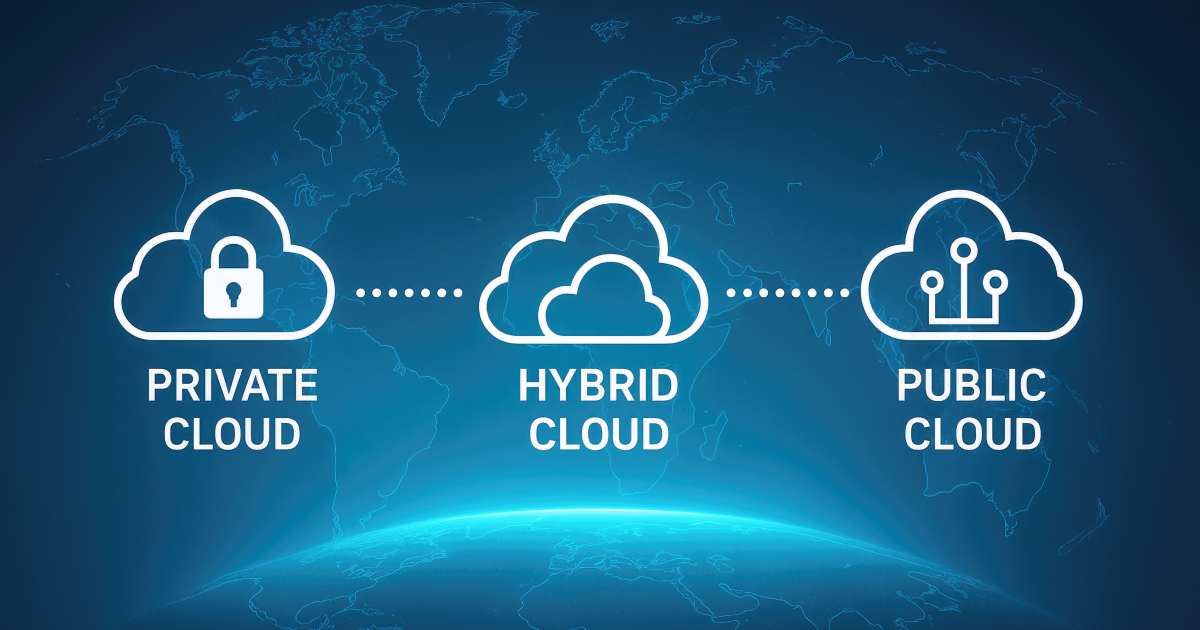
Public cloud, private cloud, and hybrid cloud are the three main cloud deployment models, each offering a different balance of cost, control, scalability, and compliance. For most businesses, the right choice is not one model for everything, but the right model for each workload. The brief clearly positions this topic as a decision framework for IT leaders, not just a definitions article, and recommends choosing based on data sensitivity, traffic predictability, and compliance requirements.
What Is Public Cloud?
Public cloud is a multi-tenant environment operated by a third-party provider such as AWS, Azure, or Google Cloud. Organizations consume infrastructure and services on demand instead of owning hardware, which makes public cloud attractive for speed, elasticity, and lower upfront cost. It is especially well suited to variable workloads, digital products, dev/test environments, and rapid experimentation. The brief also requires public cloud to be explained through pricing flexibility and the shared responsibility model.
The main trade-off is control. Public cloud customers gain flexibility, but they still remain responsible for configuring IAM, encryption, workloads, and many security controls correctly. That is why public cloud can be highly secure, but never “secure by default” just because a major provider is involved.
What Is Private Cloud?
Private cloud is a cloud environment dedicated to a single organization. It may run on-premises, in colocation, or in a hosted single-tenant model. Its value lies in greater control over infrastructure, data location, performance, and governance. This makes private cloud attractive for predictable workloads, strict compliance, and environments where direct control matters more than instant elasticity.
The drawback is cost and operational overhead. Private cloud usually requires more CapEx, more internal IT skill, and more responsibility for lifecycle management. It can be the right fit, but typically only when the workload profile or regulatory burden justifies that investment.
What Is Hybrid Cloud?
Hybrid cloud combines public and private environments so workloads can run where they make the most sense. In practice, that often means keeping sensitive or legacy systems in private infrastructure while using public cloud for burst capacity, customer-facing services, analytics, or AI workloads. The brief explicitly wants hybrid cloud positioned as a workload-placement strategy, not just “a bit of both.”
This model is often the most realistic for growing companies and enterprises because it reflects how infrastructure actually evolves. But it only works well when networking, IAM, observability, and governance are consistent across environments.
Hybrid cloud vs multi-cloud
These terms are often confused:
- Hybrid cloud = public + private cloud together
- Multi-cloud = more than one cloud provider
A company can be hybrid, multi-cloud, or both. The brief marks this distinction as mandatory because many competitor articles blur it.
Public vs Private vs Hybrid Cloud: Quick Comparison
| Dimension | Public Cloud | Private Cloud | Hybrid Cloud |
| Upfront cost | Low | High | Mixed |
| Scalability | Very high | Limited by owned capacity | High |
| Control | Lower | Highest | Balanced |
| Compliance fit | Possible, with correct setup | Strong | Strong |
| Best for | Variable demand, speed | Predictable, sensitive workloads | Mixed environments |
Public cloud usually wins on agility. Private cloud wins on control. Hybrid cloud wins when different workloads need different operating models.
Cost, Security, and Performance
Cloud cost is not just about monthly bills. The brief specifically requires a TCO view, including CapEx vs OpEx, long-term economics, and egress costs. Public cloud removes upfront infrastructure spending, but always-on workloads can become expensive over time. Private cloud requires investment up front, but at stable scale it may become more cost-efficient. Hybrid cloud exists partly to balance those two realities.
Security also differs by model, but not in simplistic terms. Public cloud relies on a shared responsibility model: the provider secures the platform, while the customer secures configuration, identity, and workloads. Private cloud gives the organization more direct control, but also more operational responsibility. Hybrid cloud can support strong security and compliance, but only if policy, IAM, encryption at rest, and encryption in transit are handled consistently. The brief explicitly requires these points.
Performance depends on workload shape. Public cloud is strongest for bursty and elastic demand. Private cloud is often better for steady, latency-sensitive, or tightly integrated workloads. Hybrid cloud is strongest when the business needs both.
Security, Compliance, and Data Sovereignty
For regulated organizations, cloud choice is often driven less by technology preference and more by compliance. The brief requires direct coverage of HIPAA, GDPR, PCI-DSS, data residency, and data sovereignty.
| Requirement | Public Cloud | Private Cloud | Hybrid Cloud |
| HIPAA / PHI | Possible | Recommended | Recommended |
| GDPR / strict data residency | Possible | Recommended | Recommended |
| PCI-DSS / isolated CDE | Possible | Recommended | Recommended |
Public cloud can support regulated workloads, but only with correct configuration, contracts, and region design. HIPAA workloads require a BAA and strong PHI isolation. GDPR requires attention to processor agreements, data residency, and jurisdiction. PCI-DSS often pushes organizations toward tighter control of the cardholder data environment (CDE). That is why private and hybrid cloud are frequently preferred in regulated industries.
Data sovereignty is a related issue. If data must remain under the laws of a specific country or region, private cloud offers the most direct control. Public cloud can help through region-locked deployment, but organizations still need to understand replication, metadata handling, and legal jurisdiction. The brief also flags sovereign cloud as an emerging European consideration.
Which Cloud Model Is Right for Your Business?
This is the core of the article. According to the brief, the decision framework should start with workload classification and then account for CapEx budget, IT skill set, and migration timeline.
A practical decision framework looks like this:
- Classify workloads
- How sensitive is the data?
- How predictable is the traffic?
- What compliance rules apply?
- Assess organizational constraints
- Do you have CapEx budget?
- Do you have the IT skill set to run private infrastructure?
- How fast do you need to migrate?
- Choose the model per workload
- Public cloud for elasticity and speed
- Private cloud for control and predictability
- Hybrid cloud for mixed needs
A simple rule of thumb from the brief:
- regulated or highly sensitive workloads → private or hybrid
- variable or fast-scaling workloads → public
- mixed environments with legacy + cloud-native systems → hybrid
Workload suitability matrix
| Workload type | Public | Private | Hybrid |
| Dev/test | Recommended | Possible | Possible |
| Regulated data | Not recommended as default | Recommended | Recommended |
| AI/ML training | Recommended | Possible | Recommended |
| Legacy mission-critical apps | Not recommended as default | Recommended | Recommended |
| Seasonal traffic | Recommended | Not recommended | Recommended |
| Disaster recovery | Recommended | Possible | Recommended |
| Big data analytics | Recommended | Possible | Recommended |
This matrix is explicitly required in the brief because it makes the article more practical than typical vendor content.
AI and ML workloads
The brief requires a separate 2026 angle for AI and ML. Public cloud is often the fastest way to access GPU infrastructure for training. Private cloud can make sense for controlled inference or highly sensitive data, but building private GPU environments is expensive. Hybrid cloud is often the most practical option when large datasets stay in controlled environments, while model training bursts into public cloud. The brief also points to data gravity, training vs inference, and the EU AI Act as relevant decision factors.
Industry Use Cases
The brief calls for three example industries: healthcare, financial services, and government.
In healthcare, PHI often stays in private or hybrid environments, while public cloud supports patient-facing apps or telehealth scaling. In financial services, cardholder data and PCI-scoped systems often stay in private or hybrid cloud, while public cloud supports fraud analytics or digital services. In government and public sector, sovereignty and frameworks such as FedRAMP or ITAR often push sensitive workloads toward private or tightly governed hybrid models.
Cloud Migration Strategy
The brief also requires the article to go beyond model comparison and address migration. The main point is that cloud migration is not one move, but a set of decisions per application.
The 6 Rs remain a useful framework:
- Rehost
- Replatform
- Refactor
- Repurchase
- Retain
- Retire
Common migration mistakes include lifting monoliths without redesign, ignoring egress costs, assuming provider certifications equal compliance, and skipping cloud readiness assessment. The brief specifically wants these pitfalls included because many competing articles stop at architecture and never address implementation reality.
How to choose the right cloud model for long-term growth
The best cloud model is rarely one universal answer. Public cloud is strongest for speed and elasticity, private cloud for control and predictability, and hybrid cloud for organizations that need both. For most businesses, the most useful approach is not choosing one model once, but classifying workloads carefully and placing each one where cost, control, and compliance are best aligned. That workload-first logic is the central takeaway of the brief, and it is also the most practical answer for real-world IT decision-making.
Choosing between public, private, and hybrid cloud also requires a broader view of architecture, security, connectivity, and delivery model maturity.
Check also: Cloud infrastructure and security services, Network as a Service, agile outsourcing, web and mobile applications development, IT resource center.
FAQ: Common Questions About Cloud Deployment Models
What is the difference between public, private, and hybrid cloud?
Public cloud uses shared infrastructure operated by a third-party provider. Private cloud is dedicated to one organization. Hybrid cloud combines both and allows workloads to be placed where they fit best.
Is hybrid cloud better than public cloud?
Not inherently. Hybrid cloud is better when an organization needs both public cloud elasticity and private-cloud-level control for certain workloads.
Which cloud model is the most secure?
No model is automatically “the most secure.” Security depends on architecture, governance, IAM, encryption, and operations. Private cloud offers the most direct infrastructure control, while public cloud depends heavily on correct use of the shared responsibility model.
Is public cloud cheaper than private cloud?
Usually at smaller scale and for variable demand, yes. At larger and more predictable scale, private cloud can become more cost-efficient over time, especially when TCO is modeled carefully.
What is the difference between hybrid cloud and multi-cloud?
Hybrid cloud combines public and private environments. Multi-cloud means using more than one cloud provider. They can overlap, but they are not the same thing.
Which cloud model is best for AI workloads?
For many organizations, hybrid is the most practical model: keep sensitive data under stronger control, but use public cloud GPU capacity when needed for training or burst compute.
For additional context, it is also worth exploring related articles on cloud architecture, connectivity, and enterprise technology decisions.
Check also: NaaS glossary: key terms every IT manager must know, LLMs in business – how large language models are changing enterprises?