
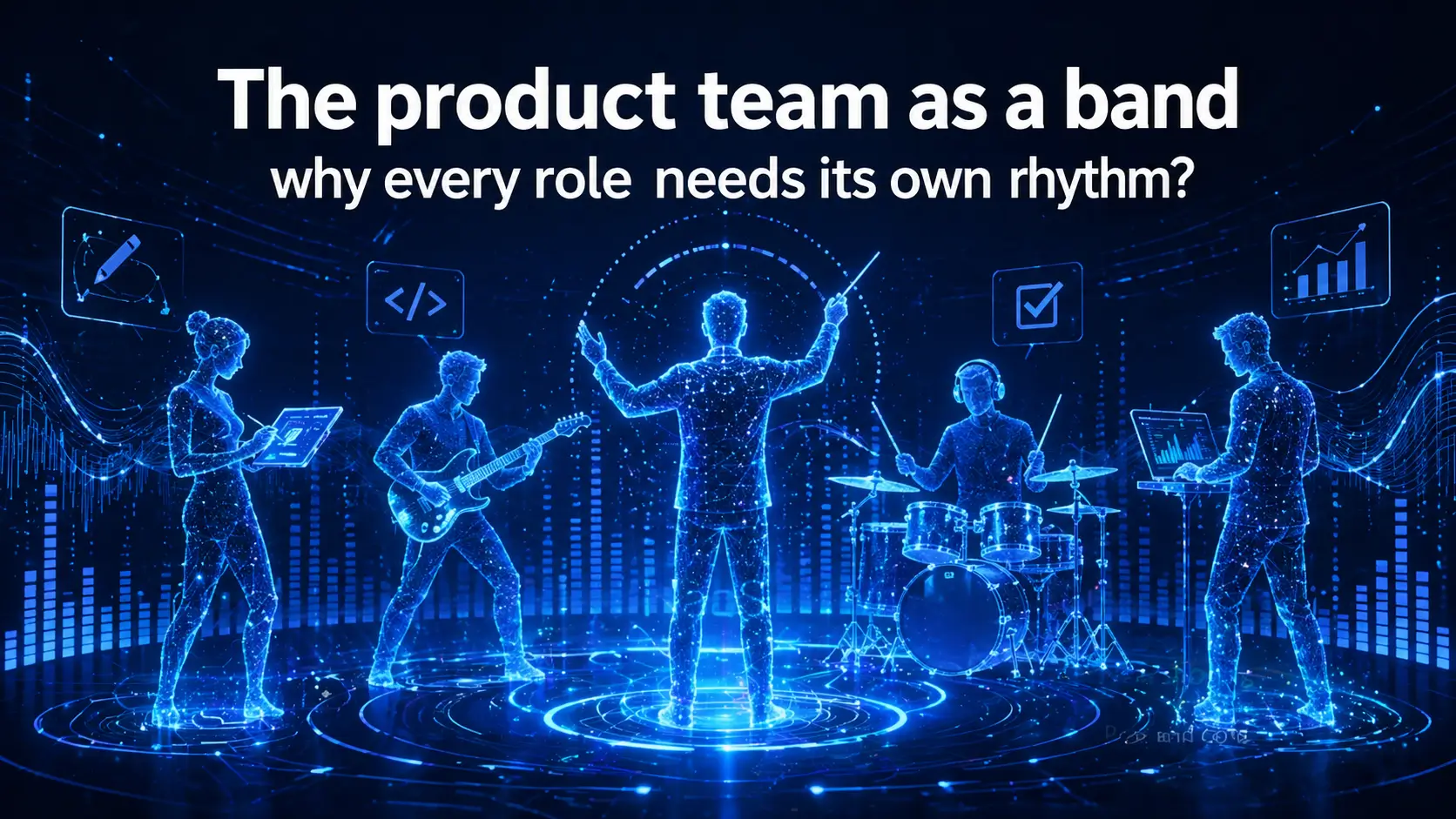
The product team as a band – why every role needs its own rhythm?
And why outsourced teams can be your best ensemble
A product team works like a band: every role — PM, developer, designer, QA — has a distinct rhythm, and the music only happens when everyone plays their part. Unlike generic team analogies, this lens reveals why outsourced product teams, when structured well, often groove better than in-house ones. This guide maps each instrument to a product role and shows tech leaders and startup founders how to build an ensemble, not a collection of soloists.
Why the band metaphor works and why orchestras do not?
A product team works like a band because modern product work depends on listening, improvisation, role clarity, and shared rhythm.
An orchestra follows a score, sections, and a conductor. A product team rarely has that luxury. Markets shift, users behave unpredictably, technical debt appears, and priorities change. Product work needs structure, but it also needs adaptation.
That is why the band metaphor fits better. A cross-functional team is an ensemble of specialists: product manager, developer, designer, QA engineer, and tech lead. Each role has its own rhythm, but no single role owns the whole sound.
In agile product development, teams inspect, adapt, ship, learn, and adjust. This makes product work closer to jazz than classical music. Miles Davis’ Kind of Blue is a useful reference: the musicians had direction, but not a rigid script. They knew the key, the mood, and the space they had to explore.
For an outsourced product team, this is especially important. External teams cannot rely on office habits or assumed responsibilities. They need explicit role clarity, shared cadence, and a clear rhythm from day one. When that happens, IT outsourcing becomes less like adding extra hands and more like hiring a professional session band.
Every instrument has a role: mapping your product team to the band
Every product team role has a distinct rhythm, and the ensemble only works when each player understands their contribution.
A product team becomes noisy when roles overlap without intention. The PM tries to design. The developer makes product decisions alone. QA appears only at the end. The tech lead dominates every discussion. The designer is asked to “make it look good” after the product is already built.
A band cannot work like that. The bassist, drummer, guitarist, keyboardist, and lead player each understand their lane. They can improvise and support one another, but they know what the song needs from them.
For an outsourced product team, this mapping must be clear from the start. The team needs to know who sets direction, who builds, who shapes experience, who protects quality, and who owns technical decisions.
| Instrument | Product team role | Rhythm | Contribution | What breaks without it |
| Bass | Product manager / PM | Directional rhythm | Defines priorities and user value | The team plays in different keys |
| Rhythm guitar | Developer / engineer | Delivery rhythm | Builds the core product | Ideas never become usable features |
| Keyboard | Designer / UX designer | Experience rhythm | Adds flow, usability, and feel | The product works but feels wrong |
| Drums | QA engineer | Quality rhythm | Keeps tempo honest | Bugs and delivery dissonance |
| Lead guitar | Tech lead | Technical rhythm | Solves complex engineering moments | The product lacks technical direction |
This is not about reducing people to instruments. It is about making team dynamics easier to hear. A high-performing product team is an ensemble: each role has a sound, a responsibility, and a rhythm that supports the whole.
The PM as bassist: clarity over virtuosity
The product manager is the bassist of the product team. The PM rarely needs to solo. Their job is to connect business goals, user needs, roadmap constraints, and delivery decisions into one clear direction.
Great bass lines are often simple. Kim Deal’s part in Pixies’ “Gigantic” is memorable because it is direct and confident. Adam Clayton’s line in U2’s “With or Without You” works for the same reason: it creates direction without unnecessary complexity.
That is the PM’s role: clarity over virtuosity. Without the bass, the band loses grounding. Without a strong PM, the product team may produce tickets, designs, and code while still missing the product goal.
In an outsourced product team, the PM should be one of the first roles defined. They become the translation layer between client, users, and delivery ensemble.
The developer as rhythm guitarist: building the core sound
The developer is the rhythm guitarist of the product team. This role turns direction into something users can actually experience: features, flows, APIs, integrations, and product functionality.
Malcolm Young of AC/DC is a strong reference. Angus Young may be the more visible soloist, but Malcolm’s rhythm guitar created the structure that made the band work. The rhythm guitarist holds the song together.
A fullstack developer or engineer does the same. They understand the codebase, connect systems, maintain delivery rhythm, and often carry the institutional memory of the product.
In an outsourced team, this role is the persistent backbone. A good developer does not just complete tasks. They understand why a feature exists, how it fits the roadmap, and which compromises are acceptable.
The designer as keyboardist: color, depth, and feel
The designer is the keyboardist of the product team. The keyboardist adds color, atmosphere, emotion, and depth. Sometimes the part is subtle, but the song feels empty without it.
Think of “Jump” by Van Halen without the keyboard. The structure might still exist, but the identity changes completely. That is what happens when design is treated as decoration instead of product thinking.
A strong UX designer shapes flow, friction, accessibility, information hierarchy, and emotion. Designers often see the full experience end to end.
In many teams, the designer is invited too late. That is like asking the keyboardist to join after the album is recorded. In an outsourced product team, cutting design first to save budget is a false economy. Users may not name the missing UX depth, but they will feel it.
The QA engineer as drummer: keeping the tempo honest
The QA engineer is the drummer of the product team. This is one of the most overlooked and most important mappings.
A drummer does more than keep time. They control energy, expose mistakes, and prevent the band from rushing. A QA engineer does the same for a product team.
QA is not the last person in the chain. QA should shape the rhythm throughout the sprint: clarifying acceptance criteria, identifying risk, testing assumptions, and catching dissonance early.
When the drummer is off, everyone falls out of sync. When QA is missing, bugs reach production, developers lose time to rework, releases slow down, and trust erodes.
In IT outsourcing, QA is often the most undervalued hire. It is also one of the most dangerous roles to cut. A strong outsourced product team treats QA as a tempo-setter, not a bug-catcher at the end.
The tech lead as lead guitarist: solo when the song needs it
The tech lead is the lead guitarist of the product team. This role brings technical mastery, architectural judgment, and the ability to step forward during difficult moments.
A lead guitarist should solo when the song needs it. Jennifer Batten’s work with Michael Jackson or Eddie Van Halen’s technical brilliance shows what happens when skill meets timing.
The same rule applies to a tech lead. They lead during architecture decisions, incidents, scaling questions, and complex technical trade-offs. But they should not shred over every discussion.
The danger is overengineering: a 12-minute solo when eight bars would work. In an outsourced product team, the tech lead needs a clearly scoped engagement model. They guide the technical sound, but they do not run the set list.
Playing for the song, not the ego
The strongest product team optimizes for collective product progress, not individual output or role-based ego.
“Play for the song, not the ego” is the ensemble principle every product team needs. A band fails when every musician tries to prove they are the best player. A product team fails the same way.
The developer says, “I wrote 300 lines of code today.” The designer says, “My flow is cleaner.” The PM says, “This was already in the roadmap.” The tech lead says, “This architecture is more elegant.”
Those statements may be true, but they are not the main question. The real question is: did we move the song forward?
In a healthy product team, agile ceremonies work like rehearsals. Standups are rhythm checks. Sprint planning sets the tempo. Retrospectives help the ensemble hear what went wrong. A product launch is the live concert.
Missed notes are normal. A bug appears. A story is estimated badly. A user flow underperforms. What matters is whether the product team can recover together.
This is critical for an outsourced product team. External teams perform best when they internalize the client’s product goal, not just their own delivery metrics. Webellian’s creative-technical balance depends on engineering, design, QA, and product management serving the same song.
When role ego breaks the rhythm
Role ego breaks a product team when a specialist optimizes for their own instrument instead of the ensemble.
A tech lead overengineering against PM direction is the lead guitarist shredding over the vocalist. A designer ignoring feasibility is the keyboardist changing the mood without listening to the rhythm section. A developer saying “it works on my machine” is the guitarist playing perfectly at home but failing on stage.
Patrick Lencioni’s Five Dysfunctions of a Team is relevant here because product dysfunction often starts with low trust and fear of conflict.
Common signals include missed handoffs, blame culture, slow releases, standups dominated by one role, and quality issues discovered too late. These are not isolated process problems. They are ensemble problems.
The outsourced band: why external product teams can groove better
A well-structured outsourced product team can build ensemble rhythm faster because roles, cadence, and collaboration rules are explicit from day one.
The common objection is: “Outsourced teams cannot really collaborate.” That is true only when IT outsourcing is treated as ticket-taking. If the external team receives disconnected tasks, no product context, and no decision rights, it will sound like musicians playing different songs.
A proper outsourced product team works differently. It is assembled as an ensemble.
First, outsourced teams define roles explicitly from the start. The PM, developer, designer, QA engineer, and tech lead know how they connect, what decisions they own, and how they communicate with the client.
Second, experienced external teams have played many gigs. A strong outsourced team has seen different industries, products, tech stacks, release cycles, stakeholder styles, and failure modes. Like a professional session band, they can enter a new project, listen quickly, and support the song without ego.
Third, creative-technical balance can be designed into the team from sprint one. Webellian’s strength sits at the intersection of programming and creativity: the keyboardist and guitarist are in the same room early.
A groove-ready outsourced team shows three signals: they ask product questions before estimating, they include QA and design in early discovery, and they can explain how sprint cadence connects to release cycle and business outcomes.
A skill-ready outsourced team can play notes. A groove-ready outsourced product team can play together.
The three rhythms every product team must maintain
A product team runs on planning, development, and release rhythms, and the product ships smoothly only when all three stay aligned.
A band has tempo, time signature, and key. A product team has planning cadence, sprint rhythm, and release cycle. These rhythms are different, but they must support the same song.
The first rhythm is planning: priorities, investment areas, OKRs, and roadmap intent. The second is development: the sprint cycle where the agile team builds, tests, reviews, and adapts. The third is release: how value reaches users.
In an outsourced product team, these rhythms must be agreed at engagement start. The client and team need shared rules for planning cadence, sprint rituals, release cycle, acceptance criteria, and decision ownership.
Planning rhythm: setting the key
Planning rhythm is the key signature of the product team. Quarterly planning often works well because it gives direction without freezing the roadmap for too long.
This rhythm defines investment allocation, product bets, problem statements, OKRs, and success metrics. A product team without planning rhythm may complete tickets, but the work lacks tonal center.
Development rhythm: keeping the beat
Development rhythm is the sprint. For many agile teams, two-week cycles balance focus and adaptability.
Sprint planning sets the measure. Daily standups act like metronome clicks. User stories become individual bars of music. QA checks whether the rhythm is stable, while developers and designers adjust as the product takes shape.
Release rhythm: the live performance
Release rhythm is the live performance. Users do not experience your backlog or sprint board. They experience what reaches production.
CI/CD is the soundcheck. Feature flags are setlist adjustments. A customer-facing release is opening night. A strong release cycle includes messaging, support readiness, analytics, QA confidence, and stakeholder alignment.
Do you like your article? Check also What is agile outsourcing – Your complete guide for 2026, Agile vs Waterfall outsourcing – how to choose the right methodology? , Nearshore vs Offshore IT Outsourcing, Offshoring vs nearshoring: pros & cons.