
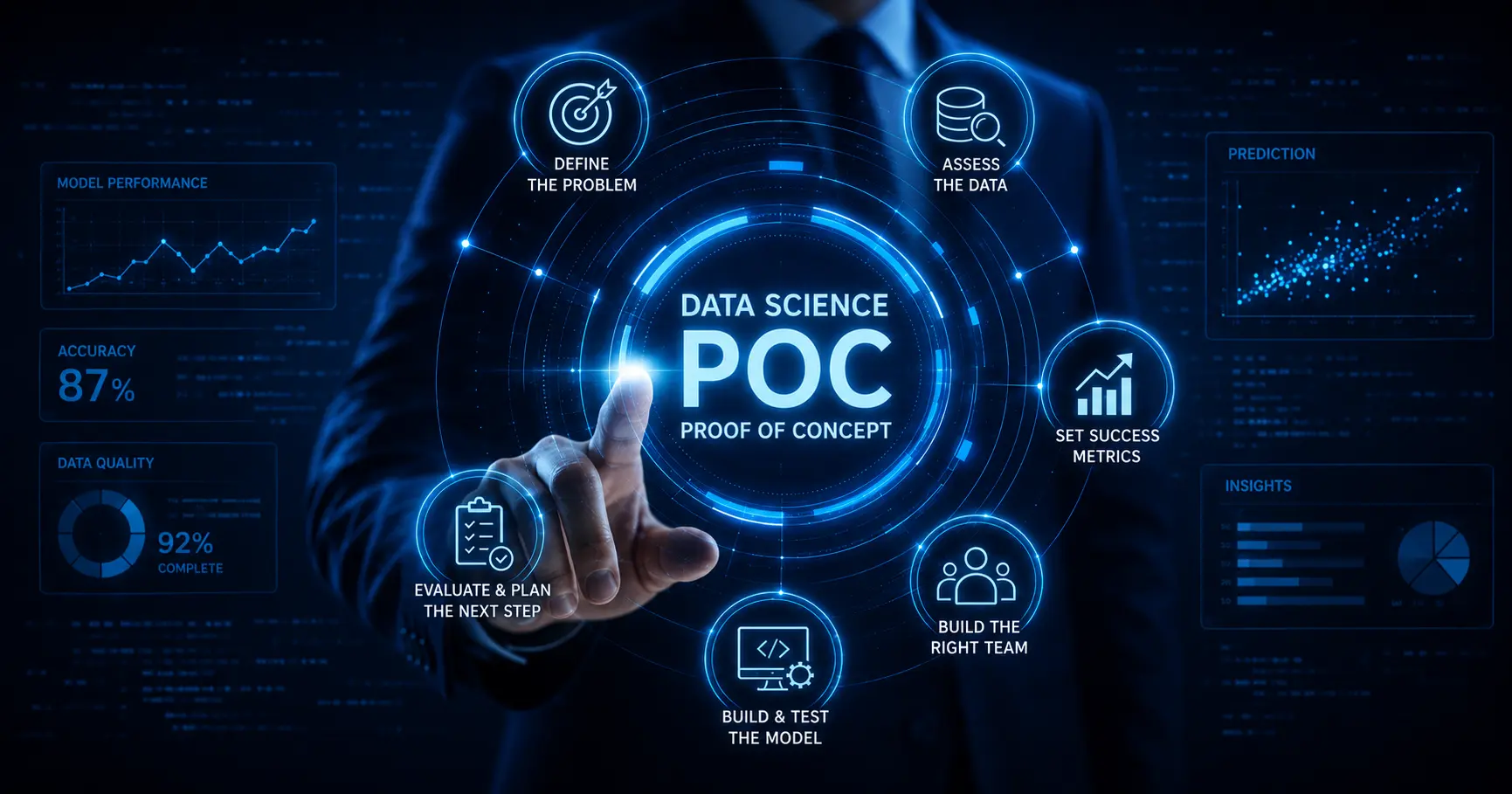
Data science proof of concept: how to plan and execute
A data science PoC validates whether an AI or machine learning solution can solve a specific business problem before you commit budget to full implementation. It is not a demo, not a brainstorming exercise, and not a shortcut to production. It is a controlled feasibility test designed to answer one question: should we invest further?
That distinction matters. Many enterprise AI pilots never reach production or fail to deliver measurable business impact. The problem is rarely that the technology is impossible. More often, the PoC was too broad, poorly scoped, built on weak data, or disconnected from a real business decision.
This guide explains how to plan, execute, and evaluate a data science PoC that can move beyond the prototype graveyard. It covers use case selection, data assessment, success metrics, team setup, timelines, common mistakes, and the path from PoC to production.
If you are evaluating an AI or ML initiative and want to reduce risk before committing to full delivery, Webellian’s data science and AI solutions can help structure the process from first assessment to production deployment.
What is a data science PoC?
A data science PoC, or proof of concept, is a small-scale experiment that tests whether machine learning, AI, analytics, or automation can solve a specific business problem using the data available in your organization.
In data, PoC stands for proof of concept. The goal is not to build a finished product. The goal is to validate feasibility before investing in a full data science project.
A strong PoC should answer five questions:
- Is there a measurable business value?
- Is the solution technically feasible?
- Is the available data sufficient?
- Can the team build and evaluate the model?
- Is there a realistic path to production deployment?
This is where many AI initiatives fail. They start with a broad ambition, such as “we want to use AI in customer service”, instead of a precise business use case, such as “classify 80% of recurring customer requests with human-review fallback while reducing average handling time by 20%”.
A PoC is also different from a pilot and an MVP.
| Format | Purpose | Audience | Typical timeline |
| PoC | Feasibility test | Internal stakeholders | Weeks |
| Pilot | Limited production deployment | Real users in a controlled group | Months |
| MVP | Minimum shippable product | External or production users | Months to quarters |
A PoC tests whether the idea can work. A pilot tests whether it works in a limited real environment. A minimum viable product (MVP) tests whether a usable product can be shipped and improved with real users.
In data science, the PoC sits before major investment. Its value is not only the model output. Its value is the decision it enables: scale, kill, or pivot.
When does your business need a data science PoC?
A data science PoC is useful when uncertainty is high and the cost of full implementation would be significant.
You probably need a PoC when you have a business hypothesis but no track record of similar AI deployments in your organization. For example, a retail company may believe that churn prediction could reduce lost revenue, but it may not know whether its historical customer data contains the right signals.
You also need a PoC when stakeholders require proof before approving budget. A CFO or CTO may support AI in principle, but still need evidence that the use case has measurable business potential.
A PoC is also valuable when data quality is unclear. If you are unsure whether your CRM, ERP, product, or transaction data can support the model you want, a short exploratory phase is safer than a six-month build.
Other strong triggers include vendor evaluation, new technology adoption, regulatory validation, and cases where customer, employee, financial, or operational decisions may be influenced by model outputs.
However, a PoC is not always necessary.
You may not need one for an off-the-shelf SaaS AI tool with documented ROI in your industry and low integration risk. In that case, vendor due diligence and a limited rollout may be enough.
You may also skip a formal PoC for small projects under $20k where direct iteration is cheaper than validation. If the cost of trying is lower than the cost of proving, a PoC may slow you down.
The right question is simple: will the PoC outcome change a business decision? If not, do not run one.
Types of data science PoCs in 2026
Modern data science PoCs are not limited to traditional machine learning. Enterprise teams now validate predictive models, generative AI, RAG systems, AI agents, and data engineering foundations. If your team is still aligning terminology, start with our guide to AI vs. machine learning vs. deep learning.
| Type | What it validates | Typical timeline |
| Classical ML | Predictive models on historical data, such as churn, fraud, demand, pricing, or risk | 4-8 weeks |
| Generative AI / LLM | Chatbot, copilot, classifier, or content workflow quality and safety on your data | 2-3 weeks |
| RAG | LLM grounded in your documents, with accuracy, retrieval quality, and citation checks | 3-6 weeks |
| AI Agent | Autonomous or semi-autonomous workflow, such as invoice reconciliation or ticket routing | 4-8 weeks |
| Data Engineering | Scalable AI-ready pipeline before modeling begins | 4-8 weeks |
A classical ML PoC is usually the right choice when you have structured historical data and a measurable target. Examples include predicting churn, detecting fraud, forecasting demand, scoring leads, or estimating delivery risk.
A generative AI or LLM PoC is useful when the output is language-based. This may include customer support assistants, internal knowledge copilots, classification workflows, summarization, or document generation. These LLM-based applications need quality, safety, hallucination, and governance checks before broader use.
A Retrieval-Augmented Generation (RAG) PoC validates whether an LLM can answer questions using your documents instead of relying only on general model knowledge. This is especially relevant for legal, healthcare, insurance, finance, technical support, and enterprise knowledge management.
An AI agent PoC tests whether a system can complete a workflow across tools, APIs, documents, and decisions. These projects need stricter guardrails because the system is not only generating text. It may also trigger actions.
A data engineering PoC validates whether the organization has the pipeline, quality, access, and governance foundations needed for AI. In many enterprises, this should happen before modeling. No model can compensate for inaccessible, inconsistent, or legally unusable data.
For broader AI adoption patterns, see our guide to generative AI for enterprise.
How to plan a data science PoC: 6-step framework
Step 1: define a specific, measurable business problem
The weakest PoCs start with a technology statement: “we want to use AI”.
The strongest PoCs start with a business problem: “predict customer churn 14 days in advance with 80% precision to reduce monthly churn by 2 percentage points”.
That sentence is useful because it defines the process, outcome, timeline, metric, and business value. It also makes the PoC falsifiable. The team can later say whether it worked.
Before the PoC starts, answer two validation questions:
- Does solving this problem affect revenue, cost, risk, customer experience, or operational efficiency?
- Will the PoC outcome change a real business decision?
If the answer to either question is no, the PoC is not ready.
Step 2: audit your data before writing a single line of code
Data quality decides whether a data science PoC has a chance.
A supervised learning model usually needs enough labeled examples to learn from. As a rough planning rule, start by checking whether you have at least 1,000 relevant labeled examples. More complex problems may need far more.
The data audit should cover four areas.
Volume: is there enough historical data for the model to learn meaningful patterns?
Quality: what percentage of values are missing, duplicated, outdated, or inconsistent?
Accessibility: can the team legally and technically access the data, including permissions, system access, PII constraints, and security rules?
Relevance: does the data actually contain signals related to the outcome you want to predict or automate?
A PoC should expose data gaps in weeks, not after months of development. If the audit shows that key fields are missing or unreliable, that is not a failed PoC. It is a valuable finding.
Step 3: set success metrics before you start
Success metrics must be agreed before the PoC starts. If you define them after seeing model results, you will move the goalposts.
Use three levels of measurement.
First, define the business KPI. This could be cost saving, revenue uplift, risk reduction, processing time reduction, lower churn, fewer manual reviews, or faster customer response.
Second, define the technical metric. For classification, this may be F1 score, precision, recall, or AUC. For forecasting, it may be RMSE, MAPE, or forecast bias. For LLM and RAG use cases, it may include answer accuracy, citation accuracy, hallucination rate, latency, and human evaluation scores.
Third, define the no-go threshold. A negative result is valuable when it is clear. For example: “If the model cannot reach 75% precision on high-risk cases, we will not proceed to production this quarter”.
Good metrics connect analytics to decision-making. That is also why AI should not sit separately from reporting. For more on how analytics is changing business operations, see how AI is transforming business intelligence.
Step 4: assemble a focused cross-functional team
A good data science PoC does not need a large committee. It needs the right people.
The optimal team is usually 3-7 people:
- One data scientist
- One business owner or domain expert
- One data or infrastructure engineer
- One project coordinator
- Optional support from legal, security, or compliance
The business owner defines the value and validates whether the output is useful. The data scientist builds and evaluates the model. The data or infrastructure engineer ensures access, pipelines, and technical feasibility. The coordinator keeps the scope tight and decisions visible.
The anti-pattern is a large steering group with more than 10 people. In that setup, meetings replace execution.
A data science PoC should move fast, but it still needs disciplined delivery. If your organization needs support with team setup, governance, and cadence, Webellian’s Agile delivery practice can help structure the work.
Step 5: build a minimum viable model, not a perfect one
A PoC is not the place to build the most advanced model possible. It is the place to learn quickly.
Start with a baseline model. In many cases, a simple model that beats the current process is more useful than a sophisticated model that takes months to refine.
For example, logistic regression with 78% accuracy in two weeks may be more valuable than a neural network reaching 82% after six months. The first result creates a decision. The second may become a research project without business impact.
The right cycle is simple:
Build. Test. Learn. Refine.
Document what works, what fails, what data matters, what assumptions were wrong, and what would be required for production. This documentation becomes the first draft of your production roadmap.
Step 6: evaluate and define the production path
At the end of the PoC, compare results against the success metrics from Step 3. Do not ask whether the model is interesting. Ask whether it passed the business and technical thresholds agreed at the start.
The final evaluation should include:
- Model performance
- Data quality findings
- Computing requirements
- Data pipeline requirements
- MLOps requirements
- Monitoring needs
- Retraining schedule
- Security and compliance gaps
- Team skills gap
- Business case update
Every PoC should end with one of three decisions.
Scale means the PoC passed and should move toward pilot or production.
Kill means the use case is not worth further investment.
Pivot means the original use case was wrong, but the learning points to a better opportunity.
All three outcomes are valid. The only bad outcome is no decision.
Data science PoC timeline: what to expect
Most data science PoCs take 2-8 weeks, depending on data readiness, use case complexity, stakeholder availability, and model type.
A practical timeline looks like this:
| Phase | Typical duration | Main output |
| Discovery | 1 week | Business problem, assumptions, stakeholders, success metrics |
| Data assessment | 1-2 weeks | Data quality review, access check, feasibility risks |
| Model development | 1-3 weeks | Baseline model, experiments, technical findings |
| Evaluation | 1 week | Results, go/no-go recommendation, production path |
A 2-week PoC may work for a narrow LLM classification task, a simple generative AI workflow, or a clean dataset with a well-defined problem.
A 4-8 week PoC is more realistic for classical ML, RAG, AI agents, data engineering, and regulated use cases.
A 5-day PoC sprint can make sense, but only when the dataset is small, the problem is well defined, access is already solved, and stakeholders are available for fast decisions. It is not a replacement for proper validation in complex enterprise environments.
A PoC running longer than 12 weeks without a go/no-go decision is a red flag. At that point, it may have become an unfocused prototype rather than a feasibility test.
6 mistakes that kill data science PoCs
1. Vague use case
“Use AI to improve operations” is not a PoC scope. It is a theme. Without a measurable business problem, the team cannot evaluate success.
A better scope is: “predict late deliveries 48 hours in advance to reduce manual escalation time by 30%”.
2. Skipping data audit
Many PoCs fail because teams discover too late that the data is incomplete, inaccessible, inconsistent, or not legally usable.
Data audit should happen before modeling. If the data does not support the use case, the PoC should expose that quickly.
3. Moving goalposts
If stakeholders change success criteria after seeing results, the PoC loses credibility.
The business owner must sign off on success metrics before development begins. A model that misses the threshold may still produce useful learning, but it should not be redefined as a win after the fact.
4. Team too large
Large committees create slow feedback loops. A PoC needs a small cross-functional team with authority to make practical decisions.
The larger the group, the more likely the project becomes coordination-heavy and execution-light.
5. Optimizing for accuracy, not decision
A model with 94% accuracy that never gets deployed is less valuable than a model with 82% accuracy that improves a real process.
Accuracy matters, but only in context. For fraud detection, recall may matter more. For automated customer replies, precision and safety may matter more. For demand forecasting, business impact may matter more than the technical metric alone.
6. No production plan
A PoC without a production path becomes a demo. The team may show an impressive notebook, dashboard, or prototype, but no one knows how to turn it into a reliable system.
Production planning should start during the PoC, not after it.
Moving from PoC to production
Many data science PoCs end up in the prototype graveyard because the team treats the PoC as the final deliverable. It is not.
A PoC should produce two things: evidence and requirements.
Evidence shows whether the use case is worth scaling. Requirements show what production would need.
The path from PoC to production usually depends on five foundations.
First: a production data pipeline. The model cannot rely on manually exported spreadsheets or ad hoc data pulls. It needs reliable, monitored, refreshed data.
Second: MLOps. Production models need versioning, deployment workflows, monitoring, rollback, retraining, and ownership.
Third: governance. Teams must define data access, model accountability, privacy rules, compliance requirements, and decision rights.
Fourth: stakeholder sponsorship. A model changes a business process. If the business owner does not own adoption, the model may never be used.
Fifth: team capacity. Production AI requires ongoing support, not only initial development.
A practical transition checklist should include:
| Requirement | Status |
| Model performance meets success metrics | Ready / not ready |
| Data pipeline can be productionized | Ready / not ready |
| Infrastructure requirements are clear | Ready / not ready |
| Data governance is approved | Ready / not ready |
| Monitoring and retraining plan exists | Ready / not ready |
| Business case is still valid | Ready / not ready |
| Team capacity is confirmed | Ready / not ready |
The PoC is valuable because it replaces assumptions with evidence. Production requirements should come from what the PoC revealed, not from what the team hoped would be true.
If your use case is ready to move forward, Webellian can help design the end-to-end ML pipeline from data ingestion to deployment, monitoring, and support.
How Webellian structures your data science PoC
A strong data science PoC starts before model development. It starts with the right question, the right data, and a clear decision framework.
Webellian structures PoCs around business value, data readiness, and production viability. The goal is not to create a prototype that looks impressive in a meeting. The goal is to learn whether the use case deserves investment and what it would take to scale.
The entry point is the AI Exploration Program: a free exploratory data analysis designed to assess your data and use case before you commit budget to a full PoC. During this phase, Webellian reviews available data, identifies potential use cases, evaluates data quality, and recommends a practical PoC scope.
For enterprise teams, this lowers risk. Instead of starting with a large AI project, you start with a focused assessment: what data exists, what problem is worth solving, what is feasible, and what should not be pursued yet.
Webellian works across Google Cloud, AWS, and Azure, so the PoC can be designed on infrastructure that can later scale to production. Our data scientists specialize in business-oriented machine learning, which means the model is evaluated not only by technical performance, but by business usefulness.
After the PoC, Webellian can support the full delivery path: data pipelines, model development, MLOps, dashboards, monitoring, and ongoing improvement. When the output needs to connect with management reporting or operational dashboards, our Business Intelligence reporting team can turn model results into usable decision systems.
Not sure if your use case is PoC-ready? Start with our free exploratory data analysis through the AI Exploration Program.