
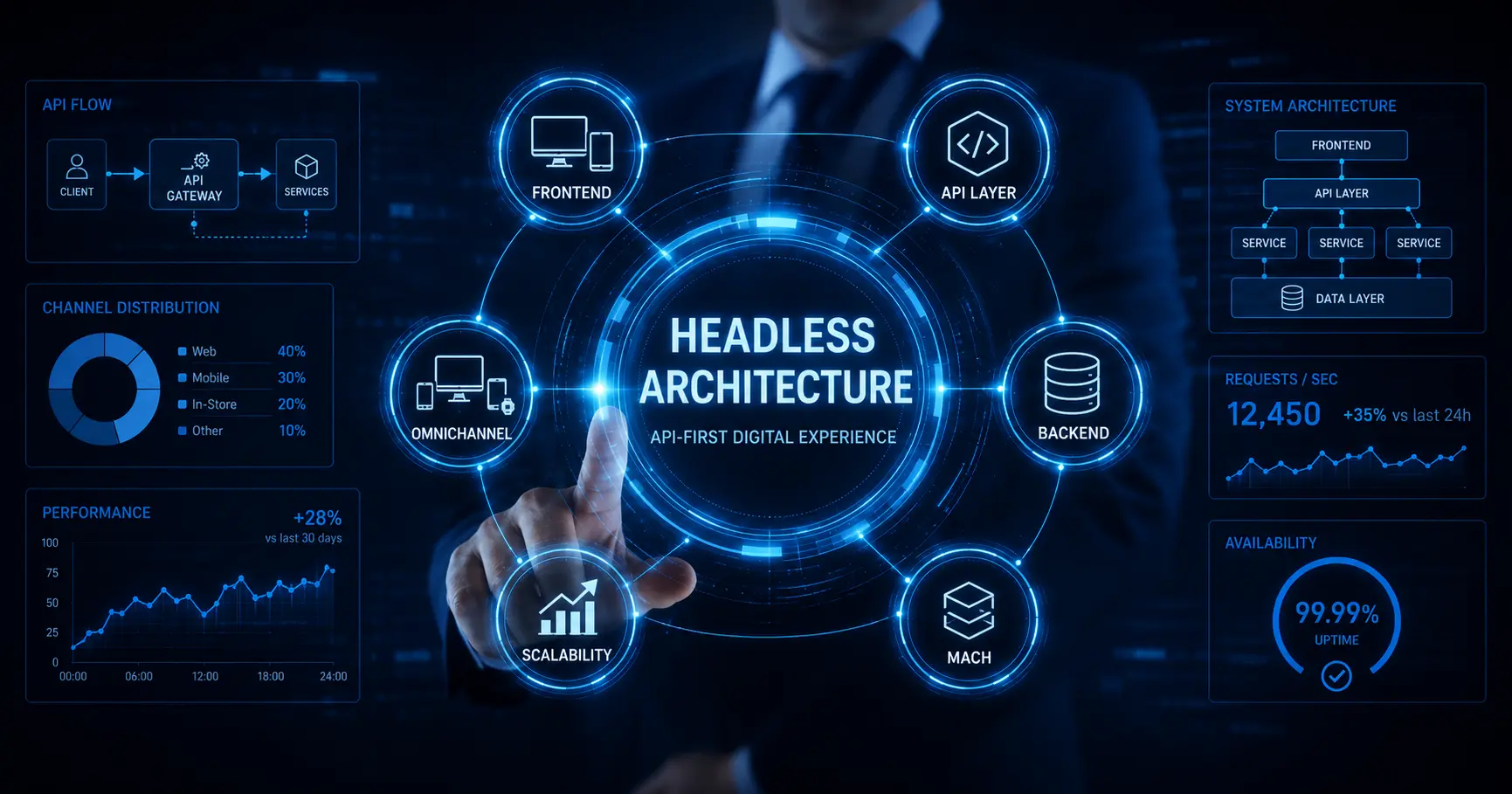
Headless architecture: What it is, why it matters, and when enterprise should adopt it
Headless architecture decouples your frontend presentation layer from your backend systems, connecting them through APIs so each side can scale, update, and evolve independently. This guide goes beyond the definition and explains the financial reality, including when headless makes ROI sense and when it creates avoidable complexity. If you are a CTO or IT leader evaluating architectural modernization, use this as a strategic decision framework.
What is headless architecture? Core definition and how it works
Headless architecture separates the frontend presentation layer from backend logic and data through APIs, giving each side independent control over its technology stack and deployment lifecycle.
Headless architecture is a software architecture pattern where the “head” of the system, meaning the frontend presentation layer, is separated from the backend systems that store content, business logic, commerce data, user data, and integrations. The frontend and backend no longer live inside one tightly coupled platform. They communicate through APIs.
A simple way to understand it: in a monolithic setup, the frontend is tethered to the backend like a puppet controlled by one system. In a headless architecture, the frontend can perform independently. The backend still provides data and logic, but the frontend decides how to present that data across websites, mobile apps, kiosks, smartwatches, AI chatbots, or connected devices.
The core idea is “content as data.” Instead of storing content as page templates tied to one website, the backend stores structured content, often as JSON. Any frontend can request that data through an API and render it in the right format for a specific channel.
This shift became more important as digital experiences moved beyond websites. The monolithic era worked well when companies managed one website and one CMS. Then Jamstack, the API economy, headless CMS platforms, headless commerce systems, and cloud-native development made decoupled architecture more practical for enterprise teams.
In plain terms, the structure looks like this:
- Frontend: web app, mobile app, IoT interface, digital kiosk, smartwatch, voice assistant, or chatbot.
- API layer: REST API, GraphQL API, middleware, service API, or integration gateway.
- Backend: CMS, commerce engine, PIM, CRM, ERP, search, personalization engine, data platform, and business logic.
Headless architecture matters because it gives enterprise teams more freedom. Frontend teams can update experiences without waiting for backend release cycles. Backend teams can evolve systems without breaking every channel. CTOs can modernize digital products gradually instead of replacing the full platform at once.
The three layers: Frontend, API, and backend
Headless architecture usually has three core layers, with an optional fourth middleware layer when enterprise systems become more complex.
| Layer | Role | Common examples |
| Frontend | Presents the user experience | Website, mobile app, kiosk, smartwatch, voice assistant, digital signage |
| API layer | Connects frontend and backend | REST API, GraphQL, service API, API gateway |
| Backend | Stores data and business logic | CMS, commerce engine, PIM, CRM, ERP, search, data services |
| Middleware | Coordinates multiple backend systems | Integration layer, orchestration service, business logic glue |
The frontend is no longer restricted by backend templates. It can be built with React, Next.js, Vue, native mobile frameworks, or any other frontend technology. The backend can focus on content, transactions, inventory, user accounts, workflows, or data management.
Middleware becomes especially important in enterprise headless architecture. It can connect multiple backend services, normalize data, apply business rules, and protect the frontend from backend complexity. Webhooks can also support real-time interoperability. For example, when a product price changes in a PIM or commerce system, a webhook can trigger updates across relevant channels.
How APIs bridge the gap: REST vs. GraphQL
APIs are the foundation of headless architecture. They define how the frontend requests data and how the backend responds.
REST is widely used, reliable, and easy to understand. It uses standard HTTP methods and works well for simple content delivery, stable resources, and broad compatibility. REST APIs are often the right choice when the frontend needs predictable data structures and the backend services are not overly complex.
GraphQL is more flexible. It lets the frontend request only the data it needs. This is useful for complex digital products where different channels require different combinations of content, commerce data, personalization, search results, or user information.
A practical rule:
- Use REST for simple content delivery, stable resources, and broad compatibility.
- Use GraphQL for complex frontend requirements, multiple data sources, and highly customized user experiences.
The API contract is the most important technical agreement in a headless project. Once frontend and backend teams agree on the contract, they can work in parallel. This is one of the biggest reasons headless architecture can improve team velocity and time-to-market.
For teams designing the API layer, Webellian’s API integration services can support architecture, implementation, and integration planning.
Headless vs. monolithic: The architectural shift explained
In a monolithic architecture, frontend and backend share one codebase, while headless architecture separates them so teams can deploy independently and at their own cadence.
A monolithic architecture combines frontend presentation, backend logic, content management, plugins, templates, and database interactions inside one platform. This can be useful at the beginning because the system is easier to launch, easier to buy, and easier for small teams to operate.
The problem appears at scale. Every new channel, campaign, integration, and feature must fit inside the same release train. A marketing team may wait for developer availability to launch landing pages. A frontend redesign may require backend changes. A security update may affect the entire system. Over time, the monolith becomes slow, risky, and expensive to change.
Headless architecture removes this dependency. The frontend and backend become separate systems connected through APIs. This allows independent deployment, technology freedom, better scalability, and more flexible digital product development.
| Dimension | Monolithic | Headless |
| Codebase | Unified | Separate frontend and backend |
| Deployment | All-or-nothing release | Independent releases |
| Tech stack | Vendor-dictated | Best-of-breed |
| Scalability | Scale entire application | Scale frontend and backend independently |
| Time to change | Weeks or months | Days in mature teams |
| Upfront complexity | Low | High |
| TCO at scale | Increases rapidly | Stabilizes when governance is strong |
Monolithic architecture still has strengths. It can be the right choice for small teams, simple websites, limited budgets, and marketer-first workflows where WYSIWYG editing is critical. A modern monolith can be faster and cheaper to operate than a poorly planned headless stack.
The problem is not that monoliths are outdated. The problem is that they often become restrictive when enterprise teams need omnichannel delivery, API-first integrations, custom frontend experiences, and independent release cycles.
Where monolithic architecture falls short at scale
Monolithic architecture usually breaks down when the organization needs more than one channel, one market, or one release rhythm.
Common pain points include:
- Plugin bloat: Too many plugins create performance, compatibility, and security debt.
- Template lock-in: Content and presentation are tied together, making new channels harder to launch.
- Single release train: Frontend, backend, marketing, and integration changes depend on the same deployment process.
- Channel silos: Web, mobile, kiosk, and app teams may create separate content workflows.
- Technical debt: Workarounds accumulate because the platform was not designed for evolving digital products.
WordPress is a common example of monolithic risk at scale. Plugin dependencies can create security and maintenance debt, and industry data often shows a high percentage of WordPress sites not running the latest version. This does not mean WordPress is always the wrong choice. It means plugin-heavy monoliths require careful governance when used for enterprise digital products.
Headless vs. microservices vs. composable: Clearing up the confusion
Headless architecture, microservices, and composable architecture are related, but they are not the same thing.
| Architecture | Scope | What it decouples |
| Headless | Frontend and backend split | Presentation from data and logic |
| Microservices | Backend granularity | Backend services from each other |
| Composable | Full digital stack | All components into best-of-breed services |
Headless architecture separates the frontend from the backend. A company can be headless even if the backend remains a monolith. For example, a headless CMS can serve content through APIs while the rest of the backend remains centralized.
Microservices break the backend into smaller independent services. Each service usually owns a specific capability, such as pricing, search, user profiles, inventory, recommendations, or checkout.
Composable architecture goes further. It assembles the whole digital stack from best-of-breed components, such as CMS, commerce engine, search, personalization, analytics, experimentation, and identity.
MACH connects these ideas:
- M: Microservices
- A: API-first
- C: Cloud-native
- H: Headless
A simple rule for CTOs: you can be headless without being microservices, but you cannot be fully composable without being headless.
The business case: Key benefits of headless architecture
Headless architecture delivers measurable business outcomes, including omnichannel delivery, faster release cycles, and independent frontend and backend scaling.
The business case for headless architecture is not just technical flexibility. It is about speed, reach, resilience, and the ability to build digital products across multiple channels without duplicating content and development work.
Headless architecture enables enterprise teams to separate content, data, and business logic from presentation. This creates several business benefits:
- Omnichannel delivery: One backend can serve many channels.
- Technology freedom: Teams can choose the best frontend tools for each experience.
- Faster time-to-market: Frontend and backend teams can work in parallel.
- Scalability: Frontend and backend layers can scale independently.
- Performance: CDN, SSG, SSR, and ISR can support faster digital experiences.
- Lower long-term platform friction: Teams are less dependent on one vendor or one release train.
Industry data suggests growing adoption of headless and headless CMS models, with some sources pointing to 73% of businesses using headless architecture in relevant digital commerce and content contexts. The headless CMS market is also projected to grow from around $1B in 2025 to $7.1B by 2035, showing that the market is moving toward API-first digital experience delivery.
For CTOs, the important question is not whether headless is modern. The important question is whether headless architecture creates measurable value for the business model, traffic profile, channel complexity, and delivery organization.
Omnichannel delivery: One backend, every channel
Omnichannel delivery is one of the strongest benefits of headless architecture. The principle is simple: create once, publish everywhere.
Instead of creating separate content workflows for each channel, the backend stores structured content and data. Different frontends can then request and render that data for specific use cases.
A single backend can support:
- website,
- mobile app,
- in-store kiosk,
- voice assistant,
- smartwatch,
- digital signage,
- in-car entertainment,
- AI chatbot,
- partner portal,
- customer service interface.
In a monolithic architecture, teams often create shadow content silos. The website has one CMS, the mobile app has another workflow, the retail team uses spreadsheets for signage, and customer support uses a separate knowledge base. This creates duplicated work, inconsistent messaging, and governance problems.
Headless architecture reduces that fragmentation. It lets the enterprise manage content and product data centrally while delivering tailored experiences across every channel.
Faster time-to-market and independent team velocity
Headless architecture can improve time-to-market because frontend and backend teams can work in parallel once the API contract is defined.
This changes how digital delivery works. Frontend teams can redesign user experiences without waiting for backend platform changes. Backend teams can improve content, commerce, search, or personalization services without blocking every frontend release.
This matters for marketing and product teams. A campaign landing page, product drop experience, or customer portal improvement can be launched faster when the frontend is not tied to a monolithic release cycle.
Practical benefits include:
- shorter release cycles,
- fewer dependencies between teams,
- faster experimentation,
- easier A/B testing,
- independent frontend deployment,
- faster localization and market rollouts.
Case evidence cited in industry sources shows organizations reducing changes from “weeks or months” to a couple of days after moving to headless delivery. For enterprise teams, this can translate into faster campaign execution, higher experimentation velocity, and lower opportunity cost.
The same principle supports Webellian’s delivery model: dedicated frontend teams, backend teams, DevOps engineers, and architects working around clear API contracts.
Scalability and performance at enterprise scale
Headless architecture can improve scalability because the frontend and backend no longer need to scale as one unit. During traffic spikes, the frontend can scale independently through CDN, static generation, edge caching, and cloud-native hosting.
Performance strategies include:
- CDN: Delivers static assets and cached content closer to users.
- SSG: Static Site Generation creates fast prebuilt pages.
- SSR: Server-Side Rendering supports dynamic content and SEO-sensitive pages.
- ISR: Incremental Static Regeneration blends performance with content freshness.
- API caching: Reduces backend load and improves response times.
Mature headless implementations can target 90%+ cache hit ratio and sub-100ms latency for cached content. These metrics are not automatic. They require strong architecture, caching strategy, observability, and performance optimization.
Headless architecture also helps with cost control during traffic spikes. For example, a high-traffic product drop can require massive frontend capacity while backend inventory and checkout services scale separately. This is why headless commerce is especially relevant for enterprise ecommerce, retail, media, and digital product companies with unpredictable demand.
Headless architecture in the MACH context
Headless is the H in MACH, the enterprise architecture framework that also includes microservices, API-first, and cloud-native principles.
Headless architecture should not be evaluated in isolation. For enterprise CTOs, it usually sits inside a broader modernization strategy. MACH gives that strategy a clear language: Microservices, API-first, Cloud-native, and Headless.
MACH architecture is designed to reduce vendor lock-in, support best-of-breed platforms, and make digital systems more adaptable. Instead of relying on one large suite for every capability, organizations can combine specialized services and connect them through APIs.
This matters because headless architecture is often the first visible step toward a broader composable roadmap. Once the frontend is decoupled, the company can gradually modernize backend services, move workloads to cloud-native infrastructure, and introduce best-of-breed tools for search, personalization, commerce, analytics, and experimentation.
Enterprise CTOs are aligning with MACH because it supports:
- vendor lock-in reduction,
- faster digital product evolution,
- independent team ownership,
- better scalability,
- cloud-native operations,
- API governance,
- long-term technology flexibility.
For companies building on AWS, the AWS Well-Architected Framework can support governance for cloud-native headless systems, especially around reliability, performance efficiency, security, cost optimization, and operational excellence.
What MACH means for your architecture roadmap
MACH adoption does not need to happen all at once. In most enterprises, a phased roadmap is safer.
A practical sequence looks like this:
- Start with H, meaning frontend and backend decoupling.
- Add A, meaning clear API-first contracts between systems.
- Expand into C, meaning cloud-native deployment, scaling, and observability.
- Introduce M, meaning microservices where backend complexity justifies independent services.
This sequence lets the organization modernize without forcing a big-bang replacement. A company can start by decoupling one frontend channel, validate the delivery model, and then expand into deeper composable architecture.
Full MACH migration can take 1-2 years depending on system complexity, team maturity, vendor landscape, and business urgency. MACH Alliance certification can also help CTOs evaluate vendors and platforms against enterprise architecture standards.
The key principle: MACH is not a checklist to complete for its own sake. It is a roadmap for building digital systems that can change without breaking the entire stack.
Cloud-native and zero-trust: Headless security considerations
Headless architecture can improve security, but only when API and cloud governance are designed properly.
A headless setup can reduce risk because the backend admin panel does not need to be directly exposed to the public frontend. Each layer can be protected, monitored, and audited separately. But the API layer becomes a critical security boundary.
Required controls include:
- OAuth 2.0,
- JWT authentication,
- strict CORS configuration with no wildcard access,
- rate limiting,
- API gateway protection,
- DDoS mitigation,
- logging and observability,
- role-based access control,
- secrets management,
- secure webhook validation.
Zero-trust principles fit naturally into headless architecture. Every API request should be authenticated, authorized, and monitored independently. The system should not assume that traffic is trusted only because it comes from inside the network.
For a deeper security perspective, see Webellian’s guide to the zero-trust security model and security by design principles.
Cloud-native deployment also matters. Teams building enterprise headless systems often use containerization, managed cloud services, CDN, serverless functions, API gateways, and observability tooling. Webellian supports this through cloud-native deployment on AWS and broader cloud architecture expertise.
The real costs and risks: What enterprise CTOs need to know
Headless architecture implementation is custom software development, not theme installation, so enterprise teams must budget for specialized engineers, architecture work, and ongoing integration overhead.
Headless architecture can create strong business value, but it is not a low-effort platform change. It requires custom development, solution architecture, API governance, DevOps, frontend engineering, backend integration, cloud infrastructure, observability, and security.
This is where many organizations underestimate the real total cost of ownership. A monolithic platform may include many capabilities in one suite. A headless or composable stack often separates those capabilities into different services: CMS, commerce, search, personalization, analytics, hosting, experimentation, customer data, email, and identity.
That separation brings flexibility, but it also brings integration overhead. Every service needs contracts, monitoring, error handling, upgrades, vendor management, and cost control.
Headless architecture requires organizational maturity. Teams need experienced architects, specialized frontend developers, platform engineering, observability practices, and clear ownership. Without those foundations, the organization can experience “headless regret”: the realization that the new architecture is more flexible but harder to operate than expected.
CAPEX, OPEX, and the total cost of ownership
Headless architecture changes both CAPEX and OPEX.
CAPEX usually includes:
- React or Next.js frontend engineers,
- solution architects,
- backend developers,
- DevOps or platform engineers,
- UX and frontend performance specialists,
- API design and integration work,
- migration and replatforming costs.
OPEX usually includes:
- CMS subscription,
- commerce engine,
- search service,
- personalization tool,
- analytics platform,
- hosting and CDN,
- experimentation platform,
- email and marketing automation,
- monitoring and observability,
- ongoing integration maintenance.
This can create SaaS bloat. The total stack may exceed the cost of a single Adobe, Salesforce, Shopify Plus, or BigCommerce suite, especially when every team adds another best-of-breed tool.
A practical ROI threshold: headless architecture usually makes the strongest financial sense for organizations with $50-150M+ in online revenue or large digital product budgets. At that scale, a 1-2% conversion improvement, faster release velocity, or lower platform friction can justify the investment.
Below $20M in online revenue, a modern monolithic SaaS or hybrid model may deliver 80% of the benefit at a much lower cost.
For related cost considerations, see Webellian’s guide to frontend TCO.
The “headless regret” phenomenon and organizational readiness
Headless regret happens when an organization adopts headless architecture for flexibility but is not ready for the operational complexity.
A single page view in a headless system may call:
- CMS,
- PIM,
- commerce engine,
- recommendations engine,
- search,
- personalization service,
- customer data platform,
- inventory service,
- pricing service.
If one service becomes slow, the full experience can suffer. This is called head-of-line blocking. Teams must design circuit breakers, retries, async loading, fallback content, monitoring, alerts, and graceful degradation.
Organizational readiness is just as important as technical readiness. A company needs:
- experienced solution architects,
- frontend specialists,
- backend integration skills,
- DevOps or platform engineering,
- API governance,
- observability culture,
- incident response process,
- product ownership,
- vendor management.
Some organizations, including well-known technology teams, have publicly discussed moving from overly distributed systems back toward more consolidated architectures when distributed complexity outweighed the benefits. The lesson is not that headless is wrong. The lesson is that distributed patterns should match business complexity and team maturity.
When headless is not the right choice
Headless architecture is not always the right decision. CTOs should avoid full headless adoption when the organization does not have the budget, team, or operational maturity to support it.
Headless may not be the right choice if:
- the engineering team has fewer than 5 engineers,
- online revenue is below $20M and digital complexity is limited,
- the business needs a simple single-channel website,
- marketers rely heavily on WYSIWYG editing,
- the project timeline is short,
- there is no DevOps or platform engineering capability,
- the company cannot maintain multiple SaaS subscriptions,
- the organization lacks API governance,
- content workflows are simple and stable.
In those cases, a modern monolith, Shopify, BigCommerce, WordPress with strong governance, or a hybrid SaaS plus custom frontend approach may be more practical.
The best architecture is not the most modern one. It is the one that matches the business model, delivery organization, budget, and risk profile.
Headless architecture use cases: Enterprise examples
Headless architecture delivers the clearest ROI in enterprises with complex omnichannel requirements, high-traffic ecommerce, multi-brand content, and custom digital products at scale.
Headless architecture is most valuable when the organization needs flexibility across channels, markets, and user experiences. It is less valuable when the digital footprint is simple and stable.
| Use case | Why headless fits | Example signal |
| High-traffic ecommerce | Frontend can scale independently during spikes | Product drops and flash sales |
| Multi-channel publishing | One CMS can serve web, app, kiosk, voice, and signage | Media and publishing platforms |
| Multi-brand and multi-market | Shared backend with custom frontend per brand or region | Enterprise portals |
| Digital product development | Custom UX and API-first integrations | SaaS platforms and customer portals |
| IoT and connected devices | Structured data can feed any device | Retail displays and smart signage |
| Personalization at scale | Data-centric rendering supports user-specific experiences | CDP and headless CMS integration |
In ecommerce, headless commerce allows brands to create custom storefronts while connecting to backend commerce services for pricing, inventory, checkout, and order management. This is valuable for high-traffic campaigns, product drops, and international expansion.
In publishing, headless architecture allows one editorial workflow to support web, mobile, newsletters, digital signage, and voice assistants. This reduces duplicate content management and improves brand consistency.
In enterprise portals, headless architecture supports multi-market and multi-brand environments. The backend can centralize content, permissions, user data, and integrations while each market or brand gets a tailored frontend.
In digital product development, headless architecture gives teams freedom to build custom user experiences without being restricted by CMS or commerce templates. This is especially relevant for customer portals, partner portals, employee platforms, and AI-powered interfaces.
Ready to evaluate headless for your product? Talk to Webellian’s Digital Factory team.
How to adopt headless architecture: A practical starting path
Moving to headless works best as a phased migration: decouple one frontend channel or service, validate the approach, then expand.
A headless migration should rarely start as a full platform replacement. Big-bang replatforming increases risk, extends timelines, and forces teams to solve too many unknowns at once.
A safer path follows four steps:
- Assess: Audit the current architecture, business goals, content workflows, frontend limitations, backend dependencies, and integration pain points.
- Decouple: Choose one frontend channel or service and build an API layer around it.
- Validate: Measure performance, team velocity, content workflow, API stability, and business impact.
- Scale: Expand the headless footprint to more channels, services, markets, or product areas.
The API contract should be designed before major development starts. It defines how the frontend and backend will work together, what data is required, how errors are handled, and what performance standards apply.
A typical headless delivery team includes:
- solution architect,
- frontend engineers,
- backend engineers,
- DevOps or platform engineer,
- UX designer,
- QA engineer,
- product owner,
- security specialist for enterprise environments.
The most common mistake is adopting a full composable stack from day one. A full stack of CMS, commerce, search, personalization, analytics, experimentation, and CDP can create complexity before the organization is ready. A phased migration lets the team prove value before expanding the architecture.
Migrating from a legacy monolith: Phased approach
A legacy monolith should be modernized gradually when possible. The Strangler Fig pattern is a useful approach: replace parts of the legacy system step by step while the old and new systems run in parallel.
A practical migration plan:
- Phase 1: Assess. Audit the current monolith, identify bottlenecks, map dependencies, and select the highest-pain decoupling candidate.
- Phase 2: Decouple. Build an API layer for the target service or channel and connect it to a new frontend.
- Phase 3: Validate. Test performance, content workflow, team velocity, SEO, conversion, operational stability, and monitoring.
- Phase 4: Scale. Decouple additional services, expand to more channels, and retire legacy components gradually.
This approach reduces migration risk because the enterprise does not need to replace everything at once. It also creates measurable checkpoints before more budget is committed.
A mid-size enterprise migration can take 6-18 months depending on scope and legacy complexity. A first decoupled channel or service can often be delivered in 8-12 weeks when the scope is well defined.
For related migration planning, see Webellian’s guide to a phased migration approach and its broader cloud architecture capabilities.
How Digital Factory accelerates headless delivery
Webellian’s Digital Factory brings together the architecture expertise, cloud-native engineering, and delivery discipline needed to take a headless project from design to production.
A headless transformation requires more than frontend development. It needs architecture design, API-first development, cloud-native deployment, DevOps, quality governance, security-first thinking, and product delivery experience.
Digital Factory supports headless delivery through:
- architecture discovery,
- API contract design,
- frontend development,
- backend engineering,
- AWS cloud infrastructure,
- DevOps and CI/CD,
- security by design,
- quality assurance,
- phased migration planning,
- product delivery governance.
A typical team can include solution architects, frontend engineers, backend engineers, DevOps specialists, QA engineers, UX specialists, and delivery managers. This structure is useful for companies that have tried to go headless alone and encountered organizational complexity, integration overhead, or unclear ownership.
If you are evaluating whether headless architecture fits your roadmap, Webellian’s Digital Factory can help assess readiness, design the migration path, and deliver the product end to end.
FAQ: Headless architecture for enterprise decision makers
These answers address the questions enterprise CTOs and IT leaders most often ask when evaluating headless architecture.
What is the difference between headless and microservices?
Headless architecture decouples the frontend from the backend. Microservices break the backend itself into independent services. You can have headless architecture with a monolithic backend, and you can have microservices without being headless. MACH combines both ideas: Microservices, API-first, Cloud-native, and Headless.
What are the main disadvantages of headless architecture?
The main disadvantages are higher upfront complexity, need for specialized engineers, ongoing integration maintenance, API governance, and SaaS bloat from multiple vendor subscriptions. Headless architecture usually works best at enterprise scale. Smaller organizations may get better ROI from a modern monolith or a hybrid approach.
What best describes a headless architecture?
Headless architecture is a software design pattern where the frontend presentation layer is decoupled from backend data and business logic. APIs, usually REST or GraphQL, act as the communication bridge between both sides. The backend stores structured data, while each frontend renders it for a specific channel.
When does headless architecture make financial sense for enterprise?
Headless architecture usually makes the strongest financial sense for organizations with $50-150M+ in online revenue or large digital product budgets. At that scale, a 1-2% conversion improvement, faster release cycles, or lower platform friction can justify the investment. Below $20M, a modern monolith or hybrid SaaS model may be more cost-effective.
What is MACH and how does headless fit in?
MACH is an enterprise architecture framework: Microservices, API-first, Cloud-native, and Headless. Headless is the principle that frontend and backend are decoupled. Organizations adopting MACH often begin with headless and API-first foundations, then gradually introduce microservices and cloud-native operations where business complexity justifies them.
How long does it take to migrate from a monolith to headless?
A phased migration for a mid-size enterprise typically takes 6-18 months, depending on scope, team size, and legacy complexity. A first decoupled service or channel can often be delivered in 8-12 weeks. A big-bang replacement carries higher risk because it forces teams to solve architecture, content, integration, and operational problems at the same time.
What is the difference between headless and composable architecture?
Headless architecture focuses on decoupling the frontend from the backend. Composable architecture goes further by assembling the full technology stack from best-of-breed services such as CMS, commerce, search, personalization, analytics, and experimentation. All composable architectures are headless, but not all headless architectures are fully composable.
If you are evaluating whether headless architecture fits your roadmap, Webellian works with enterprise CTOs across digital transformation and product delivery programs. Start with the Digital Factory team.