
The 3 5 3 rule of Scrum for DevOps teams
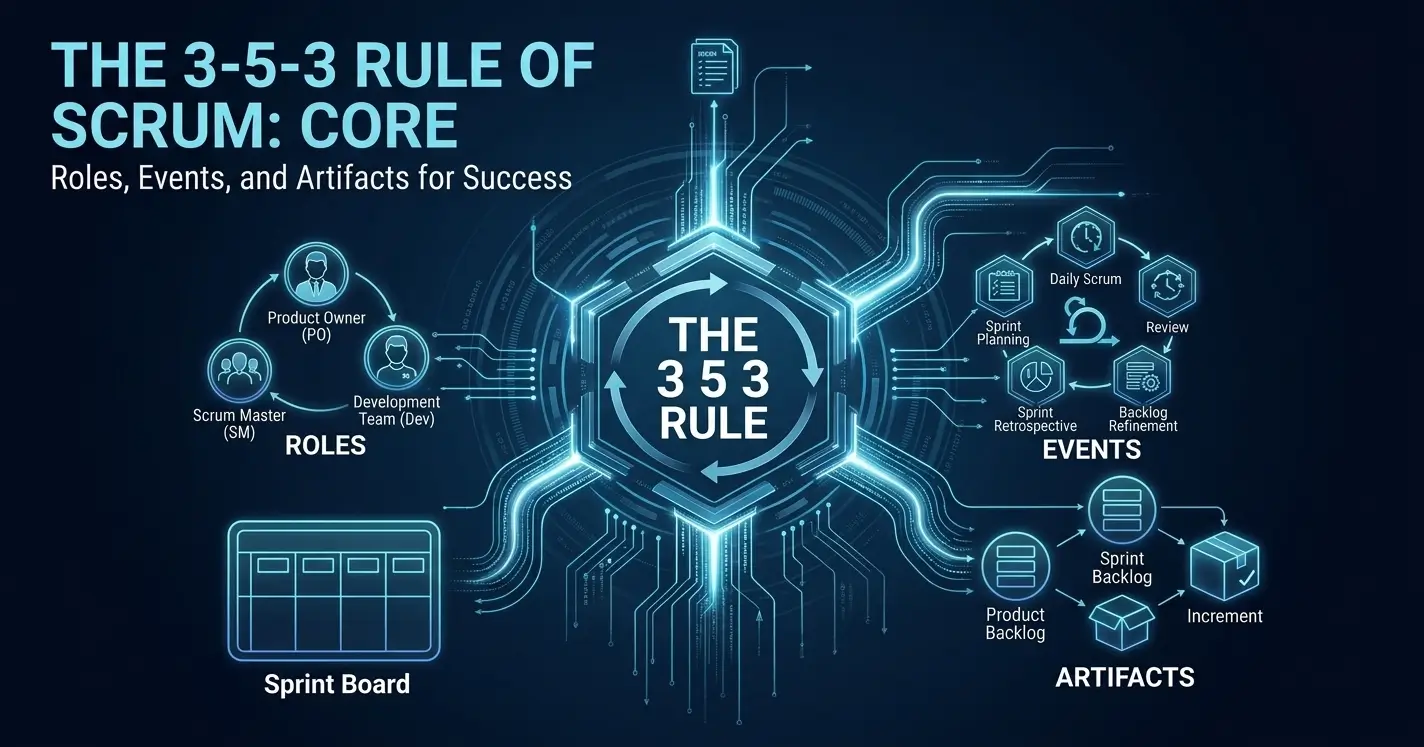
The 3-5-3 rule of Scrum is a practical mnemonic for Scrum’s 3 accountabilities, 5 events, and 3 artifacts. It is not official Scrum Guide terminology, but it provides a useful way to understand how Scrum works as a system. For enterprise cloud migration and DevOps teams, it can create a clear delivery rhythm for migration waves, technical debt, infrastructure and stakeholder feedback.
What is the 3 5 3 rule of Scrum?
The 3-5-3 rule summarizes eleven fundamental elements of Scrum:
3 Scrum accountabilities
- Product Owner
- Scrum Master
- Developers
5 Scrum events
- Sprint
- Sprint Planning
- Daily Scrum
- Sprint Review
- Sprint Retrospective
3 Scrum artifacts
- Product Backlog
- Sprint Backlog
- Increment
The structure is sometimes used as a teaching device because it makes Scrum easier to remember. However, the phrase “3-5-3 rule” does not appear as an official term in the Scrum Guide. The Scrum Guide defines the underlying accountabilities, events and artifacts, while 3-5-3 is a practitioner mnemonic used to organize them.
For enterprise teams, the distinction matters. The value of Scrum does not come from simply having three accountabilities, five meetings and three documents. It comes from how these elements work together to create transparency, inspection and adaptation.
This is particularly relevant to enterprise cloud migration. Large migration programs involve multiple workloads, infrastructure dependencies, security requirements, technical debt and migration waves. Teams need enough structure to coordinate the work without relying on a rigid plan that becomes obsolete when new information emerges.
Is 3 5 3 in the official Scrum Guide?
No. The Scrum Guide does not formally define a “3-5-3 rule.”
It defines the individual elements represented by the mnemonic. This makes 3-5-3 a useful map of Scrum, but not a replacement for the framework itself.
Knowing that Scrum has five events, for example, does not explain why a Sprint Review exists or how a Retrospective should change the team’s way of working.
Enterprise teams should therefore use the 3-5-3 structure as a way to understand Scrum’s operating model rather than as a compliance checklist.
The 3 Scrum accountabilities in cloud migration teams
The three Scrum accountabilities are Product Owner, Scrum Master and Developers. They can be mapped to existing enterprise responsibilities without creating artificial job titles.
The Product Owner is accountable for maximizing value and managing the Product Backlog.
In a migration context, this person needs enough authority to balance business priorities, risk, dependencies and migration sequencing. Depending on the organization, this could be an IT Director, transformation lead or platform owner.
A migration Product Owner may need to decide:
- which workloads should move first
- which applications should be modernized
- which technical debt should be prioritized
- which dependencies block the next migration wave
The Scrum Master helps establish Scrum and improve team effectiveness.
For cloud and DevOps environments, that requires understanding infrastructure dependencies, CI/CD pipelines, security gates, operational handovers and cross team blockers. The Scrum Master should help the team remove impediments rather than act as a project administrator.
The Developers are responsible for creating the Increment.
In a cloud migration squad, this may include Cloud Architects, Platform Engineers, DevOps Engineers, SREs, security specialists and application engineers. Scrum does not require them to perform identical work. It requires them to collaborate toward a shared Sprint Goal.
Why accountabilities matter more than job titles?
The 2020 Scrum Guide uses the term accountabilities instead of the traditional shorthand of “roles.”
This distinction is useful in enterprise environments. A job title describes organizational position. Accountability describes responsibility within Scrum. A Cloud Architect can remain a Cloud Architect while operating as one of the Developers. An IT Director can retain their corporate role while taking Product Owner accountability.
Problems arise when accountability becomes unclear. If several executives can independently reprioritize the backlog, there is effectively no single Product Owner. If specialists optimize only their own tasks, Developers stop acting as one team.
A practical mapping may look like this:
| Scrum accountability | Enterprise mapping | Primary focus |
| Product Owner | IT Director, platform owner, migration lead | Value and migration priorities |
| Scrum Master | Scrum Master, Agile Delivery Lead, DevOps delivery lead | Team effectiveness and impediments |
| Developers | Cloud Architects, Platform Engineers, SREs, DevOps and security specialists | Delivering the Increment |
The 5 Scrum events in a cloud migration cadence
The five Scrum events are Sprint, Sprint Planning, Daily Scrum, Sprint Review and Sprint Retrospective. Together, they create a recurring rhythm for planning, execution, feedback and improvement.
In an enterprise cloud migration program, each Sprint can advance a migration wave by delivering a usable and inspectable Increment.
A large migration wave may require several Sprints, but every Sprint should still produce a valuable and inspectable Increment.
Sprint
The Sprint is the container for all other Scrum events and lasts one month or less.
A cloud migration Sprint might focus on migrating a group of workloads, improving a landing zone, automating infrastructure provisioning or removing technical debt.
Sprint Planning
Sprint Planning determines why the Sprint is valuable, what can be delivered and how the work will be completed.
Migration teams should consider workload dependencies, security requirements, architecture decisions, testing and rollback requirements.
Daily Scrum
The Daily Scrum is a 15 minute event for Developers to inspect progress toward the Sprint Goal and adapt their plan.
In cloud migration, this is useful because blockers often cross technical boundaries. A networking, IAM or security issue can quickly affect several workstreams.
Sprint Review
The Sprint Review allows the Scrum Team and stakeholders to inspect the outcome and decide what should happen next.
Cloud teams can demonstrate deployed infrastructure, migrated workloads, monitoring dashboards, security controls, automation, performance data or cost metrics.
Sprint Retrospective
The Sprint Retrospective focuses on improving quality and effectiveness.
This is particularly valuable across migration waves. Problems discovered during one wave can be addressed before the next workloads move.
Timeboxes for Scrum events
For a one month Sprint, Scrum defines the following maximum timeboxes:
| Event | Maximum timebox |
| Sprint | One month or less |
| Sprint Planning | 8 hours |
| Daily Scrum | 15 minutes |
| Sprint Review | 4 hours |
| Sprint Retrospective | 3 hours |
For shorter Sprints, events are usually shorter.
Enterprise complexity should not automatically result in longer Scrum events. Architecture, security and program coordination can happen separately when required while the core Scrum cadence remains focused.
Sprint Review as an inspection of infrastructure, risk and operational outcomes
Infrastructure teams need something concrete to inspect just as software teams do.
A cloud migration Sprint Review may include:
- deployed Infrastructure as Code
- migrated workloads
- availability and performance metrics
- monitoring dashboards
- infrastructure costs
- backup and recovery evidence
- security control outcomes
- operational readiness indicators
This gives the Scrum Team and stakeholders an opportunity to inspect not only what was delivered, but also the operational, security and risk implications of the Increment.
The evidence surfaced during the Sprint Review can inform follow-up actions, backlog priorities and separate governance or compliance processes where required. The Sprint Review itself remains focused on inspection and adaptation, not formal approval or risk sign-off.
For more on infrastructure design, CI/CD, observability and rollback planning, see our guide to cloud migration architecture for CTOs.
The 3 Scrum artifacts in enterprise cloud migration
The three Scrum artifacts are Product Backlog, Sprint Backlog and Increment.
For migration teams, they create transparency around what needs to happen, what is being delivered now and what has actually been completed.
Product Backlog
The Product Backlog contains everything needed to improve the product.
For enterprise cloud migration, it can include:
- workload migrations
- platform capabilities
- automation
- security remediation
- architecture improvements
- observability
- technical debt
- resilience
- decommissioning
Migration waves can therefore be organized through one transparent backlog instead of functioning as disconnected projects.
Technical debt should remain visible as well. A workload may be rehosted quickly to accelerate data center exit, but modernization work should not disappear once the migration is technically complete.
Sprint Backlog
The Sprint Backlog contains the Sprint Goal, selected Product Backlog items and the plan for delivering them.
A large migration program may contain hundreds of backlog items, but the Sprint Backlog clarifies which outcome currently matters.
Increment
The Increment represents a concrete step toward the Product Goal.
For cloud teams, this could be a production ready platform capability, automated deployment process, migrated workload or verified infrastructure component.
The essential point is that it meets the Definition of Done and is usable.
The 3 Scrum commitments
Each artifact has an associated commitment:
- Product Backlog has the Product Goal
- Sprint Backlog has the Sprint Goal
- Increment has the Definition of Done
These commitments prevent migration from becoming a collection of unrelated infrastructure tasks.
For cloud teams, the Definition of Done may include automated deployment, monitoring, security validation, backup, documentation and operational readiness.
How the 3 5 3 rule differs from Scrum pillars and values
The 3-5-3 structure is often confused with other numerical concepts associated with Scrum and Agile.
| Concept | What it contains | What it describes |
| 3-5-3 structure | 3 accountabilities, 5 events, 3 artifacts | Structure of Scrum |
| 3 Scrum pillars | Transparency, Inspection, Adaptation | Empirical process control |
| 5 Scrum Values | Commitment, Focus, Openness, Respect, Courage | Team behavior |
| 3 Ps of Agile | No canonical Scrum definition | Various external models |
The three Scrum pillars are Transparency, Inspection and Adaptation. They describe Scrum’s empirical foundation.
The five Scrum Values are Commitment, Focus, Openness, Respect and Courage. They influence how Scrum Teams work together but are not the “five” represented by 3-5-3.
The phrase “3 Ps of Agile” is not an official Scrum concept and is used differently by different authors.
Similarly, expressions such as the “golden rule of Agile” or “20-30-50 rule” should not be confused with elements formally defined by the Scrum Guide.
Common mistakes when applying the 3 5 3 structure
The 3-5-3 structure works as a system. Applying only selected elements reduces its effectiveness.
One common mistake is replacing Product Owner accountability with stakeholder consensus. Migration involves business, infrastructure, security and architecture stakeholders, but requiring everyone to agree on every backlog decision slows prioritization.
Another is turning the Daily Scrum into a management status meeting. Its purpose is to help Developers inspect progress and adapt their plan.
Teams also frequently drop Sprint Retrospectives under delivery pressure. This is particularly costly during migration, because improvements identified after one wave can prevent the same problems from recurring.
Another anti pattern is treating Scrum artifacts as static documents. Product and Sprint Backlogs should change as the team learns.
Finally, a weak Definition of Done can create false confidence. A workload running in the cloud may still be incomplete if monitoring, backups, IAM, security validation or operational ownership are missing.
We discussed related delivery risks in common Agile outsourcing challenges in more detailed way.
Scaling the 3 5 3 structure across migration waves
Instead of creating one oversized team, enterprises can organize work across multiple cross functional Scrum Teams. The setup depends on whether those teams are contributing to the same Product or to different Products.
If several Scrum Teams are working on the same Product, they should share the same Product Goal, Product Backlog and Product Owner, while each team can have its own Sprint Goal and plan for creating a valuable Increment. If squads are working on genuinely different Products, each Product can have its own Product Owner, Product Backlog and Product Goal.
Teams working on the same Product can align through:
- a shared Product Goal
- one Product Backlog
- one Product Owner
- their own Sprint Goals
- coordinated Sprint cadences where useful
- shared architecture principles
- transparent cross team dependencies
- a common Definition of Done for the Product
This matters particularly when external specialists participate in delivery. We explained the model further in how enterprises use Agile outsourcing.
Webellian helps organizations design cloud infrastructure, migrate applications and data, automate infrastructure operations, and build secure and scalable cloud environments.
Explore our Cloud and security services if you need a partner that can connect cloud architecture, migration execution, DevOps and Agile delivery.
Planning a multi wave cloud transformation? Contact Webellian!
FAQ about the 3 5 3 rule of Scrum
What is the 3 5 3 rule of Scrum?
It is a practitioner mnemonic representing Scrum’s 3 accountabilities, 5 events and 3 artifacts.
What are the 3 accountabilities, 5 events and 3 artifacts?
The accountabilities are Product Owner, Scrum Master and Developers. The events are Sprint, Sprint Planning, Daily Scrum, Sprint Review and Sprint Retrospective. The artifacts are Product Backlog, Sprint Backlog and Increment.
Is the 3 5 3 rule an official Scrum Guide term?
No. Its elements are defined by the Scrum Guide, but “3-5-3 rule” is an industry mnemonic.
What are the 3 pillars of Scrum?
Transparency, Inspection and Adaptation. They describe Scrum’s empirical foundation and are different from the three accountabilities in 3-5-3.
Are Scrum Values part of the 3 5 3 rule?
No. The five Scrum Values are Commitment, Focus, Openness, Respect and Courage. They are separate from the five Scrum events.
How does the 3 5 3 rule apply to cloud migration?
It provides an operating model for iterative migration. Accountabilities define ownership, events create a delivery and feedback rhythm, while artifacts make priorities, current work and completed infrastructure transparent.
What happens when a team skips one of the 3 5 3 elements?
Accountability, transparency or feedback can weaken. For example, removing Sprint Reviews delays stakeholder feedback, while skipping Retrospectives makes recurring delivery problems more likely.