
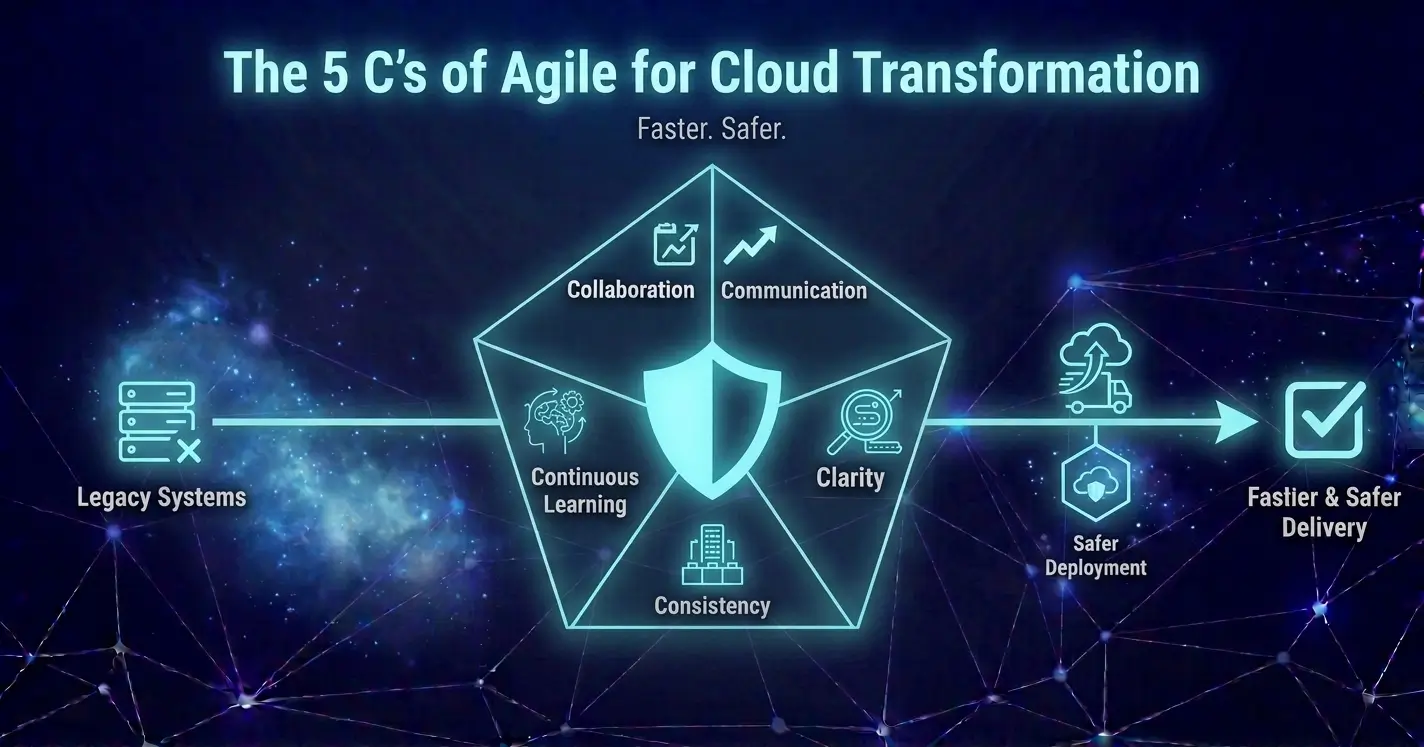
The 5 C’s of Agile for faster and safer cloud transformation
The 5 C’s of Agile are Communication, Collaboration, Commitment, Customer and Continuous Improvement. In enterprise cloud migration and DevOps, we use these principles to turn Agile from a set of ceremonies into a practical delivery model. They help distributed teams move faster, expose risk earlier and keep technical transformation connected to business outcomes.
What are the 5 C’s of Agile?
The 5 C’s of Agile provide a practical way to describe the behaviors that make Agile delivery work:
- Communication keeps information, risks and decisions visible.
- Collaboration brings technical and business specialists together around shared outcomes.
- Commitment creates ownership of realistic delivery goals.
- Customer keeps work connected to actual business value.
- Continuous Improvement turns every delivery cycle into input for the next one.
We use the version associated with Atlassian because it brings together the elements most relevant to enterprise delivery. Other interpretations exist. Some replace Commitment or Customer with Courage, while others introduce concepts such as Coordination.
That variation matters because the 5 C’s are not an official Agile Manifesto framework. They are better understood as a practical interpretation of Agile behaviors.
The Agile Manifesto established four values and twelve principles. The 5 C’s translate many of those ideas into behaviors that teams can use in day to day delivery. For us, their value becomes particularly clear in cloud migration.
A migration program involves more than moving infrastructure. Business owners, Cloud Architects, Platform Engineers, developers, security teams, operations and external partners may all depend on each other. Decisions made in one migration wave can affect architecture, cost, compliance and later waves.
Traditional sequential delivery often hides these dependencies until a formal handover or testing stage. Agile makes them visible earlier through shorter feedback loops.
We discuss this difference in more detail in our guide to Agile vs Waterfall methodology.
The 5 C’s give enterprise teams a useful behavioral layer on top of those Agile delivery mechanisms.
How the 5 C’s differ from other Agile frameworks
Agile terminology is crowded with numerical models. Several unrelated concepts are often confused with the 5 C’s.
| Framework | Main elements | Purpose |
| 5 C’s of Agile | Communication, Collaboration, Commitment, Customer, Continuous Improvement | Behavioral principles for Agile delivery |
| 4 Agile values | Individuals and interactions, working software, customer collaboration, responding to change | Foundation of the Agile Manifesto |
| 5 Agile phases | Envision, Speculate, Explore, Adapt, Close | Lifecycle model used in some Agile approaches |
| Five Pillars of Agile Transformation | Mindset, Practices, Roles, Teamwork, Support | Organizational transformation model |
| Scrum Values | Commitment, Focus, Openness, Respect, Courage | Values defined within Scrum |
The overlap is useful but the models are not interchangeable.
For example, Courage is a Scrum Value. It also appears in some alternative versions of the 5 C’s, but it does not replace the wider Scrum Values framework.
For enterprise teams, exact terminology matters less than applying the underlying behaviors consistently. The problem begins when an organization selects a framework vocabulary but does not change how people actually make decisions.
Communication in distributed cloud and DevOps teams
Communication is the first C because cloud migration depends on information moving at least as quickly as technical work.
A migration decision made by one team can affect networking, identity, security, application architecture or operations. If that information remains inside a meeting, email thread or individual engineer’s head, dependencies become delivery risks.
In our projects, effective communication is structured rather than constant.
Useful mechanisms can include:
- Daily Scrum or short delivery synchronization
- asynchronous status updates
- Sprint Reviews
- architecture decision records
- shared dashboards
- visible Product and Sprint Backlogs
- incident and risk channels
- documented decisions and owners
The objective is not more communication. It is less ambiguity.
This becomes especially important for distributed teams. A Product Owner may work in the UK, engineers in Central Europe and enterprise stakeholders elsewhere. Requiring every interaction to happen synchronously creates unnecessary meetings. Moving everything to asynchronous channels creates a different problem: context disappears and important blockers may remain unanswered.
A stronger model defines what requires a live conversation and what should be documented asynchronously.
For example, a team might reserve synchronous time for planning, architecture decisions, blockers and retrospectives while using Jira, Azure DevOps, Slack, Teams or documentation platforms for progress and routine information.
We explore these challenges in our article on common Agile outsourcing challenges.
Communication across time zones and regulatory borders
For European enterprise delivery, communication also needs to create a reliable decision trail.
Cloud programs frequently involve security, access control, data governance and compliance stakeholders. Important technical decisions should therefore be traceable rather than scattered across private messages.
A simple communication charter can establish:
- which tools are used for which type of information
- expected response times
- escalation paths
- required overlap hours
- where architectural decisions are recorded
- who owns specific decisions
- which evidence needs to be retained
This reduces communication overhead while improving transparency.
The principle is simple: if a decision can affect another migration wave, another team or production risk, it should not disappear when the meeting ends.
Collaboration across dev, ops and security
Collaboration means replacing functional handoffs with cross functional ownership of outcomes.
Traditional infrastructure delivery frequently moves work sequentially between teams.
Development prepares an application. Infrastructure creates an environment. Security reviews it. Operations receives it. Problems discovered late are passed back to the previous team.
Cloud migration exposes the weakness of this model because the boundaries between those disciplines are increasingly blurred.
A networking decision affects application architecture. IAM affects deployment. Observability affects operations and developers. Security policies affect infrastructure code.
Instead of handing work from one department to another, we prefer cross functional migration squads that bring the necessary capabilities together around a migration wave.
A squad might include:
- Cloud or Solutions Architect
- Platform Engineer
- DevOps Engineer
- application engineer
- security specialist
- SRE or operations specialist
- Product Owner or migration lead
Not everyone needs to be permanently assigned to every squad. The important change is shared ownership of the outcome.
A workload should not be considered successful because one team completed its tasks. The outcome matters when the workload operates correctly in the target environment.
Cross functional squads for migration waves
A migration wave creates a natural unit around which collaboration can be organized.
The squad can own the work from preparation through deployment and validation. Security becomes part of design rather than a final approval exercise. Operations contributes before handover. Application and platform teams solve dependencies together.
This also supports shift left security.
Instead of discovering security problems at the end of a migration wave, teams can introduce policy checks, automated scanning, access control requirements and security testing earlier in delivery.
Cloud architecture should enable this collaboration technically as well as organizationally.
In our article Move the business, not the mess, we explain how DevOps, CI/CD, Infrastructure as Code, security and observability become part of the cloud operating model rather than separate project stages.
Commitment across long migration programs
Commitment means agreeing on realistic outcomes and protecting the team’s ability to deliver them.
Enterprise cloud transformation may continue across many migration waves. Priorities change, new dependencies appear and business requirements evolve.
Commitment therefore cannot mean blindly following a plan created months earlier.
Agile commitment works at several levels.
The team commits to a clear delivery objective and quality standard. The Product Owner commits to making priorities visible and decisions available. Leadership commits to giving teams enough authority, resources and stability to execute.
That last point is frequently overlooked.
A team cannot realistically commit to a Sprint Goal when stakeholders continuously insert urgent work. A migration program cannot maintain momentum when architecture decisions remain unresolved for weeks.
Commitment therefore requires discipline from leadership as much as from engineers.
The alternative version of the 5 C’s that includes Courage is closely related here. Teams need enough psychological safety to challenge unrealistic scope, expose a failed assumption or stop a risky cutover.
Commitment without that ability easily becomes compliance.
Sprint Goals and migration wave commitment
A Sprint and a migration wave operate at different levels.
The Sprint Goal defines a near term objective. The migration wave represents a broader set of workloads or transformation outcomes and may require several Sprints.
Enterprise programs should connect the two.
Sprint commitments should move the migration wave toward its objective without pretending that every dependency can be fixed for months in advance.
Clear ownership also helps. A lightweight RACI model can complement Agile when multiple enterprise functions participate, provided that it clarifies responsibility instead of creating another approval hierarchy.
The question should always be: who can make the decision when the team discovers something unexpected?
Customer focus beyond moving infrastructure
Customer means measuring cloud migration against business outcomes, not against the number of workloads moved.
A technically successful migration can still be a business failure.
The application may run in the cloud but cost more than expected. Performance may deteriorate. Release processes may remain manual. Security complexity may increase. Users may experience no improvement.
This is why the fourth C matters.
In cloud transformation, the customer can mean several groups:
- external users
- employees using internal systems
- application owners
- business units
- operations teams
- platform consumers
- security and compliance stakeholders
Their requirements should influence migration priorities and acceptance criteria.
A migration wave should therefore answer more than:
Did we move the workload?
It should also answer questions such as:
- Did performance meet expectations?
- Did operational complexity decrease?
- Can teams deploy faster?
- Are resilience requirements met?
- Has security improved?
- Is the expected cost model realistic?
- Can the application team use the new platform effectively?
Our cloud migration strategy framework takes the same approach: migration decisions should start with business and technical logic rather than assuming that every workload should follow the same path.
Continuous Improvement through migration feedback loops
Continuous Improvement means using evidence from every migration wave to make the next one safer and faster.
Enterprise migration naturally creates repetitive patterns.
Teams assess applications, resolve dependencies, prepare environments, execute cutovers, validate workloads and stabilize production.
Every repetition produces information.
The problem is that organizations do not always capture it.
A retrospective after a migration wave can identify:
- dependencies discovered too late
- manual tasks suitable for automation
- slow security approvals
- unreliable tests
- monitoring gaps
- rollback issues
- unclear ownership
- inaccurate workload assessment
Those findings should become backlog items, automation or operating model changes before the next wave.
This creates an inspect and adapt loop around the migration program itself.
Continuous Improvement also connects the other four C’s. Communication exposes problems. Collaboration allows teams to solve them. Commitment gives improvements priority. Customer feedback clarifies which changes matter.
Without Continuous Improvement, Agile can degrade into recurring ceremonies around a delivery process that never becomes better.
Using current DORA metrics as an improvement engine
Continuous Improvement should be observable, and the current DORA model provides five software delivery performance metrics that can help teams see whether their delivery system is actually improving.
DORA now groups these metrics into Software Delivery Throughput and Software Delivery Instability:
| Metric | What it can reveal |
| Change lead time | How quickly a committed change reaches production |
| Deployment frequency | How frequently the team deploys changes |
| Failed deployment recovery time | How quickly the team recovers from a failed deployment |
| Change fail rate | How often deployments require immediate remediation |
| Deployment rework rate | How much deployment activity is unplanned work caused by production bugs |
For cloud migration and DevOps teams, we would use these metrics as signals rather than individual performance targets.
A team can establish a baseline for an application or service and then observe how delivery performance changes across migration waves. If deployment frequency improves while change fail rate or deployment rework rate increases, faster delivery may be creating additional instability.
If change lead time remains high after infrastructure automation has improved, the bottleneck may sit elsewhere in the delivery system, such as testing, approvals or cross team dependencies.
This is where DORA metrics strengthen the fifth C. They turn Continuous Improvement from a general Agile principle into an evidence based feedback loop, helping teams identify where the delivery system is improving and where further changes are needed.
Conditions that make the 5 C’s work
Communication, Collaboration, Commitment, Customer focus and Continuous Improvement require psychological safety, leadership support and clear ownership.
Without those conditions, organizations can reproduce every Agile ceremony while keeping the old operating model underneath.
Teams attend stand ups but avoid discussing difficult problems. Retrospectives happen but nothing changes. Product Owners have responsibility without decision authority. Cross functional squads still wait for approvals from disconnected departments.
This is Agile theater.Three conditions help avoid it.
First, teams need psychological safety. Engineers should be able to report risk, challenge assumptions and admit that an approach did not work.
Second, leadership needs to support the operating model. Executives cannot demand self organizing teams and then override priorities every few days.
Third, responsibilities need to be clear. Product ownership, architecture, security decisions and operational accountability should not remain ambiguous.
If your organization needs additional delivery capability or a partner that can work as part of your existing Agile organization, explore our Agile outsourcing services.
Planning an enterprise cloud migration or DevOps transformation? Contact us to embed the 5 C’s into a delivery model designed around measurable outcomes, clear ownership and continuous improvement.
FAQ about the 5 C’s of Agile
What are the 5 C’s of Agile?
The 5 C’s used in this framework are Communication, Collaboration, Commitment, Customer and Continuous Improvement. They describe behaviors that support effective Agile delivery.
Are the 5 C’s part of the Agile Manifesto?
No. The Agile Manifesto formally defines four values and twelve principles. The 5 C’s are a practitioner framework that translates related Agile ideas into practical behaviors.
What are the 4 pillars of Agile?
There is no single canonical set called the four pillars of Agile equivalent to the Agile Manifesto. The term is used by different authors for different frameworks and should not be confused with the 5 C’s.
What are the 5 phases of Agile?
One lifecycle model describes them as Envision, Speculate, Explore, Adapt and Close. They describe stages of delivery rather than the behaviors represented by the 5 C’s.
How do Scrum Values relate to the 5 C’s?
Scrum defines Commitment, Focus, Openness, Respect and Courage as its five values. There is overlap with the 5 C’s, particularly Commitment, but the frameworks serve different purposes.
Is Courage one of the 5 C’s?
It appears in some versions of the framework. We use Communication, Collaboration, Commitment, Customer and Continuous Improvement while recognizing Courage as a closely related Agile and Scrum behavior.
What are the 5 Whys in Agile?
The 5 Whys are a root cause analysis technique based on repeatedly asking why a problem occurred. They are unrelated to the 5 C’s framework but can support Continuous Improvement.
How do the 5 C’s apply to cloud migration?
They provide a behavioral operating model. Communication makes risks visible, Collaboration breaks down technical silos, Commitment creates ownership, Customer focus ties migration to business outcomes and Continuous Improvement applies lessons from one migration wave to the next.
How can you measure the 5 C’s?
There is no single score. Teams can combine delivery metrics such as DORA metrics with retrospective actions, stakeholder feedback, dependency resolution time and evidence of continuous improvement.