
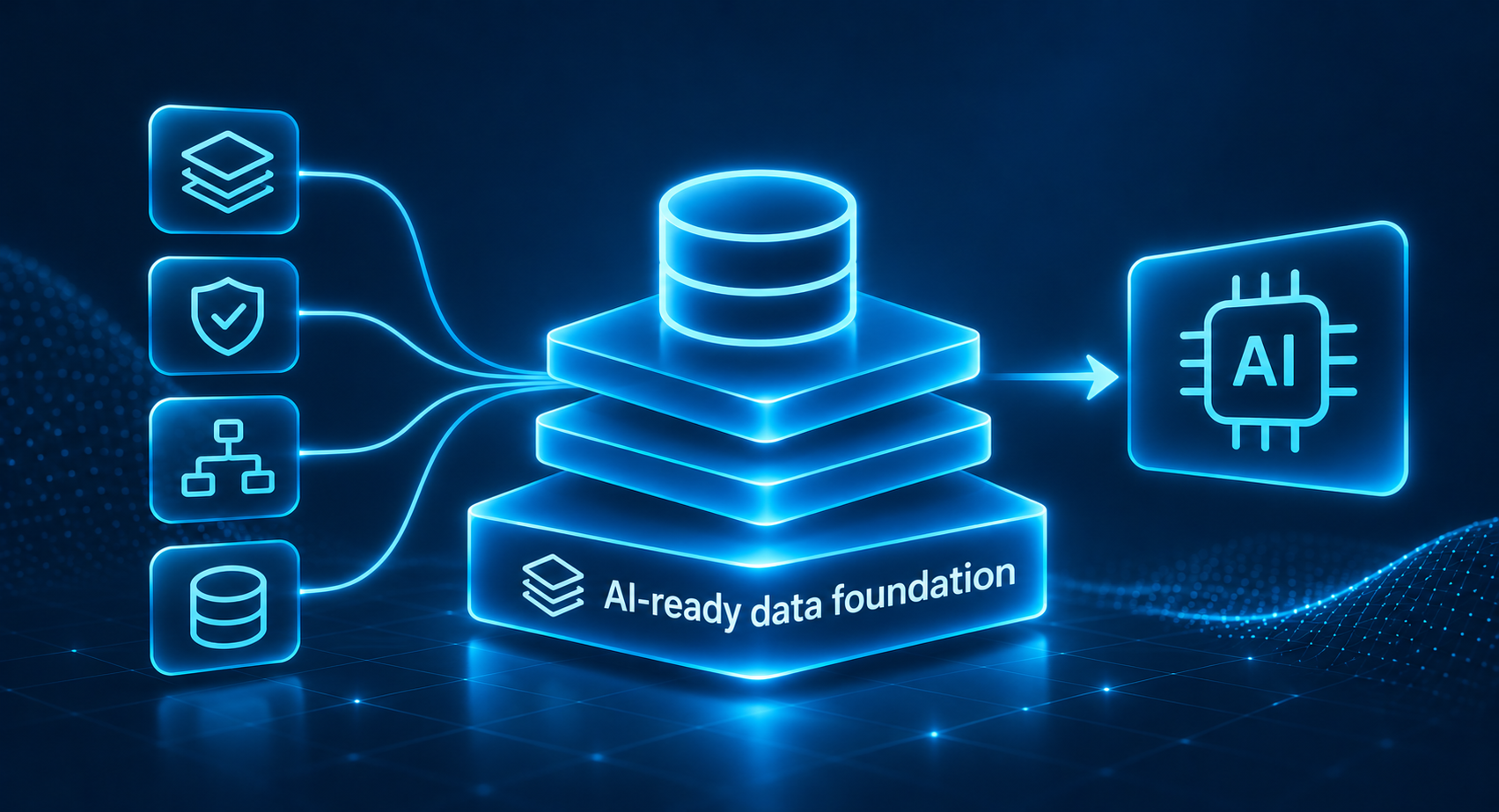
Is your data ready for AI? What an AI-ready data foundation actually requires
AI-ready data is data that fits a specific AI use case: representative, documented, governed and reliably accessible to AI systems during development and production, whether for training, retrieval, inference or tool use. Gartner predicted in 2025 that through 2026, organizations would abandon 60% of AI projects unsupported by AI-ready data. This guide sets out what the foundation requires.
What is AI-ready data?
AI-ready data is information that an AI system can use reliably, appropriately and safely for a defined purpose. It must represent the problem being addressed, have understandable meaning and origins, and remain accessible under the right permissions.
The key principle is that data readiness depends on the use case. A dataset suitable for business reporting may not be suitable for machine learning. Documents that work for an internal search tool may need additional structure, metadata and access controls before they can support a generative AI assistant.
AI-ready data vs clean data vs analytics-ready data
| Dimension | Clean data | Analytics-ready data | AI-ready data |
| Main goal | Correct records | Consistent reporting | Reliable AI outputs |
| Quality | Valid and complete values | Consistent business metrics | Representative, relevant inputs |
| Context | Basic descriptions | Business definitions | Metadata, provenance and intended use |
| Access | User permissions | Reporting permissions | Controls for specific AI activities |
| Maintenance | Periodic cleaning | Reporting updates | Continuous validation and monitoring |
Editorial comparison informed by Gartner’s 2025 research and public AI-ready data frameworks.
Clean data is not automatically AI-ready. For example, removing unusual transactions may improve a report while eliminating examples that a fraud detection model needs to recognize.
Data readiness is not the same as AI readiness
AI readiness covers an organization’s broader ability to adopt AI, including strategy, people, infrastructure and governance.
Data readiness is one part of that assessment. It asks whether the information required by a particular AI system is appropriate, trustworthy and available.
Why do AI projects fail when the data is not ready?
AI projects often struggle because problems with data become visible only after model development begins. Missing context, inconsistent definitions, inaccessible sources and unreliable pipelines can turn a promising prototype into a difficult production project.
In February 2025, Gartner reported that 63% of surveyed data management leaders said their organizations lacked, or were unsure they had, the right data management practices for AI. The survey covered 1,203 leaders in July 2024.
Five recurring problems explain why data readiness matters:
- Unrepresentative data: Training examples do not reflect real operational conditions.
- Poor data quality: Missing, inconsistent or incorrect information affects outputs.
- Missing metadata: Teams cannot reliably establish what data means or where it originated.
- Unclear permissions: The intended AI use has not been approved.
- Unreliable delivery: Data cannot reach the model consistently after deployment.
These problems should be investigated before substantial development begins. A data science proof of concept can help establish whether both the model and its supporting data are feasible.
What does an AI-ready data foundation require?
An AI-ready data foundation combines data quality, context, delivery, security and ongoing operational controls. The UK Department for Science, Innovation and Technology’s January 2026 guidance identifies four broad areas: technical optimisation, data and metadata quality, organisational and infrastructure context, and legal, security and ethical compliance.
The Open Data Institute has also developed frameworks for assessing AI-ready data, including a 2026 enterprise-focused approach.
Nine requirements for production AI
| Requirement | What it means |
| 1. Use-case alignment | Data represents the decision or task the AI must perform |
| 2. Data quality | Values and records are accurate, relevant and sufficiently complete |
| 3. Metadata | Sources, meanings, limitations and ownership are documented |
| 4. Lineage | Data transformations and origins can be traced |
| 5. Consistent definitions | Critical business concepts mean the same across systems |
| 6. Reliable pipelines | Data arrives in the required format and at the required time |
| 7. Unstructured data readiness | Documents can be extracted, interpreted and retrieved correctly |
| 8. Governance and security | Access, permitted uses and accountability are defined |
| 9. Monitoring | Changes in quality, freshness and distribution can be detected |
Editorial synthesis based on Gartner, UK DSIT and ODI frameworks. These are not presented as nine official criteria from any single source.
A foundation does not need every capability at maximum sophistication from day one. The first priority is establishing what the intended AI application requires.
Different AI systems need different data
| Requirement | Predictive ML | Generative AI with RAG | AI agents |
| Representative examples | Essential | Important | Important |
| Reliable document context | Sometimes | Essential | Often essential |
| Current operational data | Depends on use | Depends on use | Often essential |
| Data provenance | Essential | Essential | Essential |
| Access restrictions | Essential | Essential | Essential |
| Consistent business definitions | Important | Important | Essential |
Illustrative prioritization. Actual requirements depend on the application and risk.
A predictive model needs suitable historical examples. A retrieval-augmented assistant needs trustworthy source documents. An AI agent that interacts with business systems may also require current information and tightly controlled permissions.
The differences are important when designing enterprise applications using large language models.
How do metadata and data pipelines make information usable for AI?
Metadata and reliable data pipelines turn isolated records into information AI systems can interpret and use consistently. Metadata explains meaning, ownership and origin. Pipelines deliver validated data in the required format and at the right time. Both are essential when moving beyond a controlled prototype.
Metadata, lineage and business context
A dataset should answer four basic questions: What does it contain? Where did it come from? Who owns it? What may it be used for?
Data lineage records where data originates and how it moves and changes across systems. This helps teams trace the data used in predictions or retrieval back to its sources, although lineage alone does not explain why a model produced a particular output.
A shared semantic layer can encode and consistently expose agreed business definitions, but it cannot resolve disagreements between departments on its own. If teams define an active customer differently, business owners must first agree on the definition and its intended use. The semantic layer can then make that definition consistently available to AI systems, including agents combining data from different sources.
Microsoft’s October 2026 account of its enterprise AI-ready data work reinforces this approach, emphasizing semantics, ownership, lineage, observability and continuous readiness.
Microsoft: AI-ready data, building the foundation for enterprise AI at Microsoft
Training data and production data need different pipelines
Training pipelines must preserve reproducible datasets and transformations. Production pipelines must deliver reliable, sufficiently current information.
For example, a demand forecasting model may use daily batch data, while an agent checking stock availability may need near-real-time updates.
Freshness requirements should follow the business decision, not a preference for a particular technology.
How do you prepare unstructured data for generative AI?
Unstructured data such as PDFs, contracts, emails and internal documentation requires more than uploading files into an AI tool. Content must be readable, correctly segmented, associated with trustworthy metadata and kept current. Retrieval systems must also enforce the permissions attached to the original information.
Before connecting documents to a retrieval-augmented generation (RAG) system, check whether:
- Text and tables can be extracted accurately.
- Documents retain enough context for meaningful retrieval.
- Source references and version information are available.
- Outdated content is updated or removed.
- Users cannot retrieve information beyond their permissions.
A retrieval system may otherwise return an obsolete policy or expose content that should remain restricted.
These requirements are particularly important for RAG-based AI applications.
What governance and security does AI-ready data need?
AI-ready data must have a clear owner, an approved purpose and enforceable access restrictions. Data availability alone does not establish permission to use information for model training, retrieval or automated decisions.
The ODI’s June 2026 framework for AI-ready enterprise data provides 21 actionable criteria covering datasets, metadata, infrastructure and governance. It builds on earlier ODI research and is particularly relevant to organizations preparing enterprise information for AI.
Open Data Institute: A framework for AI-ready enterprise data
Practical governance should establish who approves each use case, which sensitive information is involved, where processing may occur and how access is audited.
For European organizations, GDPR requirements may apply when personal data is processed. Other obligations depend on the specific system and its purpose.
Governance should be part of the data foundation from the beginning, not a final approval after development.
How do you assess whether your data is ready for AI?
A data readiness assessment should focus on one AI use case and test whether its data is suitable, documented, accessible and sustainable. The UK government’s January 2026 guidance includes a self-assessment approach and suggests using a four-point scale to evaluate readiness across different requirements.
A practical data readiness checklist
| Area | Assessment question |
| Purpose | Is the AI use case clearly defined? |
| Representativeness | Does the data reflect the conditions the AI will encounter? |
| Quality | Are important gaps, errors and limitations understood? |
| Metadata | Are definitions, sources and owners documented? |
| Lineage | Can the data and its transformations be traced? |
| Delivery | Can the required information reach the AI reliably? |
| Security | Is the intended use authorized and appropriately protected? |
| Maintenance | Are changes monitored and responsibilities assigned? |
This editorial checklist draws on the 2026 UK DSIT and ODI frameworks. The following 0-3 scoring scale and its definitions are a practical assessment method proposed for this guide, not an official scoring system prescribed by either framework.
Rate each area using the following scale:
- 0: Not established.
- 1: Partially established.
- 2: Established with evidence.
- 3: Established and continuously maintained.
The scores help identify priorities. They should not be treated as a certification or used to average away critical legal or security gaps.
In what order should you build an AI-ready data foundation?
Start with one clearly defined AI use case, assess the data it requires and resolve the most consequential gaps. Establish repeatable delivery and monitoring before expanding to additional workloads. This approach avoids investing in a large data platform before the organization understands which capabilities it actually needs.
A practical sequence is:
- Define the use case: Specify the decision, output and acceptance criteria.
- Assess the data: Examine quality, representativeness, metadata and permissions.
- Fix critical gaps: Establish ownership, consistent definitions and appropriate controls.
- Build reliable delivery: Make training and production data available through repeatable pipelines.
- Monitor and improve: Track quality, freshness and changes as the AI system operates.
The result is what Webellian describes as an AI-grade foundation: data capabilities designed to support dependable production AI, rather than reporting alone.
This does not mean every enterprise dataset must become AI-ready. It means the organization can prepare, govern and maintain the information required by each valuable AI use case.
FAQ
How much data do you need for AI?
There is no universal minimum. The amount depends on the task, model type, variability and quality of available information. Representative examples and appropriate coverage matter more than a fixed record count.
Do you need one platform to make data AI-ready?
No. Organizations can maintain data across different systems if they provide reliable integration, consistent definitions, traceability and appropriate security. Centralization is an architectural choice, not a universal requirement.
Is AI-ready data the same as clean data?
No. Clean data focuses on correctness and consistency. AI-ready data must also be representative of the intended use case, properly documented, authorized, accessible and maintained throughout the AI system’s lifecycle.
Will AI replace data governance?
No. AI can assist with classification, metadata and quality checks, but people remain responsible for defining permitted uses, approving access and ensuring accountability.
Sources
https://theodi.org/insights/reports/a-framework-for-ai-ready-enterprise-data
https://theodi.org/insights/reports/a-framework-for-ai-ready-data
https://knowledgehub.dev.ai.gov.uk/how-to/Making-data-ready-for-AI