
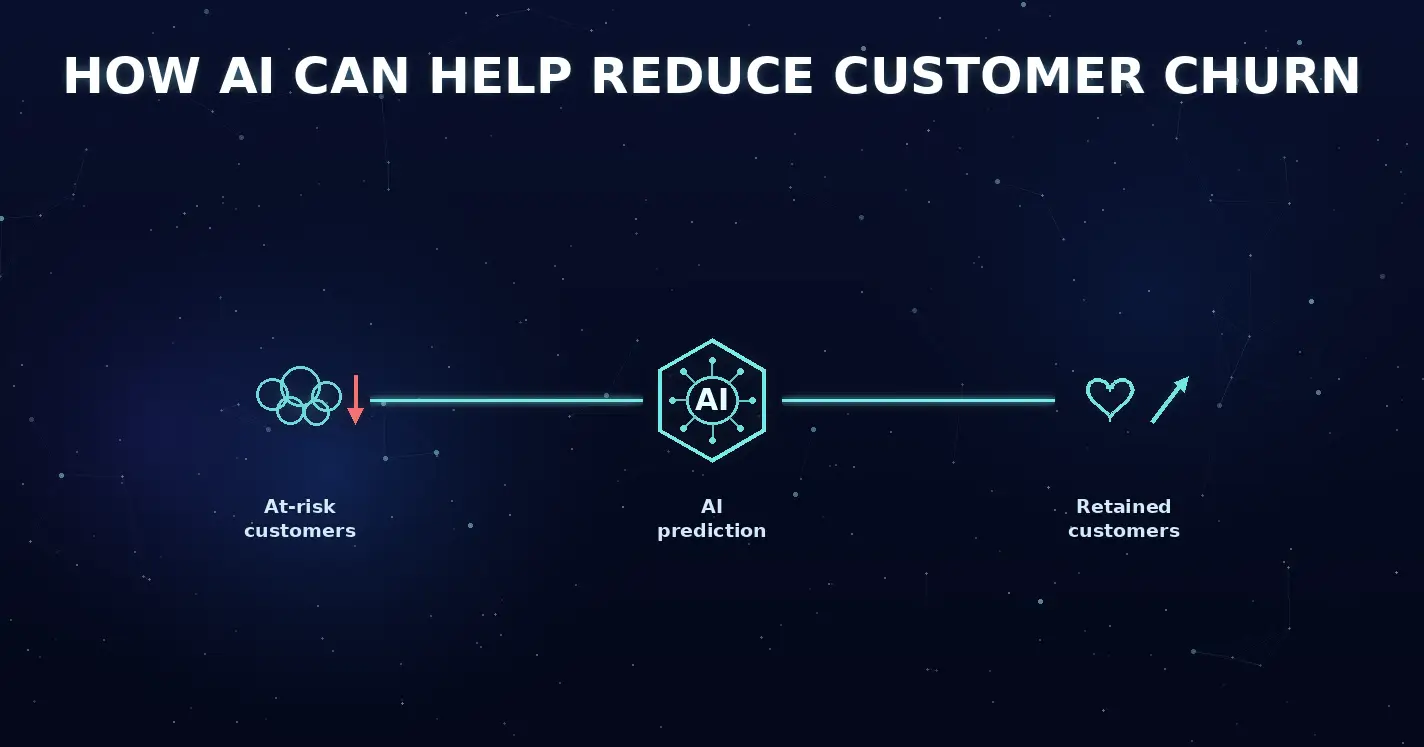
How AI can help to reduce customer churn?
AI can help to reduce customer churn by scoring behavioral, product, support, and billing data to identify accounts at risk before they cancel. The algorithm is only one part of the system. Reliable churn prediction depends on the data platform, MLOps pipeline, and customer workflows that turn a probability score into timely action.
What is an AI driven predictive churn model?
A useful model creates an early-warning window that gives Customer Success or account teams enough time to intervene. In B2B SaaS, 30 to 90 days can be a useful example of a prediction horizon, but the right window depends on factors such as contract length, renewal timing, customer segment, and how quickly the company can realistically act on a risk signal.
Churn and revenue loss can also take different forms:
- Voluntary churn: the customer actively cancels or decides not to renew.
- Involuntary churn: the relationship ends because of failed payments or other billing or administrative issues.
- Contraction: the customer remains active but reduces seats, products, usage, or contract value.
- At-risk or disengaged account: the customer has not churned, but declining usage, stakeholder engagement, or product adoption indicates a higher probability of future churn.
For B2B SaaS companies, contraction and early disengagement can be as important to monitor as logo churn because they can signal deteriorating recurring revenue and renewal risk before the customer formally leaves.
AI churn prediction vs. AI customer service tools
Predictive churn and AI customer service solve different problems.
A chatbot, agent assistant, or generative AI search tool helps handle customer interactions. A predictive churn model analyzes historical and current data to estimate future customer behavior.
The model might identify an account because weekly active users have dropped by 45%, key features are no longer used, three support tickets remain unresolved, and the renewal date is approaching.
It does not need to speak to the customer.
A customer service AI tool may later support the intervention, but prediction happens in the data and machine learning layer.
For enterprises exploring a use case before committing to production infrastructure, a data science proof of concept is a practical way to test whether available customer data contains enough predictive signal.
Why predictive churn models outperform reactive retention?
Predictive churn replaces reactive firefighting with an early warning system.
Traditional retention often begins after the customer complains, stops using the product, requests a discount, or announces an intention to cancel. At that stage, many of the conditions behind churn have existed for weeks or months.
AI can detect leading indicators earlier.
A decline in usage may begin before the customer contacts support.
A change in stakeholder engagement may appear before contract negotiations.
A drop in adoption across several teams may precede a downgrade request.
Published customer case studies illustrate the potential value of earlier churn detection and proactive intervention. Swoogo reported a 7-point increase in gross revenue retention (GRR) in its first year after improving visibility into customer health and leading churn indicators. PartsSource reported a 10+ point increase in GRR after centralizing customer intelligence and introducing automated alerts and playbooks. LastPass reported a 29% reduction in cancellations alongside a 2-point improvement in GRR after implementing behavior-based digital Customer Success.*
These are individual company case studies rather than industry benchmarks, so they should be treated as examples of potential impact, not as typical or guaranteed outcomes.
The practical value comes from moving retention activity earlier.
| Approach | Typical signal | Timing | Limitation |
| Reactive retention | Cancellation request or complaint | Very late | Limited time to change outcome |
| Manual health score | CSM judgment and selected KPIs | Periodic | Hard to scale consistently |
| Predictive churn model | Multi source behavioral patterns | Earlier warning window before likely churn | Requires reliable data and operational workflow |
AI does not replace standard retention tactics such as onboarding improvements, customer education, loyalty programmes, service recovery, or product improvements.
It helps decide where and when to apply them.
The data foundation: what signals actually predict churn?
A predictive churn model is only as strong as the data behind it. Product usage is often a very useful signal, but it rarely tells the complete story.
An enterprise model typically combines at least five categories:
- Product behavior: logins, active users, feature adoption, session frequency, usage depth, workflow completion.
- CRM data: account segment, contract value, industry, relationship history, renewal date, stakeholder engagement.
- Billing data: failed payments, late payments, contract changes, downgrades, discounts.
- Support data: ticket volume, unresolved cases, severity, escalation frequency, resolution time.
- Engagement data: onboarding progress, email activity, meetings, training participation, NPS or CSAT where available.
A single signal can be misleading. A decline in logins might indicate churn risk, but it could also mean the customer has completed implementation and now needs fewer administrator sessions. A stronger pattern might combine lower usage with fewer active users, unresolved support issues, declining stakeholder engagement, and an approaching renewal date. That is why customer 360 integration matters. It means combining customer data from systems such as CRM, product analytics, billing, support, and contract management into a single customer-level view. For churn prediction, this gives the model a broader set of behavioral and commercial signals instead of forcing it to rely on one source in isolation.
This is fundamentally a data engineering problem before it becomes a machine learning problem. Webellian’s Business Intelligence and Data Analytics services focus on building the data warehouses, processes, KPIs, and analytics foundations that predictive use cases depend on.
Structured and unstructured customer data
Not every churn signal lives in a database column.
Structured data includes values such as login count, ARR, number of tickets, subscription tier, or renewal date.
Unstructured data includes support conversations, email messages, call transcripts, survey comments, and account notes.
NLP can convert this material into additional features such as sentiment, urgency, topic frequency, or repeated dissatisfaction.
A customer with stable usage but increasingly negative support conversations may be more at risk than behavioral metrics alone suggest.
The goal is not to collect everything.
It is to identify signals that improve prediction and can be governed reliably.
Architecting the data platform behind a churn model
Before a churn model can score accounts consistently, the enterprise needs a data architecture that makes customer information reliable and reusable.
A typical architecture contains five layers:
1. Source systems
CRM, product telemetry, billing, support, marketing, contract, and customer feedback systems.
2. ETL or ELT pipelines
Pipelines ingest, clean, normalize, and join customer data.
3. Data warehouse or lakehouse
The central analytical platform stores historical customer behavior and creates a consistent account view.
4. Feature layer or feature store
Reusable model features such as 30 day usage change, ticket frequency, payment delay, or time until renewal are calculated consistently.
5. Serving layer
Predictions are written into CRM, Customer Success platforms, dashboards, APIs, or event streams.
The important principle is consistency.
If the training pipeline calculates “active user” differently from the production scoring pipeline, model performance can deteriorate even when the algorithm itself has not changed.
For cloud environments, architecture also determines scalability and cost. A warehouse may be ideal for structured SaaS analytics, while a lakehouse may provide more flexibility where product events, text data, and ML workloads coexist.
Webellian’s Cloud and Security services cover cloud infrastructure, data integration, analytics, and machine learning foundations for these types of workloads.
Real time vs. batch scoring
Not every churn model needs streaming architecture.
For annual enterprise contracts, recalculating scores once per day may be sufficient.
Batch scoring is simpler, cheaper, and easier to govern.
Real time scoring becomes useful when important risk signals change quickly. Examples include payment failure, sudden product inactivity, repeated service errors, or behavioral events that should immediately trigger intervention.
For many B2B SaaS companies, the best architecture is hybrid.
Use batch pipelines to calculate stable historical features and account level scores daily.
Use streaming or event driven components only for signals where minutes genuinely matter.
Real time should be a business requirement, not an architectural status symbol.
Operationalizing churn prediction with MLOps
A churn model is not finished when the data science notebook reaches acceptable accuracy.
Customer behavior changes.
Pricing changes.
Products change.
New features launch.
Sales teams target different segments.
A model trained on last year’s behavior can slowly lose predictive value.
A production churn system should include:
- reproducible training pipelines;
- version controlled features and code;
- automated model testing;
- CI/CD for model deployment;
- a model registry;
- approval rules for production releases;
- performance monitoring;
- rollback capability.
The model registry should make it possible to answer basic governance questions:
Which model version produced this score?
Which dataset was used for training?
What metrics were approved before deployment?
Who approved the model?
What changed from the previous version?
These controls turn a machine learning experiment into an enterprise system.
Monitoring, retraining, and model drift
Model drift occurs when relationships between input data and customer behavior change. Teams should monitor both technical and business metrics. Technical monitoring may include recall, precision, score distribution, missing features, and data quality. Business monitoring should include actual churn captured, revenue saved, intervention conversion, and false alert volume.
The correct schedule should be driven by drift and business change, not an arbitrary calendar.
Security, compliance, and data governance for churn models in Europe
Churn models can combine personal data from behavioral, commercial, support, and billing systems, some of which may also be commercially sensitive. For enterprises operating in the EU, governance should therefore be part of the architecture from the beginning, with data processing designed around EU GDPR principles such as purpose limitation, data minimization, security, and accountability.
UK organizations face closely related requirements under the UK GDPR, but the UK now has a distinct data protection framework that should be assessed separately, particularly where churn models process personal data across both EU and UK operations.
Under the EU GDPR, considerations include establishing an appropriate lawful basis for processing, limiting data collection to what is necessary for the stated purpose, defining appropriate retention periods, controlling access, and being transparent about how personal data is used.
It is also important to distinguish profiling from solely automated decision-making. Profiling can include using personal data to evaluate or predict aspects of an individual’s behavior, preferences, or circumstances, even when the model does not make a decision about that person.
A churn model that assigns a risk score and presents it to a Customer Success manager may therefore involve profiling, but that does not automatically mean Article 22 applies.
The stricter Article 22 rules become relevant when a decision is made solely through automated processing, without meaningful human involvement, and produces legal effects or similarly significantly affects the individual. If a churn score automatically triggered a materially significant action toward a customer without genuine human review, the organization would need to assess whether those requirements apply and what safeguards are necessary.
Where Article 22 applies, safeguards can include meaningful human intervention, allowing the individual to express their point of view, and providing a way to contest the decision.
Organizations should also assess whether a Data Protection Impact Assessment (DPIA) is required, particularly where profiling or other systematic evaluation is likely to result in a high risk to individuals.
The platform should also define:
- where customer data is stored;
- which teams can access raw features;
- how sensitive attributes and special category data, if present, are excluded or appropriately protected;
- how predictions are logged;
- how long scores and training datasets are retained;
- how valid erasure requests, where applicable, are reflected across source systems and machine learning datasets.
Enterprise buyers may also require controls aligned with ISO 27001 and SOC 2, particularly when churn data is processed through external SaaS or cloud providers.
Security should extend through the complete pipeline. Protecting the CRM while leaving training datasets, notebooks, feature stores, or model endpoints loosely governed creates an incomplete control model.
Turn churn prediction into a production retention system
The enterprise needs reliable data pipelines, a warehouse or lakehouse, consistent features, an appropriate machine learning model, MLOps controls, CRM integration, and retention playbooks.
The strongest architecture connects the entire chain:
customer signal → trusted data → churn score → explanation → workflow → intervention → measured outcome
Start by validating whether your existing data contains enough signal. Then design the production platform around the business response the model needs to trigger.
Contact Webellian to design and operationalize your churn prediction pipeline on your data platform.
Frequently asked questions
How does AI reduce customer churn?
AI detects patterns that indicate increasing churn risk before a customer cancels. It gives Customer Success teams more time to intervene and helps prioritize accounts where retention activity is most likely to matter.
Is AI replacing customer service?
No. Churn prediction and customer service automation are separate use cases. Predictive models identify risk, while chatbots and AI assistants help handle customer interactions.
What data do you need for churn prediction?
Useful data typically includes product usage, CRM information, support history, billing, onboarding, engagement, contracts, and customer feedback.
Which machine learning model is best for churn prediction?
There is no universal winner. Logistic Regression offers strong explainability, while Random Forest and XGBoost often handle complex structured patterns well. Survival Analysis is particularly useful for renewal based B2B SaaS.
What is the difference between churn and retention?
Churn measures customers or revenue lost. Retention measures customers or revenue that remain. Both can be measured at logo or revenue level.
How often should a churn model be retrained?
Monthly or quarterly retraining is common, but the correct schedule depends on model drift, data volume, and how quickly customer behavior or the product changes.
What are NRR and GRR?
GRR measures recurring revenue retained after churn and contraction. NRR also includes expansion revenue from existing customers. Both help connect churn prediction with financial impact.
Can AI automatically act on churn risk?
Yes, scores can trigger CRM tasks, alerts, campaigns, or AI assisted retention workflows. High value or sensitive customer actions should usually retain human oversight.
*Sources of data:
https://www.gainsight.com/customer/how-swoogos-revenue-operations-team-boosted-grr-7-points-and-increased-customer-health-15-with-gainsight/