
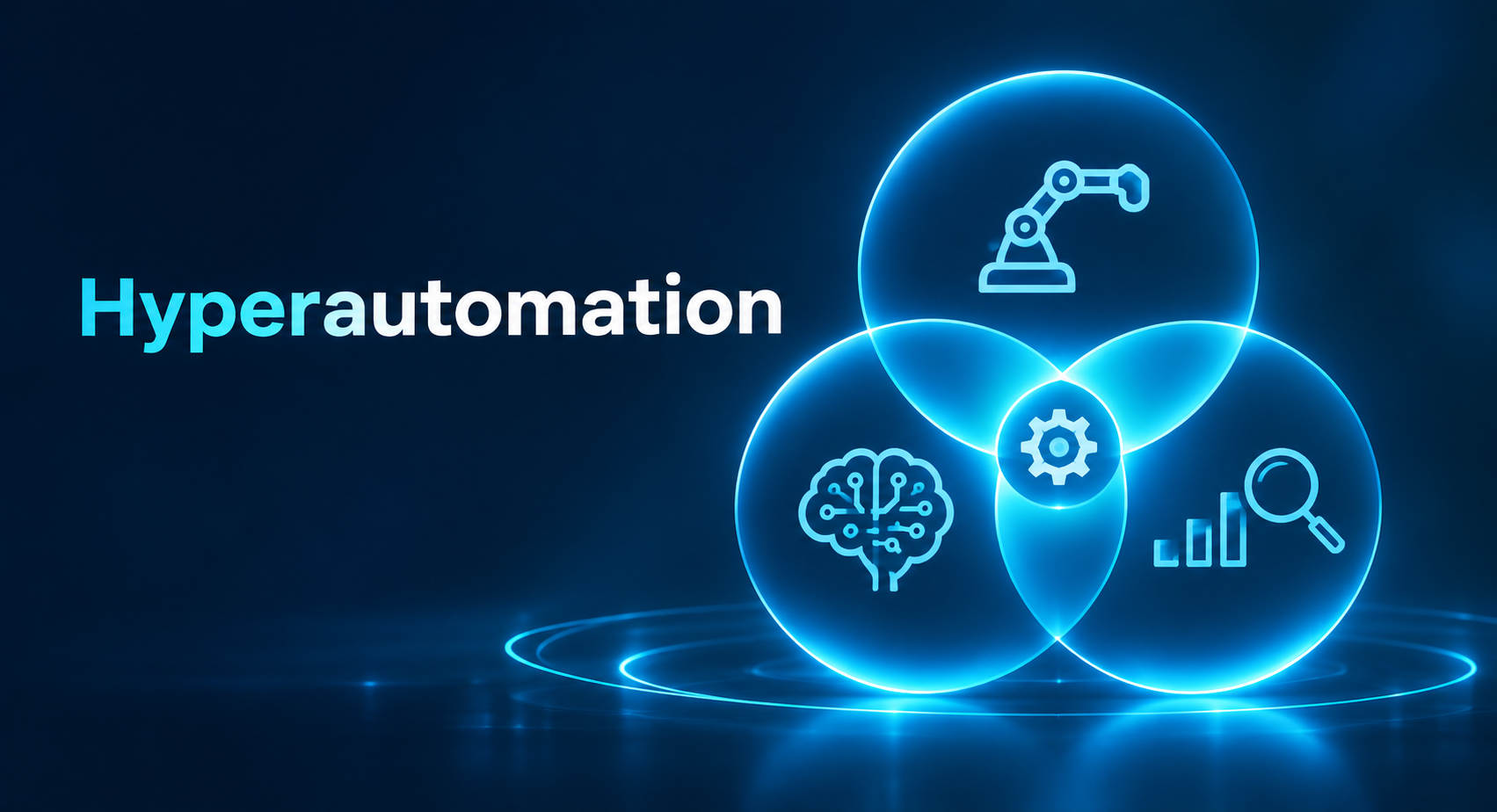
Hyperautomation: Combining RPA, AI and process mining into one stack, and knowing when it pays off
Hyperautomation brings RPA, AI, process mining, low-code, integration and orchestration together to automate business processes where automation creates value. This guide explains the five architectural layers that can support a hyperautomation approach, how to select capabilities based on process requirements and the circumstances in which a broader automation architecture is not worth the investment.
What is hyperautomation, and how does it differ from RPA and intelligent automation?
Hyperautomation is an enterprise approach to identifying, assessing and automating business processes through a coordinated combination of technologies. Rather than focusing on one repetitive task, it connects automation across applications, departments and process stages. RPA and intelligent automation contribute capabilities to this wider architecture; they are not competing approaches that hyperautomation must replace.
Three dimensions define the difference:
- Scope: Hyperautomation connects activities across complete processes rather than treating every task separately.
- Technology: It uses multiple methods of execution, decision-making and integration.
- Discipline: It involves repeatedly discovering, evaluating and improving opportunities for automation.
The objective is not to automate every activity an organization performs. Processes that change frequently, occur rarely or depend heavily on human judgment may offer little justification for a complex automation stack.
Where the term comes from: A Gartner definition that is still in use
Gartner helped establish hyperautomation as a business-driven discipline focused on identifying and automating as many suitable business and IT processes as possible.
Its significance lies in the emphasis on coordinated adoption. Hyperautomation is not defined by a particular software product or by the number of automation tools an organization purchases.
Gartner identified hyperautomation as one of its top strategic technology trends for 2020 in October 2019. At the time, Gartner described it as combining machine learning, packaged software and automation tools to deliver work, covering not only the technologies involved but also the automation lifecycle: discovery, analysis, design, implementation, measurement, monitoring and reassessment.
The terminology remains in use. On 15 October 2025, Gartner published research titled Optimize Automation Using the Hyperautomation Maturity Model, addressing how organizations can assess and advance their automation practices.
Umbrella versus parts: Why RPA and intelligent automation sit inside hyperautomation
Robotic process automation performs predefined operations, often by interacting with application interfaces. Intelligent automation extends automation into activities that require AI-based interpretation or the handling of variable inputs.
Hyperautomation addresses a different level of the problem: connecting those capabilities with business applications, process decisions and human involvement.
The distinction is primarily one of architectural reach and coordination. It does not imply that newer technologies make the underlying components obsolete.
Which technologies does hyperautomation combine?
Eight technology groups commonly appear in a hyperautomation environment: process mining, RPA, AI and machine learning, document AI, workflow management, integration, low-code development and decision engines. Organizations do not need to deploy all eight for every process. The appropriate combination depends on the information, systems and decisions involved in the work.
Eight technology groups and the job each one does
| Technology group | Job in the stack | What it cannot do alone |
| Process mining and task mining | Identify workflow bottlenecks and variation | Execute or redesign processes |
| RPA | Perform rule-based actions through interfaces | Reliably interpret ambiguous information |
| AI and machine learning | Classify, predict, extract and generate | Guarantee correct outputs without validation |
| Document AI, OCR and NLP | Convert documents into usable data | Coordinate the full business process |
| Workflow and process management | Coordinate steps, states and human tasks | Extract information or connect every legacy system |
| APIs, events and iPaaS | Connect applications and exchange data | Determine the right business process |
| Low-code tools | Accelerate application and automation development | Replace architecture and governance |
| Decision engines | Apply explicit business rules consistently | Resolve every ambiguous judgment |
Simplified editorial model. The technology groups are architectural categories, not a product checklist.
A process with clearly defined approval rules, for instance, may work with an API integration, a workflow engine and a decision engine. Introducing RPA or generative AI would not necessarily improve it.
Each additional component also creates dependencies involving licensing, maintenance and integration. Technology selection should therefore follow the needs of the process rather than a requirement to assemble every available capability.
Low-code and AI as accelerators, not foundations
Low-code platforms can make it easier to create forms, internal applications and workflow elements. They can reduce development effort, but they do not remove the responsibility to test software, manage access or establish ownership.
The role of business users in this environment is explored in citizen developers and enterprise software development.
AI becomes useful when deterministic rules struggle with variation, natural language or uncertainty. For example, NLP in business applications can interpret textual inputs before a workflow proceeds.
Both technologies accelerate selected activities. Neither resolves an unstable process or an unreliable connection between enterprise systems.
What does a hyperautomation architecture look like, layer by layer?
A practical hyperautomation stack can be organized into five layers: discovery, integration, execution, orchestration and control. Together, they answer five questions: what should be automated, how systems communicate, which components perform the work, how activities are coordinated and who ensures that the resulting process remains safe, observable and accountable.
Five layers and what breaks when one is missing
| Layer | Question it answers | Typical components | What breaks without it |
| Discovery | What should be automated? | Process inventory, process mining, interviews | Wrong processes are automated |
| Integration | Can systems exchange data reliably? | APIs, events, connectors, iPaaS | Fragile screen-level automation |
| Execution | What performs each task? | Bots, rules, document AI, ML and agents | Work remains manual or errors go unchecked |
| Orchestration | Who coordinates the steps? | Workflow engine, queues, retries, human tasks and agent-driven coordination | Disconnected point automations |
| Control | Who owns and monitors the system? | Access policies, audit logs, metrics, inventory | Tool sprawl and silent failures |
Simplified five-layer architectural model synthesized for this guide.
Discovery layer: Process mining informs what enters the stack
The first architectural concern is understanding the process itself.
Process mining can reveal how work moves through an organization, where delays accumulate and which process variations need investigation. This evidence helps teams distinguish useful automation candidates from activities that should first be redesigned.
Discovery also establishes a process inventory, a baseline and an order of priority. Without these foundations, organizations risk making an inefficient process run faster without improving its underlying design.
Integration layer: APIs first, iPaaS where many systems connect
Reliable access to applications and data is essential before automation can operate across system boundaries.
APIs expose structured interfaces that are generally easier to validate and maintain than interactions tied to changing screen layouts. When numerous applications must exchange information, integration platform as a service (iPaaS) can support connectivity and the management of integration flows.
RPA still has a place when a legacy application lacks a suitable API. However, automating its interface should not become the default integration strategy.
Further architectural guidance is available in Webellian’s articles on API-first development and enterprise API management.
Orchestration and the digital workforce: Coordinating bots, agents and people
Execution components carry out activities. Orchestration connects those activities into a functioning process.
It manages sequence, dependencies, retries and escalation when an automated step cannot proceed. A digital workforce may therefore consist of RPA bots, AI agents and employees operating within the same workflow. AI agents can also participate in orchestration by planning, routing or coordinating work.
Consider a process in which a bot retrieves a record and a document model extracts information. If the result is uncertain, orchestration can assign the case to a person before the next step takes place.
Permissions, audit records and monitoring remain necessary across the entire arrangement. Those responsibilities belong to the control layer rather than to any individual execution or orchestration tool.
Which hyperautomation capabilities should you introduce first?
Start by understanding the target process, establishing a baseline and ensuring dependable access to the systems it uses. Then introduce the execution, orchestration and AI capabilities that the selected process actually requires. AI may be part of the first implementation when the work involves document interpretation, variable inputs or other tasks that benefit from it. Ownership, security controls and monitoring should be established from the outset, while governance becomes more formal as the automation estate grows. Platform selection should follow an understanding of the first process and its integration requirements.
| Capability | When to introduce it | Key consideration |
| Discovery and process baseline | Before selecting technology | Understand process boundaries, value and ownership |
| Stable system integration | Once the first target process is chosen | Ensure dependable access to required applications and data |
| Execution for one process | When the baseline and system access are available | Select the simplest suitable execution technology |
| Shared orchestration | When workflows need coordinated steps, dependencies or reusable activities | Manage the process across tools and people |
| Formalized control and monitoring | As automation expands across teams | Build on security, ownership and basic monitoring established from the outset |
| AI and agents | Whenever the selected process requires interpretation, flexibility or dynamic decisions | Validate outputs and enforce permissions and escalation rules |
Simplified capability-expansion recommendation. This is not a required implementation sequence. Basic security, ownership and monitoring are necessary from the first automation, and AI may be part of the initial implementation.
Discovery and integration: Understand the process and establish dependable access
Start with a process whose boundaries and intended results can be described clearly. Assign responsibility to a business owner and establish how current performance will be measured.
Then examine the applications involved. Their interfaces determine whether the process can be automated reliably and what integration work is necessary.
Where an API already provides the required functionality, direct integration may eliminate the need to automate user-interface interactions.
These activities are intended to answer two questions before development begins: is the process worth automating, and can its systems support dependable automation?
Execution and orchestration: The simplest tool that fits, with coordination where needed
Once the baseline and system access are available, automate one defined process using the least complex suitable technology.
For predictable inputs, business rules may be sufficient. Other workflows may require document extraction, RPA or AI from the outset.
Shared orchestration becomes useful when automations depend on one another, require coordinated decisions or reuse common activities. It provides a way to manage the process as a whole instead of coordinating separate tools manually.
If an AI capability introduces uncertainty, a focused data science proof of concept can test whether that capability performs adequately before it is incorporated into the workflow.
Control from the outset, AI where variability demands it
Control is not something to introduce only after several automations have gone live. Each automation requires ownership, appropriate permissions and basic monitoring from the outset.
As adoption grows, organizations need more formal mechanisms: an automation inventory, common access policies, audit requirements and lifecycle procedures.
AI should be introduced wherever the process genuinely requires interpretation or flexibility beyond deterministic rules. Depending on the use case, AI may support execution, orchestration or both.
Its inputs, outputs and validation requirements must be defined. When an AI component produces an uncertain result, the workflow needs a clear route for review or escalation.
Platform or composable stack: Decide after understanding the process and integration needs
An integrated automation platform can simplify the management of connected capabilities, although it may increase reliance on a single technology ecosystem.
A composable architecture allows organizations to combine specialized tools. That flexibility comes with additional responsibility for integration, monitoring and maintenance.
Neither model is universally preferable.
The choice should reflect security needs, compatibility with existing applications, licensing, observability and the ongoing cost of connecting components. Understanding the target process and its system dependencies is more useful than starting with a vendor shortlist.
Which hyperautomation examples show the stack working end to end?
Hyperautomation is most visible in processes that cross application boundaries and combine different types of work. Order-to-cash, insurance claims and supply chain exception handling illustrate how discovery, integration, execution, orchestration and control can operate together. The following examples describe possible architectures, not verified customer deployments.
Order-to-cash: One process, five layers
Order-to-cash covers activities from receiving a customer order through fulfillment, invoicing and payment recording.
An organization could connect those activities through the five-layer model:
| Layer | Role in the scenario |
| Discovery | Identify delays between order entry, fulfillment and invoicing |
| Integration | Connect sales, inventory, finance and ERP systems |
| Execution | Validate orders, update records and generate documents |
| Orchestration | Coordinate dependencies and route exceptions |
| Control | Monitor processing, access rights and audit events |
A complete order might move through the workflow without manual intervention. An order missing customer information could instead be sent for review.
The performance question concerns the full journey from receipt to the correct business outcome. Improving the speed of one data-entry activity is useful only if it contributes to that broader result.
Insurance claims or prior authorization: Unstructured inputs and human review
Claims and healthcare authorization processes frequently involve forms, supporting documents and narrative descriptions.
Document AI can identify document types and extract relevant fields. Business rules can check whether required information is present, while a workflow engine sends incomplete or uncertain cases to an appropriate reviewer.
These processes can involve sensitive data and consequential outcomes. Their architecture therefore needs access restrictions, auditability and human oversight.
Automation can prepare and organize information without transferring every decision to software.
Supply chain exception handling: Events, rules and escalation
Supply chain processes receive information from orders, suppliers, shipments and warehouse systems.
When a shipment is delayed, an event may initiate a workflow that retrieves updated information, evaluates it against business rules and alerts the responsible team.
APIs can update connected applications, while orchestration records the status of the exception and whether it has been resolved.
AI may interpret a supplier’s unstructured message. Actions requiring explicit business authorization should still be governed by deterministic rules.
Across these scenarios, the common requirement is a coordinated process in which every exception has a defined path forward.
What can hyperautomation deliver, and how do you measure it?
The value of hyperautomation should be assessed at the level of the complete process. Potential improvements include shorter cycle times, fewer handoff errors, stronger auditability and reusable automation components. These benefits are not automatic. They need to be demonstrated against a baseline, using measures that capture the performance of the connected workflow rather than individual bots.
Possible operational improvements include:
- Shorter waiting periods: Dependent activities can proceed without unnecessary manual handoffs.
- More consistent outcomes: Rules and validation can reduce avoidable differences in execution.
- Greater process visibility: Monitoring can identify delays and unresolved exceptions.
- Component reuse: Existing integrations and workflow elements can support additional processes.
Whether these benefits materialize depends on data quality, process design and the reliability of the implementation.
Process-level results that task-level bots cannot show
Task-level efficiency does not always translate into process-level improvement.
A bot may enter information quickly, but the overall process can remain slow if the next activity waits in a manual queue for several days.
That is why hyperautomation performance should be evaluated from the defined beginning of a process to its completion.
Useful observations include elapsed time, unsuccessful handoffs and the number of cases that cannot proceed without human intervention.
Three coverage measures for the whole stack
Three measures provide a practical starting point:
- Process coverage: The share of eligible process activities or cases appropriately automated within the defined process scope, including processes that intentionally retain human steps.
- Exception rate: The share of cases requiring human intervention or review.
- End-to-end cycle time: The elapsed time between the agreed start and end points of a process.
These definitions are intended as a working measurement framework. Organizations need to specify which activities or cases are eligible for automation, which steps intentionally remain human-led, which situations qualify as exceptions and where each process begins and ends. A process can be considered covered even when its end-to-end execution includes deliberate human involvement.
Coverage alone can be misleading. A highly automated process may still perform poorly if exceptions occur frequently.
Similarly, shorter processing time is not an improvement if it introduces quality or compliance problems.
What are the main risks of hyperautomation, and when does it not make sense?
A wider automation architecture can amplify existing operational weaknesses. Hyperautomation is particularly difficult to justify when the underlying process is unstable, integration is unreliable or nobody is accountable for the resulting system. When a direct integration, simple workflow or individual bot adequately solves the problem, introducing a broader stack may create more complexity than value.
Seven failure points and who owns each one
Seven areas deserve particular attention:
- Poor data quality: Inconsistent or incorrect records undermine automated decisions. Owner: data and application teams.
- Process complexity: Automating unnecessary variations preserves inefficient work. Owner: business process owner.
- Tool sprawl: Teams introduce overlapping automation products without shared standards. Owner: enterprise architecture.
- Governance gaps: Automation inventories, access policies and retirement procedures have no clear owner. Owner: automation governance lead.
- Change management: Employees are not prepared to manage exceptions or take responsibility for revised workflows. Owner: business leadership.
- Security and compliance: Bots and agents receive excessive access, or sensitive information moves across insufficiently controlled boundaries. Owner: security and compliance teams.
- Legacy limitations: Unstable interfaces and undocumented system dependencies make maintenance difficult. Owner: application and integration teams.
These ownership assignments are editorial recommendations rather than a universal organizational structure.
Related challenges are discussed in Webellian’s guide to common digital transformation mistakes.
Decision test: Five signals that hyperautomation is the wrong frame
| Signal | Better option | Why |
| One stable task with an available API | Direct integration or simple workflow | A wider stack adds unnecessary complexity |
| Unstable or poorly understood process | Redesign before automating | Automation can reproduce existing defects |
| Low volume and little reuse | Keep manual or automate one step | Coordination costs may outweigh benefits |
| No owner or governance capacity | Start with one owned automation | Scaling creates unmanaged dependencies |
| High error cost and judgment-heavy decisions | Automate preparation, retain human decisions | Unchecked automation can conceal consequential errors |
Simplified editorial decision framework.
Two conditions are especially important before investing in a coordinated stack.
First, the process needs a stable definition and someone accountable for its operation. Without those foundations, technology can make an unclear process harder to understand and maintain.
Second, the supporting systems must be sufficiently accessible. If several legacy applications require major modernization before integration is possible, that work may deserve priority over additional automation.
Improving interfaces, process ownership or data quality can be more valuable than adding another execution tool.
The guiding principle is to use the smallest coordinated architecture that addresses the actual business requirement.
Is hyperautomation being replaced by agentic automation?
Agentic automation does not remove the need for hyperautomation. It introduces more flexible execution and orchestration capabilities within an architecture that still requires discovery, integration and control. Search terminology is changing more quickly than the underlying architectural responsibilities: search interest in hyperautomation has remained relatively stable, while searches related to agentic workflows have grown substantially.
What search data shows: A term on a plateau, not in decline
The content brief includes historical Ahrefs US search-volume estimates compiled on October 20, 2026.
| Search term | Average monthly volume, 2024 | Average monthly volume, last 12 months | Change |
| Hyperautomation | 1,470 | 1,361 | -7% |
| Agentic workflows | 962 | 4,860 | +405% |
| Agentic automation | 295 | 1,233 | +318% |
Source: Ahrefs US historical keyword-volume data, October 20, 2026, as supplied in the content brief. Search estimates are not adoption statistics.
Hyperautomation’s search volume remained close to its earlier level, while agentic terminology attracted considerably more attention.
These figures describe search behavior. They do not demonstrate that enterprises have stopped using hyperautomation architectures or that agentic systems have replaced existing automation approaches.
The concepts address different questions. Hyperautomation concerns the coordination of technologies across processes. Agentic automation concerns the ability of AI agents to select actions within defined constraints.
Where agents sit in the stack: Execution and orchestration, with independent controls
Within the five-layer model, AI agents can participate in both execution and orchestration. They may perform tasks, call authorized tools, plan subsequent steps, route work and coordinate multi-step activities.
However, agent-driven decisions must remain subject to independently enforced permissions, security policies and runtime controls. The control layer should determine which actions are authorized, enforce execution limits and provide monitoring, regardless of whether an agent is executing a task or coordinating a workflow.
An agent investigating a missing document, for example, might identify the next permitted action or recommend escalation. Its output should be validated, and consequential actions should remain subject to appropriate approval.
For additional context, see AI agents in business and large language models in enterprise applications.
How to use the terms: Hyperautomation as an approach, agentic automation as a capability
The two terms can be used without creating a false choice between them.
Hyperautomation describes a coordinated approach to identifying, assessing, implementing and scaling automation across business processes. In practice, this approach requires an architecture spanning discovery, integration, execution, orchestration and governance.
Agentic automation introduces AI-driven capabilities for dynamically selecting actions, planning next steps and coordinating work within defined constraints.
An organization can adopt agentic capabilities while retaining the wider architecture required to coordinate, secure and monitor its processes.
FAQ
What are the four types of automation?
There is no single universally accepted classification of four automation types. Common approaches include rule-based automation, robotic process automation (RPA), intelligent automation and agentic automation, but these categories describe different technologies and capabilities rather than a fixed progression. Hyperautomation is not a fourth or final type. It is a coordinated approach that can combine these capabilities to automate and improve business processes.
What is the difference between hyperautomation and AI?
AI refers to technologies that learn from data, make predictions or generate outputs. Hyperautomation is an approach to coordinating business processes through technologies that may include AI, RPA, process mining, integration and orchestration. AI can contribute to a hyperautomation system, but many activities within that system may still rely on deterministic rules and bots.
Does hyperautomation replace jobs?
Hyperautomation can alter the work employees perform, moving some responsibilities away from repetitive handling and toward review, exceptions and process ownership. It may also reduce demand for particular tasks. Employment effects should therefore not be assumed to be uniformly positive. Organizations need to evaluate role changes, provide training and clarify accountability before implementation.
Does hyperautomation need a center of excellence?
A formal center of excellence is not essential at the beginning. Each automation should nevertheless have a business owner and appear in an automation inventory from its first day. As more teams develop automations, a center of excellence can help coordinate standards, reusable components, approvals, monitoring and the retirement of outdated solutions.
Sources
https://www.ibm.com/think/topics/hyperautomation
https://www.sap.com/resources/what-is-hyperautomation
https://www.oracle.com/cloud/hyperautomation
https://www.automationanywhere.com/rpa/hyperautomation
https://www.ibm.com/think/insights/hyperautomation-benefits-and-challenges