
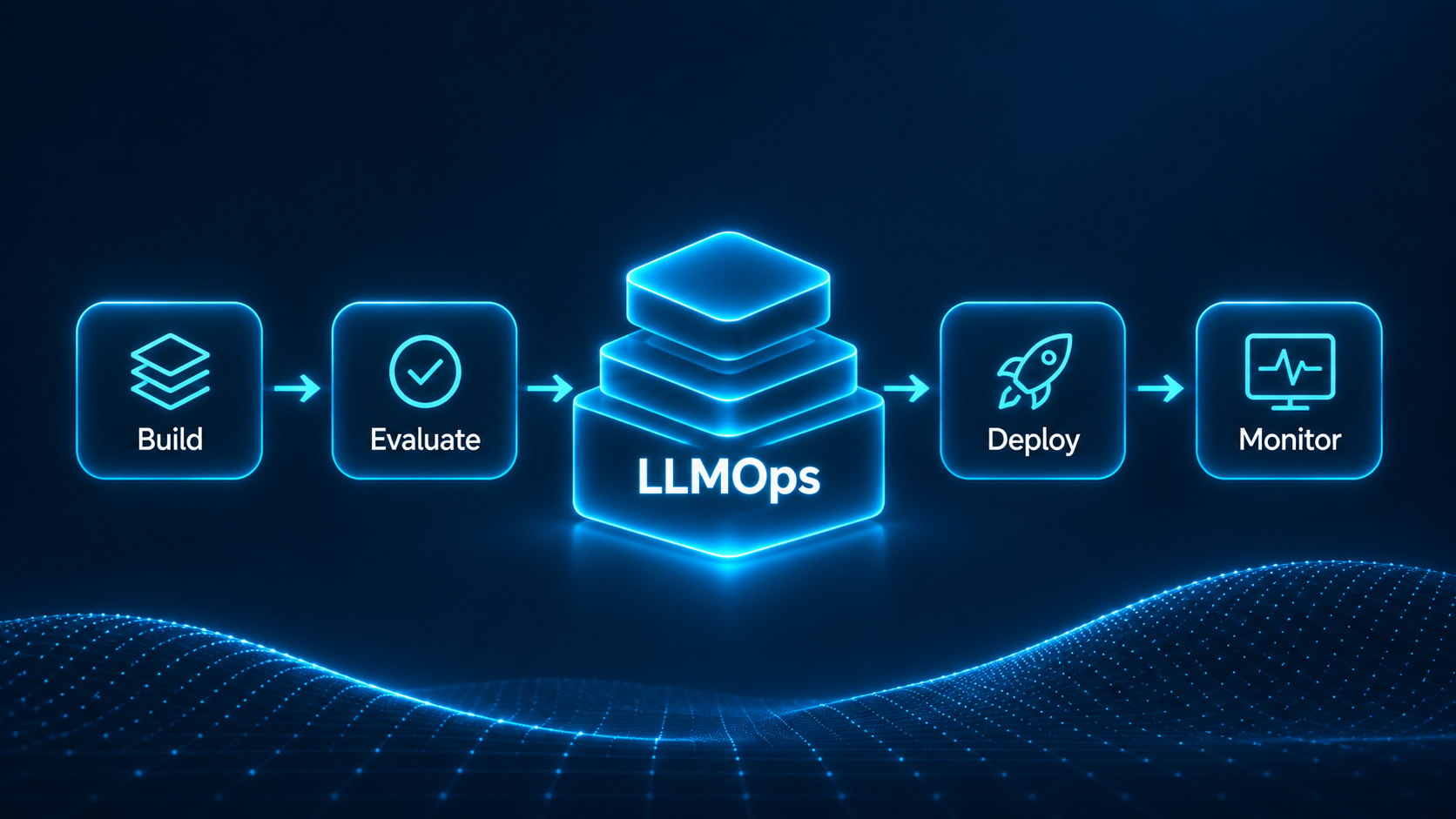
LLMOps: operating large language models in production and controlling what changes their behavior
LLMOps is the set of practices for deploying, evaluating, monitoring and changing large language model applications in production. This guide explains which application components can change behavior, how to test those changes and how to size LLMOps across three stages.
What is LLMOps, and why do large language model applications need it?
LLMOps, short for large language model operations, is the discipline of managing LLM applications throughout their production lifecycle. It combines deployment, evaluation, monitoring and controlled updates so that applications remain reliable as models, prompts, data and user requirements change.
Unlike conventional software, an LLM application can produce different results even when its application code remains unchanged.
LLMOps applies to customer support assistants, enterprise knowledge systems, document processing applications and AI agents connected to business tools.
What LLMOps covers
Four operational responsibilities define LLMOps:
- Deployment: Releasing models and application configurations safely.
- Evaluation: Testing output quality before and after changes.
- Monitoring: Tracking reliability, quality, latency and cost.
- Change control: Versioning prompts, models and supporting data, with a way to reverse problematic updates.
These practices make an LLM application more predictable without assuming that every response will be identical.
Why LLM behavior changes without a code release
Three common sources of unexpected behavior are changing user requests, updates to retrieved information and changes to the underlying model.
For example, a knowledge assistant may begin returning outdated answers because its document index has not been refreshed. Alternatively, a provider’s model update may alter response formatting.
LLMOps makes these changes visible and testable rather than treating them as isolated incidents.
How is LLMOps different from MLOps?
LLMOps extends MLOps rather than replacing it. Traditional MLOps focuses on the lifecycle of machine learning models, including training, deployment and monitoring. LLMOps adds operational control over prompts, retrieved context, model-provider changes and the cost of generating responses.
The differences that matter in production
| Dimension | MLOps | LLMOps | Operational implication |
| Main asset | Trained ML model | Model and surrounding application | Evaluate the complete application |
| Versioning | Code, datasets and models | Also prompts, retrieval indexes and rules | More changes require testing |
| Evaluation | Task metrics such as accuracy | Quality, relevance, groundedness and safety | Multiple evaluation methods |
| Updates | Retraining and model releases | Prompt, retrieval and model changes | More frequent configuration releases |
| Monitoring | Prediction quality and data drift | Responses, traces, feedback and cost | Request-level visibility |
| Costs | Training and inference resources | Tokens, context length and inference | Measure cost per successful task |
| Rollback | Restore a model version | Restore prompts, model routing or retrieval state | Multiple rollback mechanisms |
Both disciplines still require version control, reproducibility, testing and monitoring. Organizations using predictive models alongside generative AI applications generally need both.
LLMOps also differs from AgentOps, which adds operational concerns around autonomous workflows, tools and actions. These become particularly relevant for AI agents in business.
What does an LLMOps pipeline consist of?
A practical LLMOps pipeline connects model selection, prompt management, retrieval, evaluation, deployment and monitoring. Each component should produce identifiable artifacts so that teams know exactly which configuration generated an output and can reproduce or reverse a change.
Six core components
| Component | Responsibility | Artifact to track |
| Model selection | Choose and access the foundation model | Model identifier and version |
| Prompt management | Maintain instructions and templates | Prompt version |
| Retrieval layer | Supply external context when using RAG | Corpus and index version |
| Evaluation | Test application behavior | Test dataset and results |
| Deployment | Route requests and manage releases | Deployment configuration |
| Monitoring | Observe quality, latency and usage | Traces, feedback and alerts |
Not every application needs all six components immediately. A simple API-based feature may begin with a model, versioned prompt, evaluation dataset and basic logging.
Prompting, RAG and fine-tuning create different responsibilities
Prompt-based applications require prompt versioning and regression tests.
Retrieval-augmented generation adds document updates, retrieval configuration and access permissions. See how RAG works for the underlying architecture.
Fine-tuning introduces training data, model weights and additional evaluation requirements.
The important operational question is not only how an application is built, but also which components can change its behavior after release.
What changes the behavior of an LLM application, and how do you control each change?
Several components can change an LLM application’s behavior: prompts, retrieval data and configuration, foundation models, fine-tuned weights, inference parameters, output schemas, guardrail rules and, in agentic applications, tool definitions and orchestration logic. Each relevant change should be traceable, evaluated before release and supported by an appropriate rollback or recovery procedure.
Eight changeable components, with tests and rollback
| Component | Typical change | Test before release | Rollback |
| Prompt | Instructions or examples edited | Compare outputs on a fixed test set | Restore previous prompt |
| Retrieval data and configuration | Documents, chunking, embeddings, indexing, similarity thresholds, ranking or retrieval strategy updated | Test retrieval quality, groundedness and access permissions | Restore previous corpus, index or retrieval configuration |
| Foundation model | Provider or model version changed | Run full application evaluation | Return to previous model or validated alternative |
| Fine-tuned weights | Model adaptation updated | Compare target and general performance | Restore previous weights |
| Inference parameters | Temperature, token limits or other generation settings changed | Compare quality, consistency, latency and cost | Restore previous settings |
| Output schemas | Required fields, response structure or validation rules changed | Run schema validation and downstream integration tests | Restore previous schema or compatible version |
| Guardrails | Safety or policy rules modified | Test allowed and blocked cases | Restore previous rules |
| Tools and orchestration | Tool definitions, routing or workflow logic changed | Test authorization, tool behavior and workflow outcomes | Restore previous tool configuration or workflow version |
Prompt versioning and release control
Prompts should be treated as production configuration, not text that anyone can edit without review.
A reliable workflow records the reason for each change, assigns a version, tests it against the current production version and releases it through a controlled configuration update.
Each production request should be traceable to the prompt version that generated it.
Model-provider updates
When using an external LLM API, teams should record the exact model identifier and use pinned versions where the provider supports them.
If a model is updated or retired, the replacement should pass the application’s evaluation tests before traffic moves to it.
A rollback plan must also account for situations where the old provider model is no longer available.
How do you evaluate an LLM application before and after release?
LLM evaluation should test the complete application against representative tasks, not only the foundation model in isolation. A reusable evaluation dataset, automated checks and human review help detect regressions before deployment. Production feedback then reveals failures that were absent from the original test cases.
Six evaluation layers
| Layer | What it checks |
| Functional correctness | Does the application complete the requested task? |
| Output structure | Does it follow the required format? |
| Relevance | Does the response address the user’s request? |
| Groundedness | Are claims supported by the supplied context? |
| Safety and policy | Does the response comply with application rules? |
| Human review | Is the result genuinely useful and appropriate? |
Different layers require different methods.
Format validation can often be automated. Groundedness may require comparison with source material. More subjective qualities may need human reviewers or an LLM acting as an evaluator.
Building a golden dataset
A golden dataset is a maintained collection of representative requests and expected outcomes.
It should contain normal tasks, difficult cases, known failures and important edge cases.
Every meaningful application change should be tested against this dataset. When a production incident reveals a new failure, the relevant example should be added to prevent recurrence.
Using an LLM as a judge
An LLM judge can evaluate large numbers of responses against defined criteria, but its judgments are not automatically reliable.
Teams should calibrate automated scoring against human-reviewed examples, particularly for ambiguous or high-impact decisions.
A release should be blocked when critical tests fail. For other metrics, acceptance thresholds should be established in advance rather than chosen after results are available.
How do you deploy an LLM application to production?
Production deployment involves more than exposing a model through an API. Teams must decide where inference runs, how requests are routed, how releases are evaluated and how the application behaves when a model or provider becomes unavailable.
Three inference deployment options
| Option | Main advantage | Main operational responsibility |
| External model API or SaaS | Minimal model-serving infrastructure to manage | Provider dependencies, API limits, data handling and application integration |
| Managed model serving in the organization’s cloud environment | Cloud integration and greater control over deployment configuration | Model configuration, access controls, monitoring and cloud costs |
| Self-managed or self-hosted inference | Greater control over infrastructure and model serving | Capacity planning, scaling, security, performance and maintenance |
The right choice depends on security requirements, expected demand, model capabilities and the team’s operational capacity.
For broader decisions about model selection and deployment, see LLMs in business.
A safe release process should move from staging evaluation to a limited production rollout. During that rollout, teams compare quality, errors, latency and cost with the previous configuration.
Traffic should expand only when acceptance criteria are met. The rollback path should be tested before the release.
How do you monitor an LLM application in production?
LLM monitoring must cover both technical reliability and response quality. An application can have excellent uptime while providing irrelevant or unsupported answers. Effective monitoring therefore combines infrastructure metrics, application traces, evaluation results, user feedback, security and safety signals, and cost information.
Six monitoring layers
| Layer | Signals to monitor |
| Availability | Errors, timeouts and failed requests |
| Performance | Latency and response times |
| Output quality | Relevance, groundedness and task success |
| Retrieval | Missing, outdated or unsuitable context |
| Cost and usage | Tokens, requests and cost per task |
| Security and safety | Prompt-injection attempts, policy violations, potential sensitive-data exposure and unauthorized tool or data access |
Some quality measures require a reference answer. Others can be estimated from user feedback, automated evaluation or periodic human review.
What LLM observability adds
Monitoring identifies a problem. Observability helps explain where it occurred.
A request trace should connect the user’s input to the prompt version, retrieved documents, model version, generated response and associated cost.
This makes it possible to distinguish a retrieval problem from a model issue or a prompt regression.
Production feedback should feed back into the evaluation dataset, creating a continuous improvement cycle.
How do you control LLM token costs without reducing quality?
LLM cost optimization should focus on the cost of completing a useful task, not simply the number of tokens processed. Reducing context length or switching to a cheaper model can lower inference expenses while increasing failures and retries. Cost decisions should therefore be evaluated alongside quality and completion rates.
Cost per completed task
A practical metric is:
Costpercompletedtask=TotalattributableoperatingcostNumberofsuccessfullycompletedtasks
The numerator may include inference, retrieval, supporting infrastructure and other directly attributable costs.
This metric helps teams compare configurations without rewarding solutions that are cheap but ineffective.
Six cost optimization techniques
- Reduce unnecessary context: Send only information relevant to the task.
- Control output length: Avoid unnecessarily long responses.
- Use appropriate models: Route simpler tasks to less expensive models when quality remains acceptable.
- Cache reusable results: Reuse responses or retrieved context where freshness and permissions allow.
- Limit retries: Investigate failures instead of repeating requests indefinitely.
- Monitor cost by feature: Identify which workflows generate cost without corresponding value.
Semantic caching can help when requests have similar meaning, but cached answers must respect data freshness, authorization and context differences.
Every optimization should be evaluated for its effect on task completion.
Where do guardrails belong in an LLMOps setup?
Guardrails are controls that constrain what an LLM application accepts, retrieves, generates or returns. In LLMOps, they should be managed as versioned configuration and tested like other behavior-changing components.
Five intervention points
| Point | Example control |
| Input | Validate requests and application rules |
| Retrieval | Enforce document access permissions |
| Generation | Apply model-level constraints and generation rules |
| Tools and actions | Enforce least-privilege permissions, authorize each action against the specific resource and limit what the application can execute |
| Output | Check response format and policy compliance |
Changing a guardrail can create two types of regression: blocking legitimate requests or allowing responses that should have been rejected.
Both outcomes need dedicated test cases.
Guardrails complement, rather than replace, access controls and other security measures. Their effectiveness should be monitored after deployment.
How much LLMOps does your team need at each stage?
The amount of LLMOps should grow with application complexity, production exposure and risk. A small team using one external API does not necessarily need a dedicated platform. It does need reproducible configurations, basic evaluation and enough monitoring to detect failures.
Three stages of LLMOps maturity
| Stage | When it fits | Build now | What can wait |
| 1. Testable | Pilot or limited production use | Versioned prompts, known model, golden dataset, basic logging, authentication and authorization, sensitive-data protection, and defined rules for what data may be sent to the model or provider | Dedicated gateway and advanced automation |
| 2. Automated | Regular releases or growing traffic | Automated evaluations, request tracing, alerts, cost tracking, controlled rollout | Organization-wide platform standardization |
| 3. Standardized | Multiple teams, applications or providers | Shared policies, reusable deployment workflows, audit history, central ownership | Further complexity without a demonstrated need |
A move from stage one to stage two becomes appropriate when manual testing is too slow or production failures are difficult to diagnose.
Stage three becomes useful when several teams need consistent operational controls.
Is LLMOps necessary when using only a third-party API?
Yes, although the required scope may be small.
An external provider operates the foundation model. Your team still owns the prompts, application behavior, user experience, retrieval data, access controls and operational cost.
Using a managed API reduces infrastructure responsibilities. It does not remove the need for evaluation or monitoring.
Who owns each part?
| Area | Typical owner |
| Prompts and application behavior | AI or application engineering |
| Evaluation criteria | Product owner and AI engineering |
| Retrieval data | Data owner and data engineering |
| Deployment and reliability | Platform or application operations |
| Security controls | Security and application owners |
| Cost monitoring | Engineering owner with finance support |
Every critical alert should have one named person or team responsible for responding.
The exact job titles matter less than clear accountability.
Why do LLM applications still fail when LLMOps tooling is in place?
LLMOps tools cannot compensate for unreliable source data, unclear ownership or missing operational processes. A tracing platform may reveal that an assistant retrieved the wrong document, but it cannot independently resolve inconsistent business definitions or approve access to confidential information.
Six symptoms that point to the foundation
| Production symptom | Likely underlying gap |
| Answers contradict internal reports | Inconsistent business definitions |
| Assistant cites outdated documents | Weak data freshness controls |
| Retrieval exposes restricted content | Missing authorization enforcement |
| Teams cannot reproduce an answer | Missing versions or lineage |
| Model behavior changes unexpectedly | Uncontrolled configuration or provider updates |
| Incidents remain unresolved | Unclear ownership and response procedures |
These problems connect LLMOps to the broader data and engineering capabilities required for production AI.
An AI-grade foundation provides the reliable data, access controls, reproducibility and operational ownership that make LLMOps effective.
The goal is not to introduce more tools. It is to ensure every significant change can be identified, tested, monitored and, when necessary, reversed.
FAQ
Is MLOps still relevant in 2026, now that LLMOps exists?
Yes. MLOps remains relevant for traditional machine learning models, including forecasting, classification and predictive analytics. LLMOps adds specialized practices for applications built on large language models. Organizations using both types of systems need the corresponding operational capabilities.
What does drift mean for an LLM application?
Drift refers to gradual or external changes in an LLM application’s operating environment, input or user-request distribution, source data, or observed output quality over time. It can reduce reliability even when the application configuration remains unchanged. Planned updates to prompts, models or retrieval settings are controlled changes, not drift, and should be evaluated through the release process.
What is the difference between LLMOps and DevOps?
DevOps manages software delivery and operations. LLMOps applies similar principles while adding evaluation and version control for AI-specific components such as prompts, models and retrieved context. Both disciplines are needed to operate production LLM applications reliably.
What is an LLM gateway, and do you need one?
An LLM gateway provides a common interface for routing requests to models or providers. It can support authentication, usage limits, logging, fallback routing and cost tracking. A simple application may not need a dedicated gateway initially, but it becomes useful when managing multiple models, providers or teams.
Sources
https://cloud.google.com/discover/what-is-llmops
https://www.ibm.com/think/topics/llmops
https://www.redhat.com/en/topics/ai/llmops
https://www.zenml.io/blog/mlops-vs-llmops
https://www.truefoundry.com/blog/llmops-vs-mlops
https://www.braintrust.dev/articles/llm-monitoring-vs-observability
https://www.confident-ai.com/blog/a-gentle-introduction-to-llm-evaluation