
Top 7 AI outsourcing mistakes companies make and how to avoid them
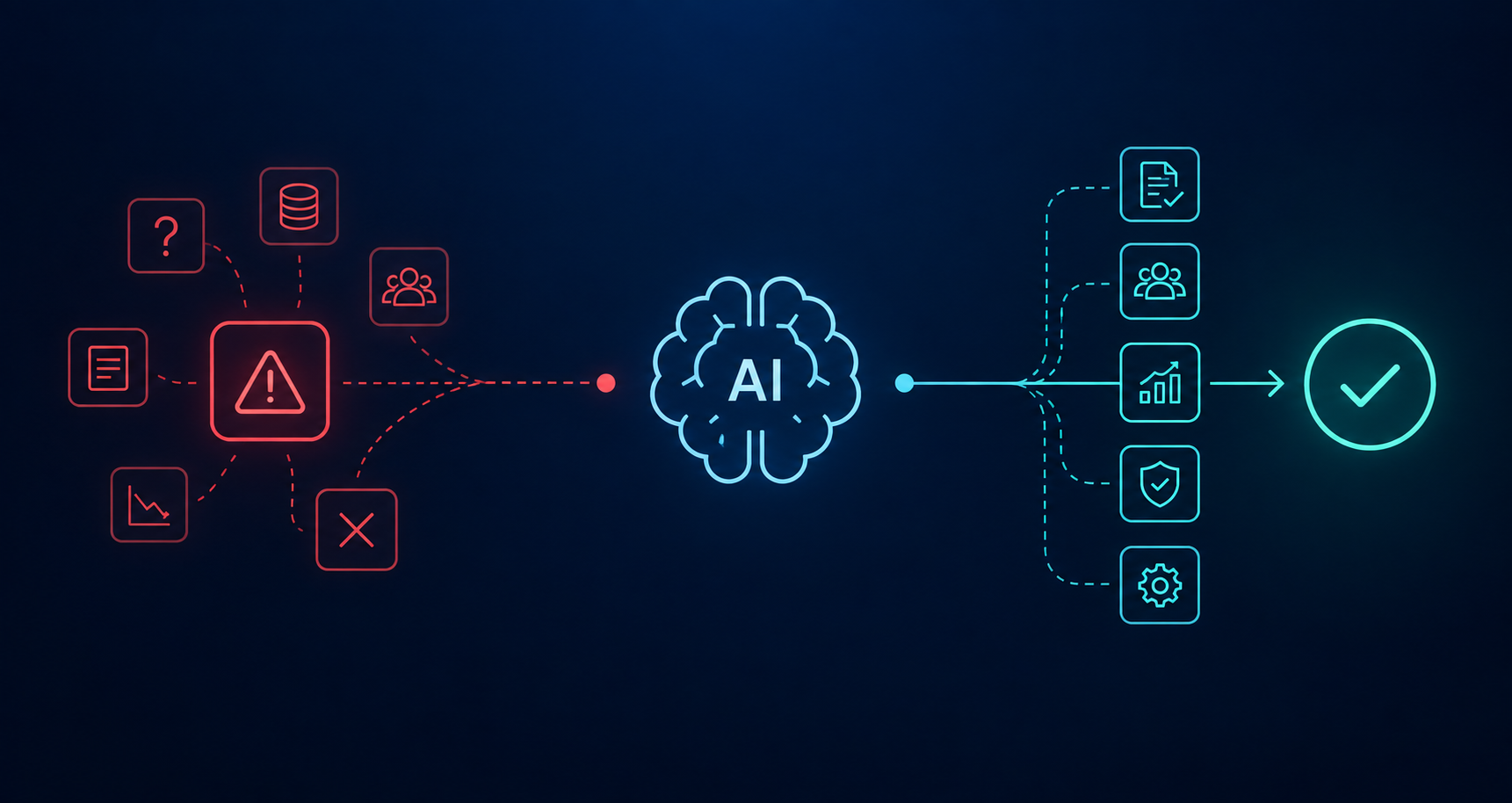
AI outsourcing fails for the same reasons across many enterprise engagements: vague scope, weak vendor vetting, and no plan past the first proof of concept. These seven mistakes can turn promising AI initiatives into wasted budget, stalled deployments, and long-term vendor dependency. Here is what to check before signing a contract, running a pilot, or moving an AI system into production.
Mistake 1: Are you treating AI outsourcing like a traditional software project?
AI outsourcing adds model, data, evaluation, and production-behaviour uncertainty on top of normal software engineering requirements, so projects often need more experimentation, monitoring, and iteration than conventional application delivery.
Traditional software projects already involve uncertainty around requirements, architecture, integrations, performance, and delivery. AI projects add another layer because system quality also depends on the data, model behaviour, evaluation methodology, and production conditions.
For machine learning and generative AI systems, the same code can perform differently as inputs, data distributions, model versions, or usage patterns change. That makes validation less about confirming only whether predefined functionality works and more about establishing whether the system performs acceptably across relevant scenarios and continues to do so in production.
That difference changes how an AI outsourcing engagement should be scoped, managed, and priced.
The most important distinctions include:
- AI development is experimental. A team can define the business objective in advance, but it cannot always guarantee that a particular model will reach the desired performance before testing it on real data.
- Model performance can degrade over time. Changes in user behavior, business processes, or source data can create data drift, requiring monitoring and model retraining.
- The data can be as important as the code. A technically strong algorithm will not compensate for incomplete, inconsistent, inaccessible, or poorly governed data.
- Delivery does not end at deployment. Production AI requires monitoring, versioning, infrastructure, feedback loops, and processes for responding when model quality changes.
This is why simply applying a standard software outsourcing contract, milestone structure, or acceptance process to an AI project can create problems later.
The distinction becomes particularly important in generative AI. Large language models can produce variable outputs and require evaluation methods that complement traditional software testing with checks for quality, reliability, safety, and task-specific performance.
That does not mean agile delivery stops being useful. Iterative development, short feedback loops, shared ownership, and frequent reviews remain highly relevant. But the way success is measured needs to reflect uncertainty and experimentation. Teams familiar with how agile outsourcing engagements are typically structured should add AI-specific checkpoints for data quality, experiments, model performance, production readiness, and retraining.
Before you outsource AI development, make sure everyone involved understands that the engagement is not simply another software project with a machine learning component added to it. The delivery model needs to account for uncertainty from the beginning.
Mistake 2: Have you skipped a data readiness and scope assessment before hiring a vendor?
Many AI outsourcing problems start before development begins, when companies hire a vendor without confirming data readiness, defining the use case precisely, or agreeing on measurable success criteria.
A request such as “build us an AI chatbot” or “use AI to improve operations” is not a project scope. It is an ambition.
Before an external AI team can make reliable technical decisions, it needs to understand what business problem is being solved, what data is available, how that data can be accessed, and how success will be measured.
A practical pre-engagement assessment should answer at least four questions:
- Is the required data available? Identify the systems, databases, files, APIs, and third-party sources the model would need.
- Is the data usable? Check completeness, consistency, historical depth, labeling quality, access permissions, and whether the data represents the real production environment.
- Is the use case specific enough? Replace broad objectives with a defined workflow, user group, decision, prediction, or automation opportunity.
- Are the success metrics explicit? Technical metrics such as precision or latency should connect to business outcomes such as time saved, reduced manual workload, higher conversion, lower error rates, or improved forecast quality.
This data readiness work should happen before a large delivery commitment is made. Otherwise, the vendor may discover several weeks into the project that critical datasets are missing, inaccessible, inconsistent, or unsuitable for the intended model.
Clear terminology also matters. Enterprise teams sometimes use AI, machine learning, deep learning, and generative AI interchangeably even though they imply very different technical approaches. Understanding the difference between AI, machine learning, and deep learning helps prevent a vague business request from turning into an unnecessarily complex solution.
A good project scope should define the problem, available inputs, users, expected outputs, constraints, integrations, security requirements, and measurable acceptance criteria. The goal is not to specify the final model architecture before discovery. It is to create enough clarity for both sides to evaluate feasibility.
For companies that are not yet ready to define those elements internally, a discovery phase can reduce risk before a larger AI outsourcing engagement begins. Webellian’s free, structured AI discovery engagement is designed around that type of early validation.
The key principle is simple: do not use an expensive development engagement to discover whether you had a viable AI use case in the first place.
Mistake 3: Are you choosing an AI outsourcing vendor on cost alone instead of vetting expertise?
AI outsourcing vendors should be evaluated on technical depth, domain expertise, delivery maturity, and production experience—not simply on the lowest hourly rate or project quote.
Cost matters, but AI vendor selection is one of the worst places to optimize on price alone.
Two vendors can both claim expertise in artificial intelligence outsourcing while having very different capabilities. One may have strong data engineering, MLOps, cloud, governance, and production deployment experience. Another may primarily build prototypes around third-party APIs.
The difference becomes visible only when you perform proper vendor due diligence.
Before selecting an AI outsourcing partner, evaluate:
- Production experience. Ask what models the team has actually deployed and maintained, not only what proofs of concept appear in presentations or case studies.
- Data engineering capability. AI projects often require substantial work on pipelines, integrations, preprocessing, data quality, and infrastructure before model development becomes the main task.
- Relevant domain expertise. A technically capable team still needs to understand the operational and regulatory context in which the model will be used.
- MLOps maturity. Ask how the vendor handles deployment, monitoring, model versioning, retraining, rollback, and incident response.
- Cloud and infrastructure skills. Enterprise AI frequently depends on platforms such as AWS, Azure, or Google Cloud as much as it depends on model development itself.
- Communication and delivery processes. Strong engineering is less valuable if the team operates as a black box.
There are also useful red flags.
For example, a vendor promising a specific model accuracy before inspecting your data should trigger additional technical due diligence. Model performance depends on the problem, dataset, target definition, evaluation methodology, and production conditions. A credible partner should explain what can be validated during discovery rather than guaranteeing an arbitrary metric in advance.
Geography should be treated as another evaluation variable rather than a proxy for quality. Offshore AI development can offer cost advantages and access to talent, while a nearshore AI development model can reduce time-zone differences and make day-to-day collaboration easier. The right choice depends on your internal team, governance requirements, communication needs, and project complexity. A broader framework for choosing a sourcing location can help separate genuine delivery trade-offs from assumptions about location.
When comparing AI outsourcing companies, evaluate the complete system the partner needs to build and operate—not just the hourly cost of the people training the model.
Mistake 4: Does your outsourcing contract actually cover AI-specific risk?
Standard outsourcing agreements often fail to address AI-specific questions such as trained model ownership, use of training data, data residency, regulatory responsibilities, and liability for model outputs.
AI outsourcing introduces contractual issues that may not exist—or may be less important—in traditional software delivery.
A normal software agreement might clearly state who owns the source code and when a feature is considered delivered. With AI, ownership and acceptance can become more complicated. A trained model may depend on client data, third-party datasets, open-source components, commercial model providers, vendor-created preprocessing logic, and continuously changing model versions.
That makes several contractual areas especially important.
Your agreement should define:
- IP ownership. Specify who owns the source code, trained models, fine-tuned model weights where applicable, prompts, configurations, feature-engineering logic, pipelines, and other project outputs.
- Training data and derivatives. Clarify whether the vendor can reuse your data, derived datasets, embeddings, synthetic data, or learned artifacts for other purposes.
- Data residency and GDPR requirements. Document where sensitive information may be stored, processed, backed up, or transferred.
- Regulatory roles and responsibilities. For systems used in the EU, clarify whether the client, vendor, or another party may act as a provider, deployer, importer, or other operator under the EU AI Act, and document which party is responsible for applicable compliance activities. Where personal data is involved, also define the parties’ controller, processor, or joint-controller roles under the GDPR.
- Access and deletion rules. State what happens to copies of your data when the engagement ends.
- Security responsibilities. Define access controls, secrets management, logging, infrastructure responsibilities, and incident handling.
- Acceptance criteria. Avoid treating probabilistic model performance like deterministic software functionality. Define evaluation datasets, performance ranges, thresholds, and conditions for testing.
- Liability clauses. Establish how responsibility is allocated if an AI system produces an incorrect prediction, recommendation, or output that affects business operations.
For European engagements, those responsibilities should reflect the actual role each party performs rather than simply assigning a label in the contract. The EU AI Act is already applying in stages: obligations for providers of general-purpose AI models have applied since August 2025, while transparency requirements for certain AI systems became applicable on August 2, 2026. Other obligations follow different implementation timelines depending on the type and risk classification of the system. GDPR responsibilities continue to apply separately whenever personal data is processed.
These issues are becoming important enough that enterprise organizations have been reassessing outsourcing contracts originally designed for traditional IT services.
The same applies to the SLA. Availability can be measured relatively easily, but AI quality can change even when a service remains technically online. An effective agreement may therefore need to distinguish infrastructure uptime from model-performance thresholds and define what happens when drift or other changes reduce output quality.
An AI outsourcing contract should also anticipate the end of the relationship. Ownership, access, handover, and deletion terms are much easier to negotiate before the vendor has become operationally critical.
Procurement and legal teams do not need to become machine learning engineers. They do, however, need technical stakeholders involved early enough to identify where a standard outsourcing template leaves important AI-specific questions unanswered.
Mistake 5: Are you neglecting structured communication with your outsourced AI team?
AI outsourcing works best when an internal technical lead stays embedded in the engagement and model performance is reviewed regularly alongside delivery progress.
Outsourcing development does not mean outsourcing ownership.
This matters particularly in AI because the external team will make decisions that depend heavily on business context: what counts as a useful prediction, which errors matter most, when a model is good enough to test, what data is trustworthy, and where automation creates unacceptable operational risk.
A purely transactional communication model makes those decisions harder.
Instead, establish a delivery structure that includes:
- An embedded technical lead on the client side. Someone internally should understand the architecture, participate in important technical discussions, and connect the vendor with business stakeholders.
- Shared tooling. Source repositories, tickets, documentation, CI/CD pipelines, experiment tracking, dashboards, and other delivery assets should remain visible to both sides.
- Regular model performance reviews. Do not rely only on sprint demos. Review evaluation metrics, failed cases, new experiments, changes in datasets, and performance against the agreed baseline.
- Documented decisions. Record why datasets, model architectures, metrics, thresholds, and infrastructure choices were selected.
- Fast access to domain experts. The outsourced AI team should be able to validate assumptions with people who understand the business process being modeled.
A weekly model performance review can be especially valuable. Traditional sprint reviews answer questions such as “what functionality was delivered?” AI reviews should also ask “what did we learn?”, “which assumptions failed?”, “how did the model behave on important edge cases?”, and “are the results stable enough for the next stage?”
Many of the underlying coordination problems are already familiar from the communication and coordination pitfalls common to any outsourced team. AI outsourcing adds another layer because progress cannot always be measured by completed features alone.
Weak communication also increases the risk of vendor dependency. If the external team is the only group that understands the datasets, experiments, pipelines, and production environment, the client may eventually own the contractual rights to the system without possessing the practical knowledge required to operate it.
An outsourced AI team should therefore function as an extension of the internal organization, not as an isolated development unit receiving requirements and returning deliverables.
Mistake 6: Are you treating the vendor’s proof of concept as a production-ready system?
A vendor-built AI proof of concept is not a production system: deployment, monitoring, versioning, security, and retraining need to be planned from the beginning rather than added after the PoC succeeds.
A proof of concept answers one central question: can this AI approach create enough value under controlled conditions to justify further investment?
It does not prove that the system is ready to support real users at enterprise scale.
A successful AI proof of concept may consist of a notebook, a limited dataset, manually prepared inputs, temporary infrastructure, and a small number of evaluation scenarios. That can be completely appropriate for validation. Problems start when the organization assumes the same implementation can simply be switched on in production.
A production AI system typically needs additional capabilities such as:
- automated and reliable data pipelines;
- production-grade APIs or application integrations;
- authentication and access controls;
- infrastructure monitoring;
- model versioning and reproducible deployments;
- evaluation and performance monitoring;
- data drift and model drift detection;
- rollback procedures;
- retraining automation or a defined manual retraining process;
- documentation and operational ownership.
This operational layer is commonly grouped under MLOps.
The production question should therefore be asked before the PoC begins: What happens to this model if the experiment works?
That decision affects architecture, tooling, documentation, cloud resources, security, and even which experiments make sense during the pilot.
A typical outsourced discovery and PoC phase may take approximately 6–12 weeks, depending on the problem, data readiness, and integration complexity. That period should validate feasibility and business value, not hide the work required for deployment.
The distinction is particularly important in generative AI. As discussed in Webellian’s analysis of 95% of enterprise GenAI pilots that never reach measurable ROI, a technically impressive pilot is not the same as a system producing sustainable business results.
Companies planning a pilot can use a structured framework for scoping and running the PoC itself to define the experiment before development begins. But the vendor should also explain the path beyond validation.
That means clarifying who will own production infrastructure, how monitoring works, what triggers retraining, how releases are controlled, and who supports the model after deployment.
Webellian’s Data Science & AI model is built to handle the AI/ML pipeline end-to-end, from design to deployment and support. Whether you use that model or another provider, the underlying principle should remain the same: production readiness is part of the architecture, not a follow-up task after a successful demo.
Mistake 7: Do you have an exit strategy for when the AI outsourcing engagement ends?
Without a documented exit strategy, companies can become dependent on an AI vendor even when they technically own the code, data, and models produced during the engagement.
Every AI outsourcing relationship eventually changes.
The project may finish. The supplier may change. The internal team may take over. Budgets may be redirected. The model may become strategically important enough to bring in-house.
If none of those scenarios has been planned for, the organization can discover that ownership on paper is very different from operational independence.
An effective exit strategy should cover:
- Knowledge transfer. Internal employees should understand the architecture, data sources, model assumptions, deployment process, monitoring, and retraining workflow.
- Documentation. Pipelines, environments, dependencies, credentials, model versions, experiments, infrastructure, and operational procedures need to be documented continuously.
- Access to assets. Confirm that the client controls the relevant source repositories, cloud environments, datasets, model artifacts, dashboards, and deployment pipelines.
- Redundant knowledge holders. Critical knowledge should not sit with one external engineer or one internal stakeholder.
- Handover responsibilities. Define what the vendor must deliver, explain, migrate, or support before the relationship ends.
- Ongoing support options. Determine whether the system will be maintained internally, by the same provider, or by another partner.
This reduces vendor dependency without requiring every company to build a complete internal AI department from day one.
The exit plan should also address business ownership. An outsourced AI initiative needs a way to communicate whether the system is delivering measurable value after deployment. Technical metrics matter, but executives also need ROI reporting tied to business outcomes such as reduced processing time, fewer manual interventions, higher conversion, faster decisions, or lower operational cost.
That is where translating technical outcomes into board-ready metrics becomes part of AI governance rather than just presentation.
Knowledge transfer should therefore include more than architecture diagrams and repository access. Internal teams need to understand what the model does, how its quality is measured, what could cause its performance to deteriorate, and which business assumptions underpin the system.
A healthy AI outsourcing engagement should increase your organization’s capability over time. If the vendor becomes more indispensable every month because critical technical knowledge remains outside the company, the engagement is creating operational debt alongside the AI solution.
Plan the handover before you need it.
FAQ
How much does AI development outsourcing typically cost?
There is no single standard price for AI development outsourcing because cost depends heavily on data readiness, project scope, integrations, model type, infrastructure, security requirements, and the level of production support required.
As one current market benchmark, most AI development companies listed on Clutch charge $24 to $49 per hour, while AI development projects reviewed on the platform typically fall in the $10,000 to $49,999 range. These figures describe projects and providers represented in Clutch’s dataset and should not be treated as a universal price range for every AI outsourcing engagement.
A proof of concept, a production machine learning system, and an enterprise generative AI platform can require very different levels of data engineering, integration, MLOps, security, infrastructure, and ongoing support. Hourly rates therefore provide only one part of the cost picture.
For enterprise buyers, a better approach is to estimate discovery, proof of concept, production deployment, and ongoing operations separately, then compare vendors on the total cost of delivering and maintaining the required system.
Is AI outsourcing the same as hiring a chatbot vendor?
No. AI outsourcing is a much broader delivery model.
A chatbot or generative AI application can be one use case, but artificial intelligence outsourcing can also cover machine learning systems, predictive analytics, recommendation engines, forecasting, computer vision, NLP, optimization, data engineering, model deployment, and MLOps.
The key difference is that a chatbot subscription usually provides access to an existing product, while AI development outsourcing typically involves external specialists designing or implementing a solution around the company’s specific data, workflows, infrastructure, and business objectives.
Is offshore AI development less secure than working with an onshore team?
Not necessarily.
Security depends more on architecture, access controls, governance, contracts, infrastructure, and supplier processes than on geography alone.
An offshore team with mature security controls, clear data residency rules, limited production access, strong identity management, and appropriate contractual safeguards can be safer than an onshore provider with weak governance.
Location still matters where regulations, time zones, data-transfer rules, or operational requirements create specific constraints. These factors should form part of vendor due diligence rather than being treated as a simple offshore-versus-onshore security assumption.
How long does an outsourced AI proof of concept typically take?
A discovery and AI proof of concept phase can often take around 6–12 weeks, although the real timeline depends on data readiness, technical complexity, integrations, stakeholder availability, and how clearly success criteria have been defined.
The goal of the PoC should be to determine whether the selected AI approach is technically feasible and commercially valuable enough to justify production investment.
A PoC should not be treated as the final system. Teams should define the potential production path—including deployment, MLOps, monitoring, security, and retraining—before the pilot is complete.
Sources:
https://eur-lex.europa.eu/eli/reg/2024/1689
https://clutch.co/developers/artificial-intelligence/pricing