
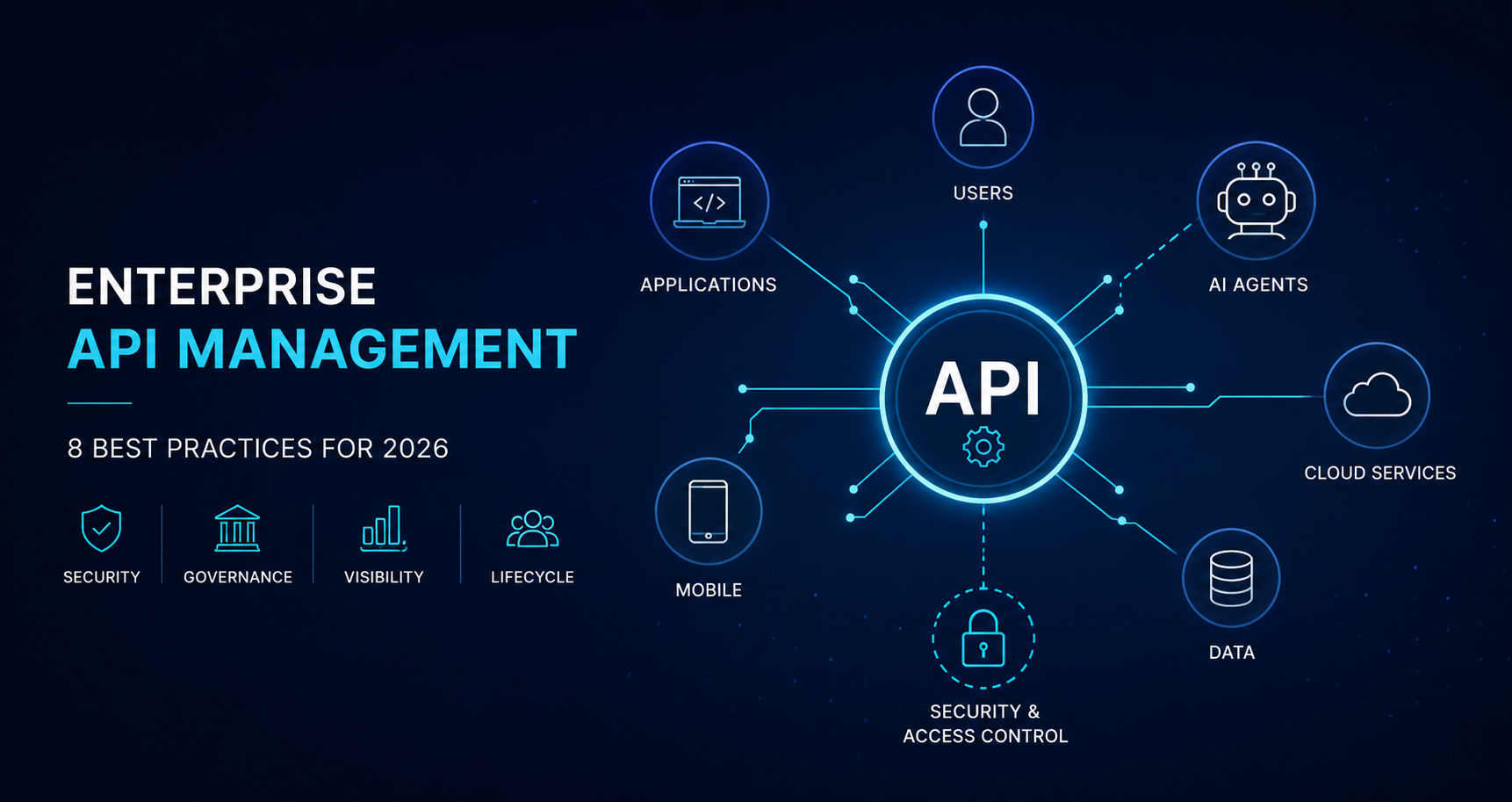
Enterprise API management: 8 best practices for 2026
Most enterprise API management frameworks were designed around predictable consumers such as applications, services, and predefined integrations. Autonomous AI agents change that model because they can dynamically decide which tools or APIs to call, when to call them, and what action to take next based on context. The eight practices below cover the fundamentals that still break at scale, plus the governance questions this more autonomous behavior introduces.
Best practice 1: Are you treating APIs as products, not one-off technical projects?
Enterprises that manage APIs effectively treat each API as a long-lived product with an owner, consumers, and a roadmap, not as a one-time integration that disappears from view once it goes live.
The difference sounds small, but it changes almost every part of API management.
A project mindset focuses on delivery: define requirements, build an endpoint, connect two systems, and close the initiative. A product mindset assumes the API will continue to evolve after release. Consumers will depend on it, new use cases will appear, security requirements will change, and eventually the API will need to be versioned or retired.
That means every important enterprise API should have:
- A clearly identified API owner. Someone must be accountable for business purpose, technical quality, lifecycle decisions, and communication with consumers.
- A documented consumer need. API design should start with how internal or external consumers will use the service, rather than exposing backend structures without considering usability.
- A roadmap. Changes, new capabilities, versioning, deprecation, and retirement should be planned rather than handled reactively.
- Service expectations. Consumers need to understand availability, support, performance expectations, and what happens when the API changes.
- A changelog and documentation process. An API that changes without notifying its consumers quickly becomes a source of integration failures.
This is where an API-first mindset becomes useful. API-first does not simply mean writing an OpenAPI specification before coding. It means treating the interface as a deliberate product boundary between capabilities and consumers.
Poor API management becomes visible when an endpoint has no business owner, no clear SLA, no maintained documentation, and no one who can explain whether it is still strategic. At that point, the organization may technically have an API portfolio, but it does not have a manageable product portfolio.
The organizational model matters too. Teams that understand how cross-functional teams typically organize product ownership are often better positioned to apply the same principle to APIs. Business, architecture, engineering, security, and operations all need representation throughout the lifecycle.
For enterprises that want a managed platform layer rather than a collection of point solutions, our AXWAY-based API management and integration services provide a practical example of how API governance, integration, access control, and service exposure can be handled as an ongoing capability.
Good API management begins when the organization stops asking, “Who built this integration?” and starts asking, “Who owns this API product now?”
Best practice 2: Is your API governance centralized, federated, or just missing?
Effective API governance requires an explicit operating model: centralized, federated, or deliberately hybrid. Without that decision, standards tend to exist on paper while individual teams gradually implement their own versions.
API governance determines how an enterprise makes decisions about design, security, ownership, naming, documentation, lifecycle, and exceptions.
The problem is rarely that companies have no standards at all. More often, different business units have overlapping standards, architecture teams publish guidelines that are difficult to enforce, and delivery teams optimize locally under deadline pressure.
There are three common governance models.
- Centralized governance. A central platform or architecture team defines standards and retains significant control over approvals and implementation. This creates consistency but can become a bottleneck when hundreds of APIs are being developed across many teams.
- Federated governance. Individual domains or product teams retain more decision-making authority while following common enterprise guardrails. This improves autonomy but requires strong tooling and clear accountability.
- Hybrid governance. Enterprise-wide rules cover areas such as security, identity, naming, documentation, and lifecycle controls, while implementation decisions remain closer to domain teams.
For many large organizations, a hybrid governance model can provide a practical balance by standardizing the areas that require enterprise-wide consistency while leaving more flexibility to individual domains or product teams.
A useful API governance framework should define at least:
- naming and versioning conventions;
- authentication and authorization requirements;
- standard error formats;
- documentation requirements;
- ownership rules;
- production approval criteria;
- deprecation and retirement processes;
- a documented exception process.
The exception process matters. If teams have no legitimate way to deviate from a standard, they often bypass governance entirely. Good API management makes exceptions visible, reviewable, and temporary where possible.
Governance also needs automation. A PDF containing API standards will not scale across dozens of teams. Policies that can be validated during CI/CD, gateway configuration, schema checks, or deployment approval are more likely to remain effective over time.
That challenge resembles the coordination pitfalls common to any cross-team governance effort. The more distributed the execution model becomes, the more important explicit responsibilities, shared tooling, and transparent decision-making become.
The objective of API governance is not to centralize every technical decision. It is to make sure every API operates within a predictable set of enterprise rules, regardless of which team builds it.
Best practice 3: Does anyone own your APIs across their full lifecycle, from design to retirement?
For this article, we use a practical seven-stage API lifecycle framework covering planning, development, testing, deployment, monitoring, versioning, and retirement. Different platforms and governance frameworks may group or name these stages differently, but ownership should extend well beyond the initial release.
Many enterprises are disciplined about creating APIs and much less disciplined about what happens afterward.
That imbalance is one of the main reasons API portfolios become difficult to manage. New endpoints are added continuously, while older services remain exposed because nobody has the authority, information, or confidence to retire them.
For this article, we use the following seven-stage lifecycle framework:
- Planning. Define the business purpose, intended consumers, ownership, data requirements, and expected service level.
- Development. Design and implement the contract, policies, integrations, and supporting logic.
- Testing. Validate functionality, security, performance, error handling, and compatibility.
- Deployment. Release the API into its target environment with access controls and operational policies in place.
- Monitoring. Track latency, errors, usage, security events, dependencies, and consumer behavior.
- Versioning. Manage changes without unexpectedly breaking existing consumers.
- Retirement. Deprecate obsolete versions, migrate consumers, revoke unused access, and remove unnecessary endpoints.
The last two stages are particularly important.
Without disciplined API versioning, teams either introduce breaking changes or maintain multiple undocumented variants indefinitely. Without retirement, obsolete APIs can become what teams often describe as “zombie APIs”: services that still exist and may remain reachable even though nobody actively maintains them.
That creates operational and security risk. An unused endpoint can still expose data. An outdated version can still depend on vulnerable components. A forgotten integration can still fail when an upstream system changes.
Retirement therefore needs a process, not an ad hoc decision. API owners should know which consumers use each version, how those consumers will be notified, how long the deprecation window lasts, and when access will finally be removed.
API lifecycle management also needs operational criteria. An API should not remain active simply because someone might still be using it. Usage data, business relevance, risk, maintenance effort, and replacement availability should all inform lifecycle decisions.
This discipline fits naturally within a broader architectural framework for reliability and operational excellence, where systems are designed with ongoing operation and change in mind rather than treated as finished after deployment.
Strong enterprise API management therefore requires ownership from design to retirement. If nobody is responsible for the final stage, API sprawl is almost inevitable.
Best practice 4: Does your API security strategy cover more than just the gateway?
API security needs to be embedded across design, development, deployment, monitoring, and deprecation because a secure gateway cannot compensate for weak authorization logic, poor visibility, insecure application behavior, or forgotten endpoints.
The attack surface is continuing to grow. Akamai’s 2026 Apps, APIs, and DDoS State of the Internet report found that the average number of daily API attacks increased by 113% year over year. The same report found that approximately 61% of API attacks in 2025 involved unauthorized workflows and abnormal activity, up from 30% in 2024, indicating a shift toward attacks that abuse API behavior rather than relying only on conventional web vulnerabilities.
A separate 2026 Akamai study of 1,840 security professionals found that 87% of organizations had experienced an API-related security incident in the previous 12 months, with an average of 3.5 incidents per organization. The EMEA edition reported a similar figure of 88% among organizations surveyed in the UK, France, and Germany.
The gateway remains an important enforcement point, but it is only one part of the security model.
A mature API security strategy should include:
- Identity and authentication. OpenID Connect (OIDC) provides an identity and authentication layer on top of OAuth 2.0, allowing a client to verify the identity of an end user. OAuth 2.0 itself is primarily an authorization framework for granting limited access to protected resources. Implementations should also follow current OAuth security guidance, including IETF Best Current Practice RFC 9700, published in 2025.
- Granular authorization. Authentication establishes identity, but APIs must still determine what that identity is allowed to do. Authorization should be enforced at the level of specific objects, functions, operations, and datasets. OAuth scopes can constrain delegated access, but they do not replace application-level authorization checks.
- Role-based or policy-based access control. RBAC and other policy mechanisms should apply least-privilege principles so users, applications, services, and machine identities receive only the access required for their purpose.
- Rate limiting and quotas. These controls help contain abuse, protect backend capacity, limit automated traffic spikes, and reduce the impact of unexpected or malicious request patterns.
- Encryption. Sensitive information should be protected in transit and, where required by the organization’s risk and compliance model, at rest.
- Logging and anomaly detection. Security teams need sufficient context to identify unusual access patterns and reconstruct incidents, including which identity called an endpoint, what operation was requested, and when it occurred.
- Layered API security testing. SAST can identify certain weaknesses in source code, while DAST evaluates a running application externally. Both can be valuable parts of CI/CD, but neither should be treated as sufficient API-specific testing on its own. APIs also need tests focused on authentication, object-level and function-level authorization, endpoint discovery, schema and input handling, rate limits, business-logic abuse, and other API-specific attack paths. OWASP’s current API Security Testing Framework is designed specifically around these risks and includes coverage of the OWASP API Security Top 10 as well as GraphQL, gRPC, mutual TLS, and other API patterns.
One of the most important examples is broken object-level authorization. An API may correctly authenticate a caller but still allow that identity to retrieve or modify an object it does not own. This is why testing whether a user can log in successfully is not enough. Authorization needs to be validated against the individual resources and operations the API exposes.
Insufficient logging creates a different problem. If the organization cannot reconstruct which identity called an endpoint, which resource was accessed, what action was attempted, and when it happened, both detection and incident investigation become harder.
Security also has a lifecycle dimension.
Authentication, authorization, testing, and logging requirements are stronger when they are designed into the API from the beginning rather than added immediately before release. Similarly, an obsolete endpoint that remains reachable after its replacement goes live can become an unmanaged attack surface even if the newer version is properly secured.
The most effective API security best practices therefore connect API governance, lifecycle management, identity, authorization, observability, security testing, and deprecation. Security is not a gateway feature. It is a property of the entire API operating model.
Best practice 5: Can you actually see every API running across your organization?
You cannot govern, secure, or retire an API you do not know exists, which makes visibility and API observability essential controls against API sprawl and shadow APIs.
As organizations decentralize development, the number of interfaces tends to grow faster than the central platform team’s ability to track them.
Some APIs are created through formal product teams. Others appear through local integrations, low-code development, temporary projects, acquired systems, or increasingly, AI-assisted coding. If those interfaces reach production without being registered centrally, the organization develops shadow APIs.
Shadow APIs create several problems at once:
- security teams may not know they exist;
- developers may rebuild functionality that is already available elsewhere;
- undocumented endpoints can remain active after projects end;
- multiple versions may expose inconsistent business logic;
- no clear owner may be responsible for patching or retiring them.
The first control is discovery.
Enterprises can combine network traffic analysis, gateway telemetry, service inventories, code scanning, cloud platform data, and mandatory API registration to identify interfaces that fall outside the managed portfolio.
The second control is API observability.
At minimum, platform teams should be able to track:
- request volume and throughput;
- latency;
- error rates;
- authentication failures;
- rate-limit events;
- consumer identity;
- version usage;
- unusual access patterns.
Those metrics serve different audiences. Engineering teams need detailed operational telemetry. Security teams need behavior and access data. Business and platform leaders need higher-level information about adoption, reliability, cost, duplication, and strategic value.
That is why translating API usage metrics into board-ready reporting matters. API management becomes easier to fund and govern when leaders can see which services are heavily reused, where failures affect critical processes, and how much unmanaged duplication exists.
Visibility should also become part of the production gate.
For organizations operating a governed API platform, production readiness should normally include discoverability in the enterprise API catalog, a clearly assigned owner, and the required operational telemetry. Making these controls part of the production gate helps ensure that APIs entering the live environment are visible, measurable, and accountable from the start.
This turns registration from an administrative request into part of the engineering lifecycle.
API sprawl cannot be solved by asking teams to stop creating APIs. Large organizations will continue to create them. The objective is to make every production API visible, identifiable, measurable, and accountable.
Best practice 6: Are your APIs discoverable and reusable, or rebuilt from scratch every time?
Without a searchable API catalog and a self-service developer portal, teams often rebuild capabilities that already exist because they cannot easily find, evaluate, or consume existing APIs.
Documentation and discoverability are related, but they are not the same thing.
Documentation explains how an API works once a developer already knows it exists. An API catalog helps developers discover what is available across the organization before they start building a new integration.
A useful catalog should provide more than endpoint documentation. It should include information such as:
- API name and business purpose;
- owner and responsible team;
- lifecycle status;
- current version;
- intended consumers;
- authentication requirements;
- documentation links;
- support information;
- whether the API is approved for reuse.
This metadata allows developers to answer a more important question than “How do I call this endpoint?” They can ask, “Is this the right API to depend on?”
The developer portal adds a self-service layer.
Depending on the platform and governance model, developers may be able to review documentation, request credentials, test endpoints in a sandbox, inspect examples, understand usage policies, and begin integration without waiting for manual support from the API team.
That reduces one of the hidden costs of weak API management: duplicated engineering.
If a developer cannot discover an existing customer-profile API, payment capability, identity service, pricing interface, or data service, building another implementation may be faster than searching across disconnected documentation. Multiplied across dozens of teams, that behavior produces inconsistent logic and unnecessary maintenance.
Discoverability therefore supports both productivity and governance.
A well-maintained catalog also helps architecture teams identify overlapping capabilities, track ownership, assess migration impact, and understand which APIs are genuinely reusable across domains.
Quality still matters. A catalog filled with obsolete or poorly documented APIs can make discovery worse rather than better. Entries should therefore reflect lifecycle status and indicate which versions are recommended for new consumers.
Enterprise API management should make reuse the easiest path. When teams can discover trusted, supported APIs quickly, they are less likely to create unnecessary point-to-point integrations or new shadow services.
The goal is not simply to document everything. It is to create a reliable internal marketplace of capabilities that developers can confidently find and use.
Best practice 7: Is your API architecture ready for multi-cloud without vendor lock-in?
For enterprises operating across multi-cloud or hybrid environments, API management should balance portability with the benefits of deeper cloud-native integration, because both single-cloud tooling and cross-platform management layers can create forms of dependency.
Enterprise architectures rarely remain static.
A company may begin with one public cloud, acquire applications running elsewhere, retain critical on-premise systems, adopt SaaS platforms, or deliberately spread workloads across AWS, Azure, and Google Cloud. API management needs to work across that reality.
The goal is not to eliminate every form of platform dependency. It is to understand which dependencies the organization is accepting and whether they support its long-term architecture.
Cloud-native API management can offer deep integration with a provider’s identity, networking, observability, security, and deployment services. That can simplify operations and reduce integration overhead when an organization is deliberately standardized on one cloud provider.
The trade-off appears when portability becomes strategically important. If authentication policies, routing logic, monitoring, developer access, and governance are tightly coupled to one provider, moving workloads elsewhere may require rebuilding parts of the management layer around them.
A more portable approach can include:
- Federated gateways placed close to workloads while following common enterprise policies;
- consistent authentication and authorization rules across environments;
- global or policy-driven routing;
- centralized visibility across distributed gateways;
- common catalog and developer access patterns;
- support for synchronous, event-driven, and asynchronous integration styles where required.
These patterns can be particularly useful in multi-cloud and hybrid environments, where APIs may expose services running across public clouds, SaaS platforms, and legacy systems through the same enterprise integration landscape.
A cross-platform API management layer can make it easier to apply consistent policies across those environments, but it does not eliminate dependency. The management platform itself becomes part of the architecture and may introduce its own migration costs, proprietary configuration, operational tooling, or skills requirements.
Webellian’s API management and integration offering uses AXWAY Amplify to help minimize vendor lock-in and make services available across cloud providers. Axway currently describes Amplify as a federated API management platform that can publish, validate, govern, secure, and monitor APIs across multiple clouds, on-premises environments, vendors, and existing gateways. That can support greater portability and policy consistency, while the Amplify platform itself should still be evaluated as an architectural dependency.
That does not mean cloud-native API management tools are inherently the wrong choice. They can be highly effective when an organization is deliberately standardized on one provider and values deep integration with that provider’s wider ecosystem.
Architecture teams should therefore evaluate API management alongside choosing between public, private, and hybrid cloud rather than after those decisions have already been made.
It is also worth considering the broader tradeoffs between cloud computing and cloud outsourcing when deciding which capabilities the organization wants to own directly and which should be supported by an external partner.
Good API management should make these trade-offs explicit. The right architecture is not necessarily the one with the least vendor dependency, but the one that provides an acceptable balance between portability, operational simplicity, integration depth, and the cost of changing direction later.
Best practice 8: Are AI agents already calling your APIs without a governance plan?
AI agents introduce a more autonomous API consumption pattern: instead of only following predefined integration logic, they can dynamically select tools or APIs, decide when to call them, and chain actions based on context and intermediate results.
This does not replace established API consumers such as applications, services, or automated integrations. It adds a more dynamic consumption pattern that creates additional governance questions around identity, permissions, rate limits, and auditability as agentic systems move into production.
Traditional governance models often assume that a developer defines the integration logic, that logic goes through some form of review and deployment process, and the resulting application calls known APIs according to relatively predictable behavior.
Autonomous agents make that assumption less reliable.
An AI agent may decide dynamically which tool or API to call based on a user’s request, intermediate model output, current context, or another system response. That creates different governance requirements.
Enterprises should consider at least four controls.
- Give agents distinct identities. Do not reuse broad service credentials across multiple agents. An agent identity should make it possible to distinguish which autonomous system initiated a request.
- Limit scopes and permissions. An agent should only be able to access the specific APIs and operations required for its job.
- Apply agent-specific rate limits and quotas. Autonomous loops can generate far more traffic than an individual developer or user expects.
- Maintain auditability. Logs should show not only that an endpoint was called, but which agent initiated the call and enough context to investigate why the action occurred.
This becomes particularly important for APIs that trigger business actions rather than simply retrieve information.
An agent that reads product documentation carries a different risk profile from one that can change customer records, approve a workflow, provision infrastructure, place an order, or modify financial data.
The governance model therefore needs to distinguish between read access, action-taking capabilities, and high-impact operations.
Protocols and agent tooling will continue to evolve, including approaches such as Model Context Protocol (MCP) for exposing tools and context to AI systems. The underlying enterprise governance questions remain the same: What can the agent access? Under which identity? With what permissions? At what rate? And how can its actions be reconstructed afterward?
Centralized or unified access-control mechanisms become particularly valuable here because they can extend existing API governance principles to new machine identities. For companies already building AI capabilities, that means governing which internal AI agents and pipelines can call which APIs should become part of the broader platform architecture.
This also connects directly with large language models, the technology now driving most autonomous agents. LLM adoption changes not just user interfaces but how software itself consumes enterprise capabilities.
The next phase of API management is therefore not simply about managing more APIs. It is about managing a rapidly growing population of non-human consumers that can decide for themselves when to call them.
FAQ
What are the top API management tools enterprises use?
There is no universal top-five list that fits every enterprise. The right platform depends on architecture, cloud strategy, security requirements, integration patterns, governance model, and whether the organization needs hybrid or multi-cloud support.
Key capabilities to compare include an API gateway, lifecycle management, access control, API catalog, developer portal, analytics, observability, policy enforcement, and support for distributed environments.
For Webellian’s API management and integration work, the brief specifically identifies AXWAY Amplify as the platform used for enterprise API integration, cataloging, access control, legacy integration, and reducing vendor lock-in.
What are the stages of the API lifecycle?
A practical API lifecycle can be divided into seven stages:
- planning;
- development;
- testing;
- deployment;
- monitoring;
- versioning;
- retirement.
The exact labels vary between frameworks, but the important principle is that API lifecycle management continues after deployment. Monitoring, versioning, deprecation, and retirement require explicit ownership just as design and development do.
What are the three pillars of API security?
A useful way to structure API security is around identity, access control, and continuous protection.
Identity establishes who or what is making a request. Access control determines which resources and operations that identity may use. Continuous protection includes monitoring, logging, rate limiting, vulnerability testing, anomaly detection, and lifecycle controls that reduce exposure as APIs change.
In practice, enterprise API security commonly combines technologies such as OAuth 2.0, OpenID Connect, RBAC, gateway policies, logging, and automated security testing.
What is the OWASP API Security Top 10?
The OWASP API Security Top 10 is a widely used framework describing common categories of API security risk.
It helps security and engineering teams assess issues such as broken authorization, weak authentication, excessive resource consumption, insecure business flows, misconfiguration, and insufficient management of API inventory.
For enterprise API management, its main value is that it shifts security reviews beyond infrastructure and gateways. Teams also need to examine object-level permissions, business logic, endpoint inventory, versioning, monitoring, and whether obsolete APIs remain accessible.
Sources:
https://www.rfc-editor.org/info/rfc9700
https://www.akamai.com/lp/soti/app-api-ddos-security-report-2026
https://www.akamai.com/lp/report/api-security-study-2026
https://owasp.org/www-project-api-security-testing-framework