
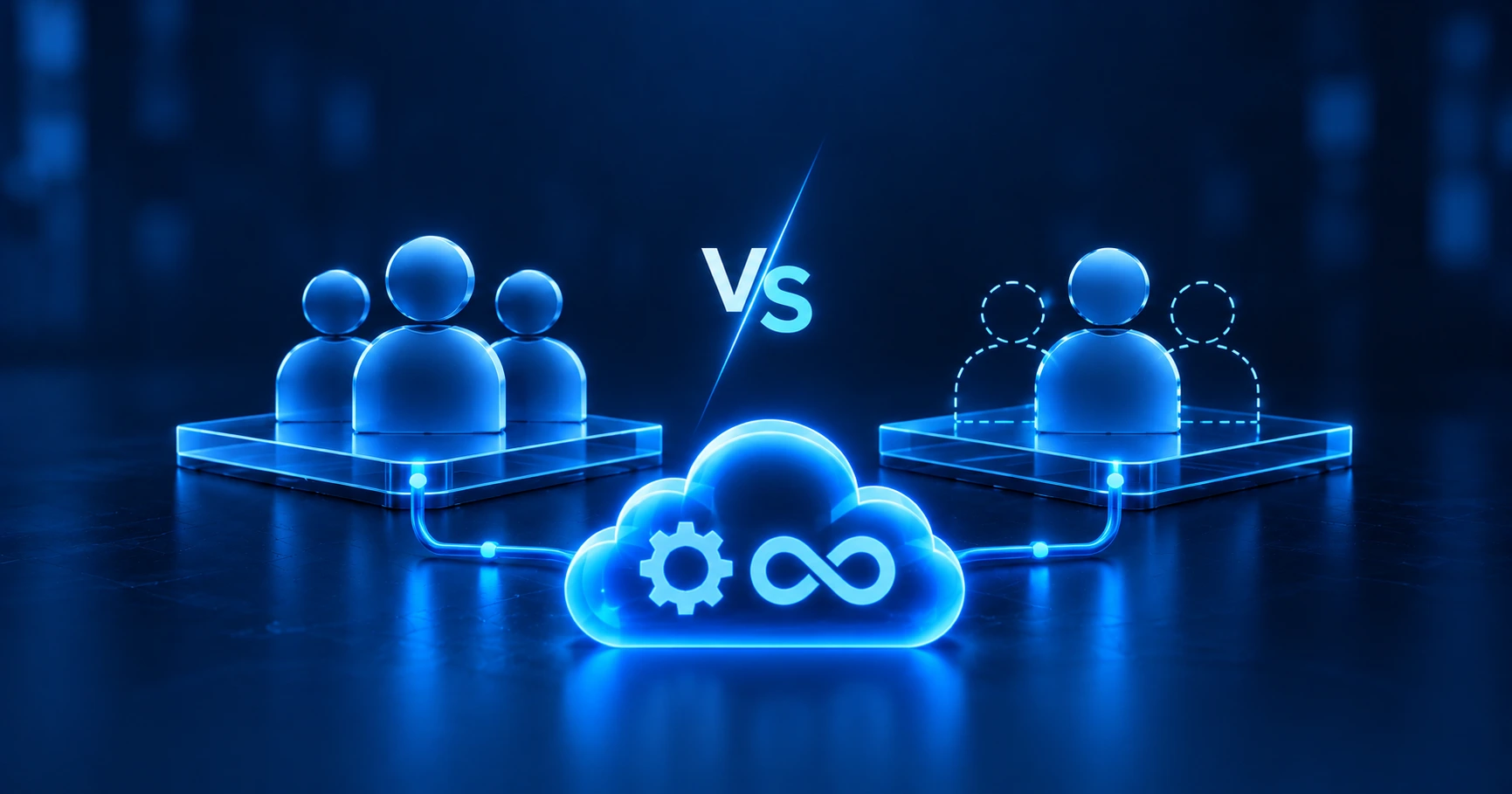
Dedicated development team vs staff augmentation: who should own cloud and DevOps delivery?
A dedicated development team gives you a stable external team with broader collective responsibility, while staff augmentation adds specialists who usually work inside your existing delivery structure. At Webellian, we choose between them primarily by asking who should own delivery, engineering standards, knowledge, and cloud or DevOps operations.
Dedicated development team vs staff augmentation: the core definitions
The main difference is not whether the engineers are external. It is how delivery responsibility, management, knowledge, and technical ownership are distributed between the client and the provider.
The terms are sometimes used loosely, so we do not rely on the label alone. Two providers may both sell a “dedicated team” while offering different governance models. One may provide reserved engineering capacity, while another adds technical leadership, QA, DevOps capability, and responsibility for maintaining engineering standards.
For that reason, we define the operating model before comparing price.
What is staff augmentation?
Staff augmentation adds external specialists to a delivery organization that the client already manages.
The augmented engineer typically joins the client’s backlog, meetings, repositories, engineering standards, and reporting structure. The client decides what should be built, allocates work, and usually retains responsibility for architecture and delivery performance.
That makes staff augmentation useful when the operating model is already strong but a capability or capacity gap remains. An internal platform team may need a Kubernetes engineer for six months, or a migration program may temporarily require an Azure networking specialist.
“Team extension” is often used for a similar model. What does not change is the ownership pattern: you are extending your team rather than outsourcing management of that team.
Internal management time is therefore part of the cost. External engineers still need priorities, architectural direction, reviews, access, onboarding, and business context.
Atlassian’s 2025 Developer Experience study, based on 3,500 developers and managers, identified finding information, adapting to new technology, context switching, and cross-team collaboration among significant sources of developer friction. Adding people without improving the system around them does not automatically remove those constraints.*
For a broader explanation of integrating external teams, see our enterprise agile outsourcing framework.
What is a dedicated development team?
A dedicated development team is a stable group assigned to one client or product area, usually with more team-level continuity and delivery responsibility than individual staff augmentation.
A typical structure can include developers, QA, DevOps or platform specialists, a technical lead, and delivery management. The exact composition depends on the work.
We would not claim that every dedicated team automatically owns the outcome. Product strategy and business priorities usually remain with the client. What changes is that the provider can take greater responsibility for turning those priorities into a functioning delivery system.
The client may own the roadmap while our team owns execution, engineering practices, CI/CD, quality, documentation, and day-to-day coordination. This reduces individual task management, but only when the governance model is explicit.
Quick comparison: dedicated team vs staff augmentation
Staff augmentation optimizes for direct client control and flexible access to skills, while a dedicated team optimizes for continuity, broader delivery accountability, and lower day-to-day management overhead.
| Factor | Staff augmentation | Dedicated development team |
| Primary purpose | Extend an existing team | Build or extend a stable delivery capability |
| Management | Mainly client-led | Shared or provider-led |
| Product priorities | Client | Client |
| Delivery coordination | Usually client | Often provider or shared |
| Architecture ownership | Usually internal | Can be shared or delegated |
| Knowledge retention | Potentially more individual-dependent | Potentially more distributed when documentation and shared ownership are in place |
| Scaling | Easy to add specific roles | Better for scaling a complete capability |
| Commercial structure | Often per specialist | Often monthly team capacity or T&M |
| Best fit | Skills gaps, temporary capacity | Long-running products and transformations |
| Cloud/DevOps fit | Strong with mature internal platform ownership | Strong when provider must also own platform delivery |
The model itself does not guarantee quality. A poorly governed dedicated team can perform worse than excellent augmented engineers, while staff augmentation can create unnecessary management load if internal leadership is already stretched.
Who owns delivery?
The most useful question is not who employs the developers, but who has to make the delivery system work when something goes wrong.
With staff augmentation, the client normally retains more responsibility. External specialists work within the client’s architecture, priorities, engineering processes, and decision structure. When priorities conflict or dependencies block delivery, someone internally usually resolves them.
A dedicated team changes that boundary. The client still owns business direction, but the provider can own more of the mechanisms required to execute it, including technical planning, code-review discipline, quality gates, release processes, documentation, and escalation.
Consider a production incident. If an augmented engineer is part of an internal platform team, the client usually owns the incident process. If a dedicated team owns the affected service and deployment workflow, its technical and delivery leadership may coordinate the response within agreed boundaries.
his is why we evaluate outsourcing through capability and responsibility, not staffing volume alone. In our guide to IT outsourcing trends in 2026, we describe the broader shift toward partnerships based on capability, governance, security, and measurable outcomes.
Team composition, knowledge retention, and scalability
Staff augmentation usually gives us more granular scaling, while a dedicated team provides a stronger structure for preserving knowledge across a long-running program.
A dedicated team can be built around the system rather than isolated vacancies. A cloud-native product may require developers, QA, DevOps, and technical leadership. Staff augmentation is more surgical and makes sense when an otherwise mature team lacks only one or two capabilities.
Knowledge retention
Knowledge retention depends on documentation, repositories, architecture practices, onboarding, and people, so neither model guarantees continuity.
The risk profile is different. If knowledge is concentrated in one augmented specialist, their departure can create a gap. A stable dedicated team can distribute knowledge across several roles, but only if the provider practices shared ownership and documentation.
JetBrains’ 2025 Developer Ecosystem Survey included 24,534 developers across 194 countries and showed that collaboration, communication, and organizational conditions are important parts of developer effectiveness alongside technical skill.*
For us, continuity means retaining the system knowledge required to keep making good decisions, not merely retaining the same individuals.
Scaling up or down
Staff augmentation is usually easier when scaling one capability. If we need one more SRE or data engineer, there is no reason to redesign the whole delivery structure.
Dedicated teams scale more structurally. Capacity has to preserve the balance between engineering, QA, leadership, and platform responsibilities.
The question is therefore whether the company needs more people inside an existing delivery system or a larger delivery system with its own coordination capability.
When to choose each model
We choose staff augmentation when the client can absorb additional specialists, and a dedicated team when delivery itself needs to expand as a coherent capability.
| Choose staff augmentation when… | Choose a dedicated team when… |
| You have strong internal technical leadership | You need provider-side technical and delivery leadership |
| The gap is one skill or role | The gap is a complete delivery capability |
| Architecture and standards already exist | The provider must help evolve engineering standards |
| The need is temporary or variable | The roadmap is long-running |
| Your platform team owns CI/CD and IaC | The external team must own significant platform delivery |
| You want direct control over work allocation | You want to delegate more execution |
| Existing teams can onboard specialists efficiently | Internal management capacity is constrained |
One test we use is simple: if five excellent engineers joined tomorrow, who would give them context, make architectural decisions, remove blockers, and maintain engineering standards?
If the answer is clear, staff augmentation may be sufficient. If the provider needs to perform much of that work, a dedicated team is closer to the actual requirement.
Beyond the two: managed services and project outsourcing
Dedicated teams and staff augmentation do not cover every sourcing need. Managed services and project-based outsourcing move responsibility toward a defined service or deliverable.
With project-based outsourcing, the provider delivers a defined scope such as an application, migration component, integration, or modernization milestone. A dedicated team instead remains available against an evolving roadmap.
Managed services move toward operational accountability. The question becomes not only who develops the system, but who keeps it operating within agreed service boundaries.
For cloud operations, this may include monitoring, incident response, SRE, patching, platform maintenance, security operations, and FinOps.
The distinction becomes important after migration. A dedicated engineering team may continue modernizing applications while a managed service handles operational reliability.
The State of FinOps 2026 reports that 78% of FinOps practices now report into CTO or CIO organizations, illustrating how cloud financial management is increasingly integrated with technology operations rather than treated as a finance-only function.*
Our cloud migration strategy framework explores how these operating-model decisions should be made before migration waves establish long-term ownership.
Choosing the right model for cloud and DevOps delivery
For cloud and DevOps programs, the decision often comes down to who owns CI/CD, Infrastructure as Code, platform standards, security controls, and production operations.
CNCF’s Q1 2026 State of Cloud Native Development report, based on more than 12,500 developers, found that 88% of backend developers used at least one form of infrastructure standardization. CNCF’s Annual Cloud Native Survey also reported 91% CI/CD adoption among mature organizations.*
These findings illustrate why pipeline and platform ownership should be explicit in the engagement model.
Who owns CI/CD and Infrastructure as Code?
| Responsibility | Staff augmentation | Dedicated team |
| Pipeline architecture | Usually internal platform team | Can be shared or provider-owned |
| IaC standards | Usually client-defined | Can be designed and maintained by provider |
| Security gates | Client framework | Provider can implement within client governance |
| Deployment | Usually internally coordinated | Team can own release execution |
| Incident process | Usually client-led | Can be delegated within defined boundaries |
| Platform roadmap | Client | Usually shared |
Mature organizations may deliberately keep platform ownership internal because infrastructure standards need to remain consistent across multiple teams.
Puppet’s 2026 State of DevOps: Platform Engineering Edition, based on 820 respondents, found that 79% of platform-mature organizations reported mature governance, compared with 14% among less mature organizations. For sourcing decisions, we see a practical implication: staff augmentation can be easier to integrate when specialists enter an already coherent platform, while a dedicated team may be useful when the provider also needs to help establish that coherence.*
Our 5 Cs of Agile for cloud migration and DevOps covers the delivery practices we use around that technical foundation.
Mapping the model to migration phases
The right engagement model can change during the same cloud program.
During assessment and architecture, organizations may need individual senior architects or FinOps specialists. Staff augmentation can work well when internal leadership already owns the transformation.
During migration waves, augmentation can add capacity to existing squads, while a dedicated team can own a defined application portfolio or migration stream.
During modernization, cross-functional ownership becomes more important because application architecture, IaC, DevSecOps, observability, and release engineering evolve together.
During steady-state operations, managed services may become more appropriate if the requirement shifts toward availability, SRE, on-call, cost governance, and platform maintenance.
Our architecture-led cloud migration guide explains why operating architecture should evolve during migration rather than simply reproduce the legacy environment.
European compliance and nearshoring considerations
The engagement model can change operational responsibilities, but it does not automatically change legal responsibilities under GDPR, NIS2, DORA, or other regulation.
Under GDPR, controller and processor roles depend on what each organization actually does with personal data. Calling a supplier a staff augmentation provider or dedicated team does not determine its GDPR role.
The same principle applies to NIS2. The EU’s 2026 ICT Supply Chain Security Toolbox emphasizes identifying, assessing, and mitigating supplier risk. A sourcing model does not remove the need to assess the provider relationship itself.
For financial institutions subject to DORA, engagement labels likewise do not replace ICT third-party risk obligations. A 2026 EIOPA Q&A confirms that a provider’s NIS2 status does not remove relevant DORA responsibilities.*
A dedicated team may make operational accountability easier to centralize because one stable group can work under consistent controls, but this is an operating-model advantage, not an automatic transfer of regulatory responsibility.
Nearshoring can simplify collaboration for European organizations where security, architecture, product, and legal stakeholders need frequent interaction. Geography should still be treated as one evaluation factor, not proof of quality or compliance.
For the full geographic comparison, see our nearshore vs offshore decision framework for CTOs.
Can you switch between models?
Yes. Engagement models often evolve as scope, internal capacity, and delivery responsibility change.
A company may start with two augmented engineers because internal architecture is clear and only additional capacity is needed. If the product expands into several workstreams, the client may later need external technical leadership, QA, DevOps ownership, and stronger coordination. At that point, converting the engagement into a dedicated team can make sense.
The reverse also happens. A dedicated team may build and stabilize a platform while internal employees gradually take ownership, after which only selected external specialists remain.
Hybrid models are also common. An internal Product Owner and architect may work with a dedicated external team while individual specialists are added temporarily for security, migration, or data work.
Transitions should be designed rather than improvised. Repositories, documentation, cloud accounts, pipelines, architecture decisions, credentials, and operational knowledge need to remain transferable.
Talk to Webellian about building a dedicated cloud and DevOps team or augmenting your existing engineers, whichever model fits your delivery risk profile.
FAQ: dedicated development team vs staff augmentation
What is a dedicated development team?
A dedicated development team is a stable external team assigned to a client, product, or program. It usually provides broader continuity and delivery capability than hiring individual specialists, although management and technical responsibilities should always be defined explicitly.
What is staff augmentation?
Staff augmentation adds external specialists to an existing internal delivery structure. The client normally manages their priorities, integrates them into internal teams, and retains responsibility for the wider delivery system.
What is the difference between team extension and a dedicated team?
Team extension normally adds specialists to a team that already has leadership and processes. A dedicated team is organized as a more stable external delivery unit and may include its own technical and delivery leadership.
Is staff augmentation outsourcing?
Staff augmentation is a form of external sourcing and is often grouped under IT outsourcing, although it normally transfers less delivery responsibility than project outsourcing, dedicated delivery or managed services.
Can staff augmentation become a dedicated team later?
Yes. Companies often start with individual specialists and move toward a stable cross-functional team as scope and management overhead grow. The reverse transition is also possible.
Who owns the code and infrastructure?
Ownership should be defined contractually rather than inferred from the engagement model. We generally recommend client ownership or clearly transferable rights to source code, repositories, cloud environments, IaC, and documentation.
Is managed services the same as a dedicated development team?
No. A dedicated team primarily delivers against an evolving roadmap. A managed service is usually defined around ongoing responsibility for a service or operational outcome such as availability, monitoring, SRE, support, or cloud operations.
*Sources:
- https://www.atlassian.com/teams/software-development/state-of-developer-experience-2025
- https://digital-strategy.ec.europa.eu/en/library/toolbox-improve-ict-supply-chain-security
- https://www.eiopa.europa.eu/qa-regulation/questions-and-answers-database/3501-dora-286_en
- https://eur-lex.europa.eu/eli/dir/2022/2555/oj
- https://blog.jetbrains.com/research/2025/10/state-of-developer-ecosystem-2025/
- https://data.finops.org/
- https://www.cncf.io/announcements/2026/03/24/cncf-and-slashdata-report-finds-cloud-native-community-reaches-nearly-20-million-developers/
- https://www.cncf.io/wp-content/uploads/2026/01/CNCF_Annual_Survey_Report_final.pdf
- https://www.puppet.com/resources/2026-state-of-platform-engineering
- https://commission.europa.eu/law/law-topic/data-protection/information-business-and-organisations/application-gdpr_en