
Digital transformation remix: what companies get wrong?
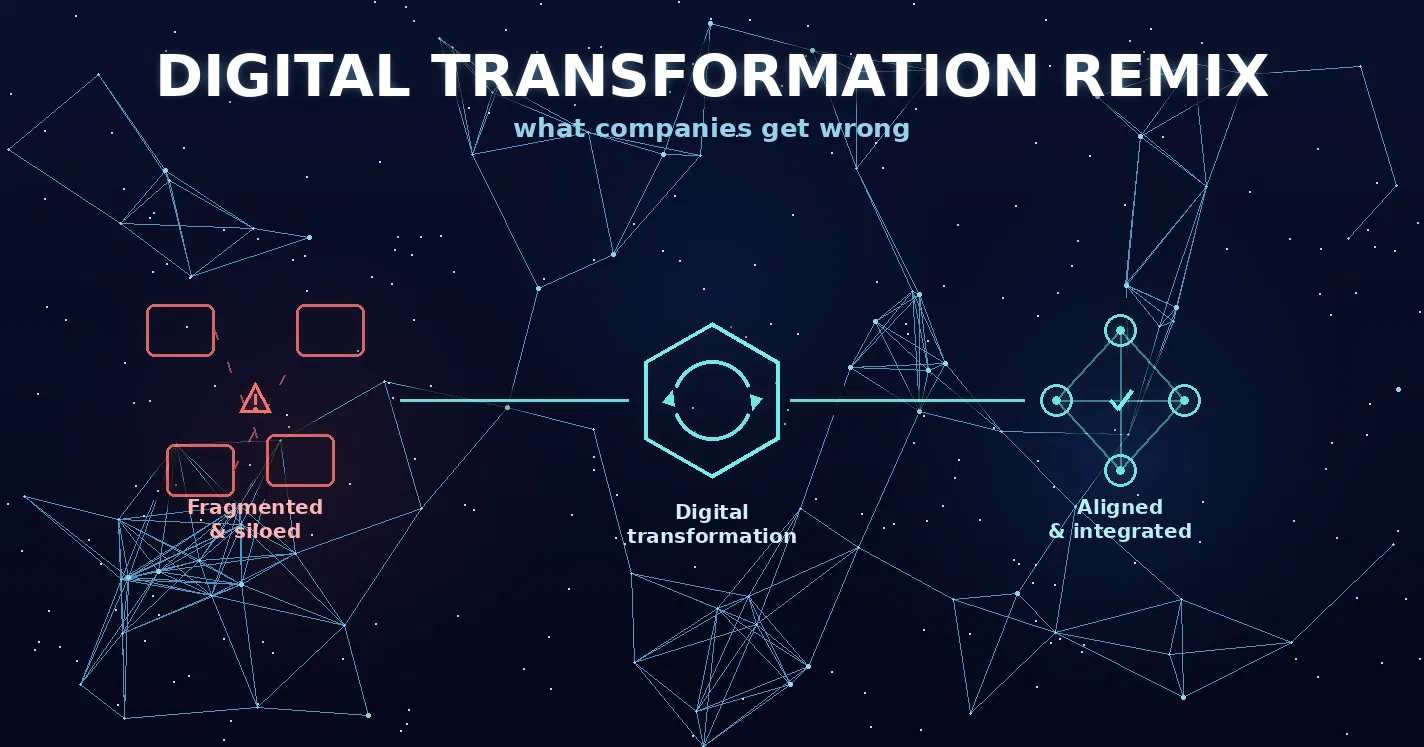
Digital transformation can fail for many reasons, from unclear strategy and weak executive ownership to poor adoption and disconnected technology decisions. One common mistake is copying technologies, operating models, or customer experiences that worked elsewhere without adapting them to the company’s own strengths and context. A better approach works like a remix: preserve what creates value, then redesign the technology, processes, and experience around it.
Why remix is the right metaphor for digital transformation
Digital transformation works best when a company preserves the capabilities that already create value while redesigning how that value is delivered.
Established organizations already have assets that digital native competitors may spend years building. These include customer trust, domain expertise, operational knowledge, data, distribution, intellectual property, and established relationships.Transformation becomes risky when leaders assume becoming digital means replacing everything.
One way we think about transformation at Webellian is through three following approaches:
| Approach | What it means | Main risk | Best use |
| Remix | Preserve valuable capabilities while redesigning technology, processes, and experience | Requires clear decisions about what stays | Best default for most organizations |
| Cover | Copy a competitor’s digital model or technology strategy | Weak differentiation | Commoditized capabilities |
| Rebuild | Replace most of the existing model and technology foundation | High cost and disruption | Structurally obsolete systems or models |
A remix asks a better question than either imitation or replacement:
What should remain valuable and recognizable, and what needs to change?
A bank can preserve trusted advisory relationships while automating repetitive administration. A manufacturer can retain engineering expertise while adding connected products and predictive maintenance. A retailer can keep its service quality while redesigning digital commerce.
Integration usually creates more value than imitation.
What digital transformation actually means?
Digital transformation is the redesign of how a company creates and delivers value through software, data, automation, operating models, and customer experience. It is not another term for buying tools.
You will often see digital transformation described through five pillars, seven pillars, four types of transformation, ADKAR, and other models. These are not parts of one standardized framework. They come from different consultancies, researchers, and transformation practitioners, and they serve different purposes.
| Model or label | What it describes | Is it standardized? |
| Five pillar models | A simplified view of major transformation dimensions | No. The five pillars vary by source |
| Seven pillar models | A more detailed view of organizational capabilities | No. Definitions differ between frameworks |
| Four types of transformation | A common way to group transformation into process, business model, domain, and cultural change | Common classification, but not a universal standard |
| ADKAR | Awareness, Desire, Knowledge, Ability, and Reinforcement | Yes. A specific change management model developed by Prosci |
| Four Ps | A way to connect areas such as people, portfolio, process, and platform | No. It should be treated as a practical heuristic rather than an industry standard |
The important point is not how many pillars a framework contains. A useful transformation model should help leaders define the desired business outcome, understand what needs to change, assign ownership, and identify the technology and organizational capabilities required to get there.
Digitization vs. digitalization vs. digital transformation
Digitization converts analog information into digital form.
Digitalization uses technology to improve an existing process.
Digital transformation changes how the organization creates, delivers, or monetizes value.
Only the third requires a true remix because the organization must decide which existing capabilities remain valuable and which assumptions need to change.
Mistake #1: copying competitors instead of building your own remix
One of the most damaging digital transformation mistakes is starting with somebody else’s solution instead of your own strategic problem.
A competitor launches an AI assistant, self service portal, subscription model, digital marketplace, or personalized experience. Leadership asks why the company does not have the same feature.
The initiative starts with a solution before anyone defines the problem.
The result is often digital sameness.
A remix starts with the company’s actual source of advantage. That may be trust, expertise, reliability, distribution, service quality, or a unique product ecosystem.
Digital strategy should amplify these strengths.
Before selecting platforms or features, ask:
- What do customers value today?
- What is difficult for competitors to reproduce?
- Which part of our operating model creates trust?
- What would customers notice immediately if it disappeared?
- Where does technology prevent us from delivering this value efficiently?
Those answers should shape the transformation strategy.
Mistake #2: treating digital transformation as an IT project
Digital transformation stalls when leadership delegates the entire programme to IT instead of redesigning people, processes, products, and technology together.
One useful example is Mendix’s digital execution approach, which has framed transformation around areas such as People, Portfolio, Process, and Platform. This is a vendor-specific methodology rather than a universal industry standard, but its underlying principle is useful: technology is only one part of the transformation equation.
People, priorities, delivery processes, and the platform itself need to evolve together if digital transformation is expected to produce measurable business results.
People: Which roles, skills, and behaviors must change?
Portfolio: Which products and initiatives deserve investment?
Process: Which workflows need redesign?
Platform: Which technology supports the new model?
Many organizations start with the last question and choose the technology before defining the operating model it is supposed to support.
That puts the sequence backwards.
Technology should support the target operating model, not define it by accident. The same principle applies to infrastructure decisions. A strong cloud migration strategy starts with workload value, dependencies, sequencing, and business outcomes rather than moving everything by default.
A better transformation sequence is:
- Define the measurable outcome.
- Identify the customer or business model change.
- Redesign the operating model.
- Define adoption and cultural requirements.
- Select supporting technology.
- Scale after the model works.
Cross functional teams are essential because transformation is a business redesign enabled by technology, not an IT initiative that affects the business by accident.
Mistake #3: treating change management as an afterthought
Employees do not necessarily resist transformation because they dislike technology. They often resist because they do not understand why the change is happening, what it means for their role, or how leadership will support them.
Prosci research shows a strong correlation between change management effectiveness and project outcomes. Projects with excellent change management are around seven times more likely to meet or exceed their objectives than those with poor change management.*
This makes employee adoption a core part of digital transformation, not a communication task added shortly before launch.
The ADKAR model offers a useful structure:
Awareness: Why is the change necessary?
Desire: Why should people support it?
Knowledge: What do they need to know?
Ability: Can they work effectively in the new model?
Reinforcement: How will the organization prevent a return to old habits?
Technology projects often focus on Knowledge through training while ignoring Awareness and Desire.
Microsoft’s shift under Satya Nadella is frequently cited because technology and portfolio decisions were accompanied by a cultural move from a know it all mindset toward a learn it all mindset.
Change management is not communication around transformation. It is part of transformation.
Mistake #4: improving internal systems while making the customer experience worse
A digital transformation can succeed technically and still fail commercially.
This happens when the organization optimizes internal efficiency but creates more friction for customers.
Automation may reduce operating costs while forcing customers into self service when they need human judgment. A new portal may reduce internal workload while making common tasks harder.
Poor UX can therefore undermine an otherwise successful transformation. A broader UX strategy for digital transformation connects interface decisions with adoption, conversion, retention, and measurable business outcomes.
Every transformation initiative should be tested against customer value.
Does it reduce effort?
Does it improve speed?
Does it improve clarity?
Does it make the outcome more reliable?
Does it solve a real customer problem?
Webvan offers a useful cautionary example. It was not a conventional digital transformation programme, but it showed how ambitious technology and logistics infrastructure could fail to produce a sustainable business. The company burned through more than $1.2 billion before filing for bankruptcy in 2001.*
Technology can improve how value is delivered, but it cannot substitute for value customers actually want.
Mistake #5: giving everyone responsibility and nobody ownership
Digital transformation requires clear executive ownership.
Sponsorship means more than approving a budget. A transformation leader must resolve conflicts, protect priorities, remove barriers, and remain accountable for results.
Without clear ownership, three problems appear:
- Decisions slow down.
- Employee confidence falls.
- Departments optimize their own priorities instead of the shared outcome.
A useful governance model should clearly answer:
Who owns the outcome?
Who controls the investment?
Who resolves cross functional conflicts?
Who is accountable if adoption or results do not materialize?
If these questions produce different answers with no clear hierarchy, the programme has a governance problem.
How to get the digital transformation remix right
The following five principles form Webellian’s “transformation remix” framework. It is a practical approach we use to think about transformation, not a universally adopted industry standard.
1. Preserve the hook
Identify the capabilities that must survive.
These may include trust, expertise, reliability, service quality, distribution, or product knowledge.
Technology should make those strengths easier to deliver at scale.
2. Integrate instead of imitate
Do not attempt to become a digital native by pretending your history has no value.
Combine existing strengths such as relationships, data, infrastructure, or industry expertise with modern digital capabilities.
3. Remove obsolete baggage
Preservation does not mean protecting every historical process.
Ask:
Which process exists only because an old system requires it?
Which product receives investment mainly because of history?
Which architecture creates unnecessary dependencies?
Which governance mechanism slows decisions without reducing meaningful risk?
This principle is particularly important during cloud modernization. Simply relocating old complexity can preserve technical debt in a more expensive environment. Webellian explores this problem in the article Move the business, not the mess, which focuses on architecture led migration instead of simple relocation.
A good remix keeps the hook and removes the noise.
4. Sequence the transformation
Do not change everything simultaneously.
Start with a measurable outcome, redesign the relevant operating model, test the approach in a contained area, validate adoption, and then scale.
5. Combine creative and technical capability
Engineering answers how to build, integrate, secure, and scale the solution.
Creative and strategic thinking answers what the experience should become, which customer problem matters, and which assumptions should change.
Strong transformation programmes need both.
Bring in the right transformation partner
An external partner can be valuable when the organization lacks the combination of product, creative, data, and engineering skills required internally.
The value is not simply additional development capacity.
A strong partner can challenge internal assumptions, identify technical debt, question unnecessary features, and connect business objectives with production systems.
The delivery model also matters. For programmes requiring frequent stakeholder input, rapid iteration, and close collaboration, the choice between sourcing models can affect delivery speed and coordination cost. Our nearshore vs offshore IT outsourcing guide provides a framework for choosing the right model based on collaboration needs, project stability, and cost.
Ownership should remain inside the organization.
The external team acts like a producer, helping the company turn strategic direction into something that works in practice.
Need help? Talk to Webellian about producing your digital transformation remix!
Frequently asked questions
What are the four types of digital transformation?
A common classification includes process transformation, business model transformation, domain transformation, and cultural or organizational transformation.
What is the difference between digitization and digital transformation?
Digitization converts information into digital form. Digital transformation changes how an organization creates or delivers value.
What is the difference between a remix and a cover?
A cover copies another company’s digital approach. A remix starts with the organization’s own customers, capabilities, and business model, then uses technology to reinterpret how those strengths create value.
Should culture or technology change first?
Start with the desired business outcome and operating model. Then define the behaviors, capabilities, and technology needed to support it.
Why use an external partner for digital transformation?
An external partner can provide specialized capabilities, additional delivery capacity, and perspective while helping internal teams connect transformation strategy with product, data, and engineering execution.
Build a transformation that preserves what creates value
Digital transformation should not turn every company into a copy of the same digital native playbook.
Strong organizations know what to preserve, what to remove, and what to reinterpret.
They modernize technology without confusing technology with strategy. They redesign processes before automating them. They validate changes against customer value. They invest in adoption and give transformation clear executive ownership.
Most importantly, they integrate instead of imitate.
That is the difference between recording a cover and producing a remix.
If your transformation requires product strategy, UX, software engineering, APIs, cloud, or scalable digital delivery, explore our Digital Factory.
*Sources:
https://www.prosci.com/blog/the-correlation-between-change-management-and-project-success
https://knowledge.wharton.upenn.edu/podcast/knowledge-at-wharton-podcast/what-webvan-could-have-learned-from-tesco/