
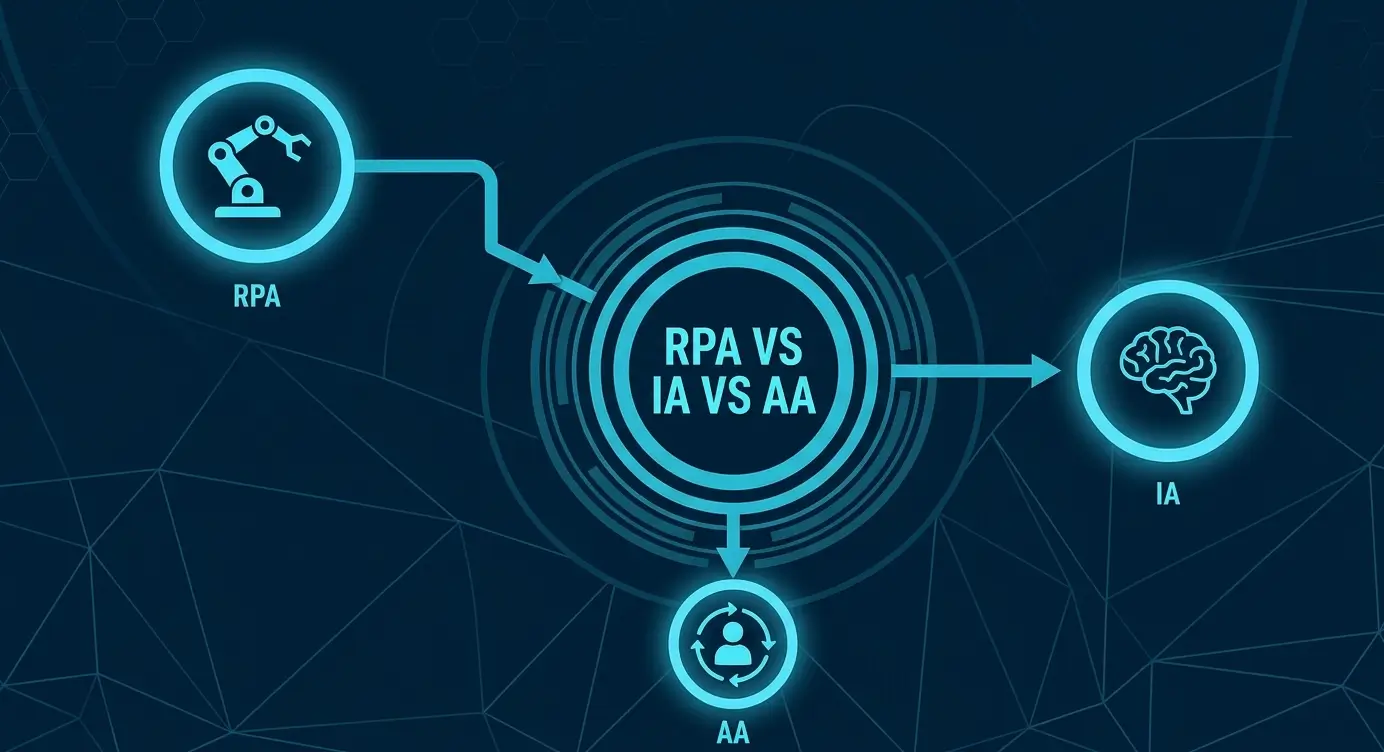
RPA vs intelligent automation vs agentic automation: what’s the difference?
RPA follows a fixed script, intelligent automation adds AI models that interpret data, and agentic automation uses AI agents that choose actions toward a goal. In this article, we use these as practical comparison categories rather than universally standardized or mutually exclusive technology classes. Most enterprises need a combination, matched to process variability, cost and operational risk.D
The short answer: scripts, predictions and goals
The clearest difference is how the next action is determined.
RPA follows predefined rules. A bot executes the same sequence when expected conditions are present.
Intelligent automation adds AI capabilities such as OCR, intelligent document processing, NLP or machine learning. A model can classify a document, extract data or make a narrow prediction, but the wider process is still defined by people.
Agentic automation introduces a different control loop. An AI agent receives a goal, selects tools, performs an action, observes the result and decides what to do next within configured boundaries.
| Approach | Decision logic | Best input type | Typical use |
| RPA | Fixed script and rules | Structured data, stable screens | Repetitive legacy-system tasks |
| Intelligent automation | AI-assisted decisions and process steps within a largely predefined workflow | Documents, text and semi-structured or unstructured data | Document processing, classification, routing and exception handling |
| Agentic automation | Goal-directed reasoning and tool selection | Variable context and multi-system work | Investigation, exception resolution, complex service cases |
A useful shorthand is:
RPA follows predefined rules and actions.
Intelligent automation uses AI and automation technologies within a largely designed process path.
Agentic automation can dynamically select actions and adapt the process path in pursuit of a goal.
The boundary is not absolute, but the key difference is how much of the process path is explicitly designed in advance versus selected dynamically at runtime.
RPA vs intelligent automation vs agentic automation: side-by-side comparison
RPA works best when the process is stable, intelligent automation handles unstructured information inside a defined flow, and agentic automation handles greater variability at the cost of higher governance effort.
| Dimension | RPA | Intelligent automation | Agentic automation |
| Decision logic | Deterministic | Probabilistic step inside fixed process | Goal-directed and adaptive |
| Input type | Structured | Structured + unstructured | Contextual and varied |
| Process variability | Low | Low to medium | Medium to high |
| Path variability | Fixed | Mostly fixed | Can vary case by case |
| Failure behavior | Often obvious | Wrong prediction may pass unnoticed | Plausible but wrong action can look successful |
| Auditability | Usually straightforward | Requires model-output logging | Requires tool, action and decision traceability |
| Maintenance | UI and rule changes | Workflow, model and data changes | Models, tools, policies and evaluations |
| Human role | Handle exceptions | Review low-confidence cases | Approve high-impact actions |
| Governance need | Moderate | High | Very high |
This also explains why intelligent automation should not disappear from the comparison.
A large number of processes do not need an autonomous agent. They simply need better perception.
For example, an invoice process may already have a stable approval flow. The bottleneck is reading varied supplier documents. Intelligent document processing solves that problem without allowing the system to decide the entire path itself.
When should you use RPA, intelligent automation or agentic automation?
Use RPA when both inputs and paths are stable, intelligent automation when inputs vary but the process is predictable, and agentic automation when the path itself changes from case to case.
| Low path variability | High path variability | |
| Low input variability | RPA, workflow or API | Redesign first; agent only if variability is legitimate |
| High input variability | Intelligent automation | Agentic automation with guardrails |
A stable transfer between two legacy systems can be a good RPA use case.
Invoice intake often fits intelligent automation because document formats vary while the underlying approval process remains relatively stable.
Complex customer-service cases may fit agentic automation because the system needs to inspect context, choose different tools and decide which action should come next.
Process variability is not the only criterion.
Leaders should also consider error tolerance, reversibility, audit requirements, transaction volume, data sensitivity and regulatory impact.
A highly variable process with almost no tolerance for autonomous error may still require an AI recommendation followed by human approval.
Before automating the interface, check whether direct integration solves the problem
Before automating user-interface interactions, check whether the underlying systems can be integrated directly. If a supported API or another reliable system-to-system integration is available, it is usually a more stable architectural boundary than automating clicks and screens.
This does not make APIs an alternative category to RPA, intelligent automation or agentic automation. APIs are an integration mechanism that can support any of them. RPA remains useful when legacy systems do not expose suitable integration interfaces or when UI automation is needed as a transitional bridge.
As the number of integrations grows, enterprise API management practices become important for ownership, lifecycle management and access control.
What do the three approaches really cost?
RPA costs are driven mainly by bot platforms and maintenance, intelligent automation adds model and exception-management costs, and agentic automation adds variable model usage, evaluation, monitoring and governance.
| Cost area | RPA | Intelligent automation | Agentic automation |
| Initial build | Process mapping, bot logic, selectors, application setup and integration | Workflow design, AI or document models, data preparation and integration | Agent design, tool integration, orchestration, permissions and guardrails |
| Runtime | Bot licences, infrastructure and execution capacity | Platform usage, model inference and exception handling | Model and tool calls, retrieval, orchestration, retries and validation |
| Maintenance | UI changes, selectors, business rules and application updates | Workflow changes, model quality, data changes and retraining or reconfiguration | Model behaviour, prompts, tools, policies, orchestration and evaluation |
| Testing | Script and regression testing | Workflow regression plus model-quality testing | Multi-step evaluation, tool-use testing and scenario-based validation |
| Governance | Access control, bot ownership and change management | Model oversight, confidence thresholds, data governance and human review | Tool permissions, policy enforcement, auditability, continuous evaluation and human approval for high-impact actions |
| People | Automation developers and process owners | Automation, data or AI specialists and business reviewers | AI engineers, platform and security teams, domain owners and process owners |
The important hidden cost is failure detection. A broken bot often stops.
An AI model can return the wrong classification without triggering a technical error. An agent can complete a workflow successfully from an infrastructure perspective while producing the wrong business result. That means agentic automation needs evaluation sets, policy controls and business-level monitoring rather than infrastructure monitoring alone.
Cost should also be measured per completed business workflow, not per token or model call.One task may require several model calls, retrieval operations, tools, retries and validation steps.
Gartner predicts that more than 40% of agentic AI projects will be cancelled by the end of 2027 because of escalating costs, unclear value or inadequate risk controls.
The lesson is not that agentic automation is too expensive. It is that its additional cost should be justified by process variability that simpler automation cannot handle.
How do RPA, intelligent automation and agents work together?
The most practical enterprise architecture is often hybrid.
Deterministic workflow and APIs execute predictable steps. Intelligent automation interprets documents or text. Agents handle selected judgment-heavy work. Humans approve high-impact exceptions.
An accounts-payable process might work like this:
invoice arrives → document model extracts fields → API retrieves ERP records → rules perform matching → agent investigates an exception → employee approves a high-value adjustment → API updates the ERP
Each technology has a narrow responsibility.
That makes the process easier to control.
Hybrid automation works best when three principles are followed.
Keep deterministic boundaries around actions that must behave predictably.
Use structured schemas between AI and enterprise systems instead of passing free-form output directly into critical applications.
Define who owns failures and exceptions across every layer.
Agents also depend heavily on the underlying data and integration foundation.
Poor CRM data remains poor data when an agent retrieves it.
Outdated enterprise knowledge remains outdated when RAG makes it easier to access.
And an agent with overly broad API permissions still has overly broad permissions.
Production agentic automation therefore requires reliable APIs, governed data, least-privilege identity and observable tool usage.
For a deeper look at the architecture behind production agents, see AI agents in business: build on your data and cloud platform, not around it.
Risks and governance: why agentic failures are harder to see
A broken RPA bot often fails visibly, while an AI agent can produce an incorrect but plausible result, so governance must become stronger as automation becomes more autonomous.
Agentic automation introduces risks such as hallucinated information, incorrect tool selection, prompt injection, excessive permissions, uncontrolled costs and agent sprawl.
Useful controls include:
- least-privilege access to tools and systems;
- approval gates for irreversible or high-impact actions;
- structured tool interfaces;
- evaluation sets for representative scenarios;
- logging of relevant inputs, outputs and actions;
- monitoring of business outcomes;
- named ownership of each automated process.
The orchestration layer becomes especially important because it can enforce policies, approvals, limits and escalation independently of the agent’s reasoning.
EU regulation also matters where automation affects individuals or regulated operations.
Under GDPR Article 22, individuals have protections in certain cases involving solely automated decisions with legal or similarly significant effects.
The EU AI Act follows a risk-based model, and agentic automation is not automatically classified as high-risk. Classification depends on the system’s intended use. Annex III includes specific high-risk use cases such as certain applications in employment and worker management, as well as AI used to evaluate the creditworthiness or credit score of natural persons. Under the current timetable, the requirements for Annex III high-risk systems apply from 2 December 2027. Other AI Act provisions are already in force, so organizations should distinguish between high-risk classification and obligations that already apply.
For financial entities in scope, DORA has applied since 17 January 2025 and brings ICT resilience and third-party technology risk into the automation architecture.
The practical requirement is to treat traceability, permissions, human oversight and change control as part of system design rather than documentation added later.
For a deeper security perspective, see how agentic AI changes threat modeling, permissions and defensive planning.
FAQ
Is agentic AI better than RPA?
Not always. Agentic AI is better suited to variable, context-heavy work. RPA can be simpler, cheaper and easier to audit for deterministic tasks.
Is RPA being replaced by AI?
AI is replacing or augmenting some RPA use cases, especially where bots struggle with documents or variable paths. Stable RPA remains useful for deterministic legacy work.
What is the difference between RPA and intelligent automation?
RPA follows predefined actions. Intelligent automation adds AI capabilities such as OCR, NLP or machine learning to interpret inputs and make narrow predictions inside the workflow.
What’s the difference between generative AI and agentic AI?
Generative AI refers to models that can create or transform content such as text, code, images or summaries. Agentic AI describes a system architecture and behavior in which AI can pursue a goal, choose tools, perform actions, observe results and decide what to do next.
The two are not mutually exclusive: generative models often power agentic systems. The distinction is therefore less about the underlying model and more about whether the system only produces an output or can also take and sequence actions toward an objective.
For the broader enterprise context, see Generative AI in the enterprise: use cases, ROI and risks.
Can RPA and AI agents work together?
Yes. An agent can decide which permitted action is needed, while RPA executes a deterministic step in a legacy application.
Sources
https://blog.modelcontextprotocol.io/posts/2026-07-28
https://eur-lex.europa.eu/eli/reg/2016/679/oj
https://digital-strategy.ec.europa.eu/en/policies/regulatory-framework-ai