
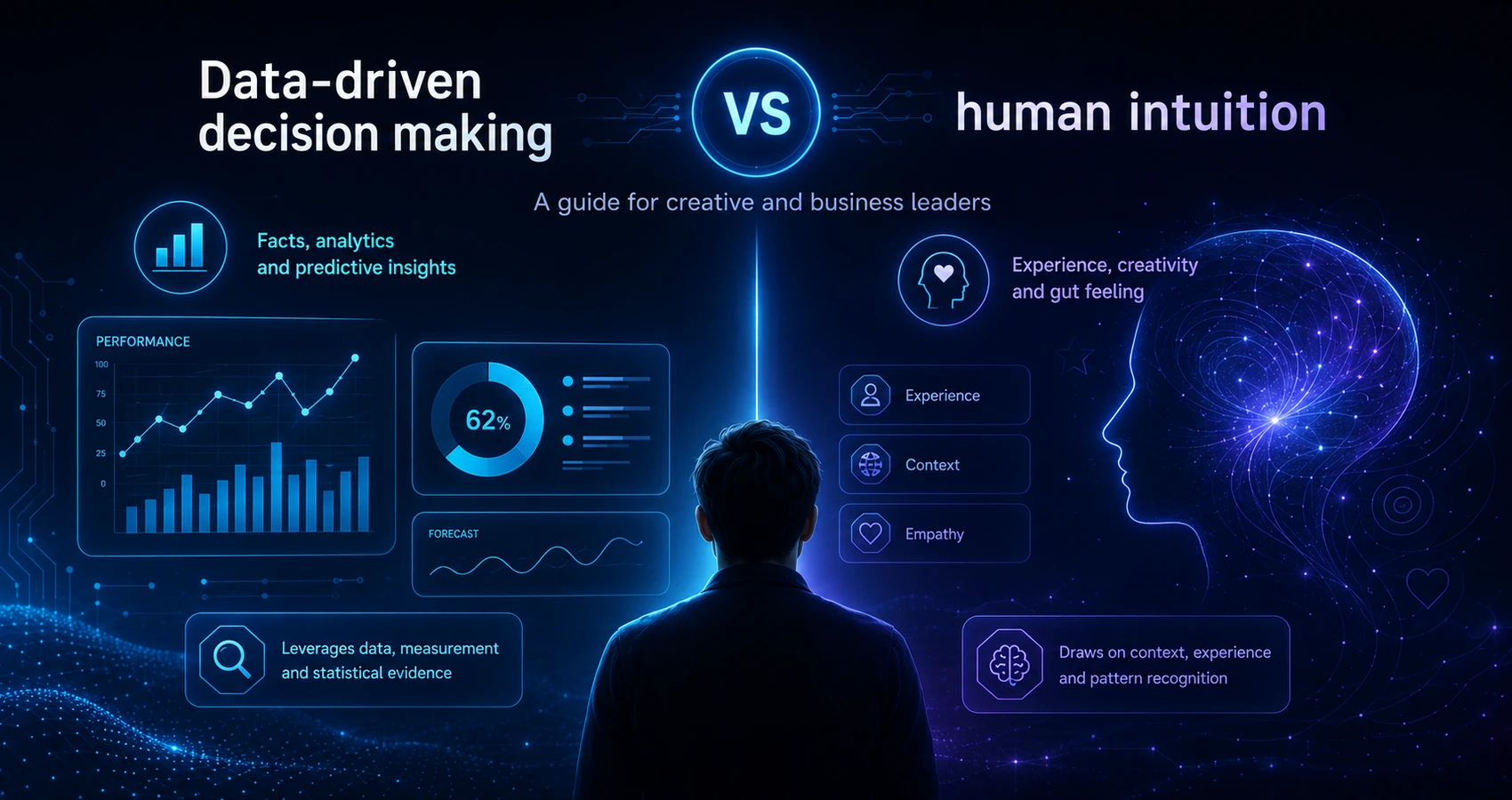
Data-driven decision making vs human intuition: A guide for creative and business leaders
Data-driven decision making and human intuition are not competing approaches. They solve different types of creative and business problems.
Predictive models perform best when data is abundant, outcomes are measurable, and the same type of decision happens repeatedly. Think media budget allocation, audience targeting, campaign timing, and creative performance optimization.
Human intuition becomes more valuable when a decision involves brand risk, cultural novelty, ambiguity, or a situation with no meaningful historical precedent. According to BARC, 58% of companies still base at least half of their regular business decisions on gut feeling rather than data. The real challenge is therefore not choosing between data and intuition. It is knowing when to trust each one.
Predictive analytics vs machine learning: Which supports data-driven decision making?
Predictive analytics is the practical application used to forecast an outcome, while machine learning is one of the methods that can identify patterns and produce those forecasts.
Predictive analytics and machine learning are closely connected, but they are not the same thing.
Predictive analytics is an application. It uses historical and current data to estimate what is likely to happen next.
Machine learning is a method. It allows a system to identify patterns in data and improve its predictions without relying exclusively on manually programmed rules.
For a creative director, the distinction matters because the value does not come from “using machine learning” in isolation. It comes from applying a model to a specific decision.
A predictive model might analyze previous campaigns and estimate:
- which creative concept is most likely to generate clicks,
- which audience segment is most likely to convert,
- when a campaign should be launched,
- which channel is likely to produce the highest return,
- or how a particular message may affect customer sentiment.
The model learns from patterns in historical data and assigns probabilities to potential outcomes. It does not know which campaign is objectively “good.” It estimates which outcome is most likely based on what has happened before.
This is also why understanding the difference between AI, machine learning, and deep learning is useful. These terms describe different technological layers, while predictive analytics describes how those technologies can be applied to a business question.
For example, a creative team may ask whether a product-focused headline will outperform an emotional one. A predictive model can compare the new concepts with past campaign data and provide an estimated result. That estimate can improve the decision, but it cannot fully assess whether the message will strengthen the brand, influence culture, or create a distinctive long-term position.
Predictive analytics helps answer: What is likely to happen?
Creative judgment still has to answer: Is that the outcome we actually want?
Why does human intuition still matter in data-driven decision making?
Human intuition remains valuable because experienced creative leaders can interpret ambiguity, novelty, brand meaning, and cultural context before reliable data exists.
Human intuition is often described as instinct or gut feeling, but that description can make it sound irrational. In professional settings, strong intuition is usually a form of compressed, unconscious reasoning built through experience.
An experienced creative director may quickly recognize that:
- a campaign idea is technically correct but emotionally flat,
- a cultural reference will feel outdated by launch day,
- a concept is too similar to competitors’ work,
- an optimized message weakens the brand’s distinctive voice,
- or a visually impressive execution will distract from the core proposition.
The person may not immediately be able to explain every signal behind the judgment. However, the conclusion can still be based on years of observing audiences, creative teams, brand reactions, internal politics, and market dynamics.
Intuition is particularly valuable when reliable data does not yet exist.
Historical data cannot fully describe a new platform, an emerging cultural movement, a previously untested audience, or a campaign format the company has never used. A model trained on yesterday’s successful work may also encourage the team to repeat yesterday’s conventions.
This does not mean every intuitive decision is correct. Intuition can be distorted by personal preferences, overconfidence, recent experiences, internal group dynamics, and selective memory. A creative leader may interpret familiarity as quality or mistake personal taste for customer insight.
The same experience that makes intuition fast can also make it resistant to contradictory evidence.
The goal is not to romanticize instinct. It is to recognize that human judgment processes information that may be difficult to structure as data, including cultural context, emotional nuance, organizational consequences, brand meaning, and ethical risk.
Data-driven decision making vs intuition: Which approach works better?
Data-driven decision making works best for repeatable and measurable choices, while intuition is stronger when teams face novelty, uncertainty, cultural context, or limited historical evidence.
Data-driven decision making and intuition have different strengths, limitations, and operating conditions.
| Area | Data-driven decision making | Human intuition |
| Primary input | Historical data, behavioral signals, measurable outcomes | Experience, context, pattern recognition, cultural understanding |
| Speed | Fast after the data infrastructure and model are operational | Often immediate, especially for experienced decision-makers |
| Scale | Can evaluate thousands or millions of data points consistently | Limited by human attention and cognitive capacity |
| Repeatability | Strong for recurring decisions with comparable variables | Results may vary between people and situations |
| New situations | Weak when relevant historical data is missing | Stronger when navigating ambiguity and novelty |
| Explainability | Depends on the model; some outputs can be difficult to interpret | The conclusion may be clear even when the reasoning is difficult to articulate |
| Bias risk | Can reproduce biases hidden in training data or measurement systems | Can reflect personal preferences, assumptions, and organizational politics |
| Implementation cost | Requires data quality, technical skills, maintenance, and governance | Requires experienced people and enough time for thoughtful judgment |
| Consistency | Applies the same logic across similar cases | Can adapt flexibly but may be inconsistent |
| Best use cases | Budgeting, targeting, forecasting, timing, performance optimization | Brand positioning, cultural interpretation, original concepts, reputational risk |
The central difference is not that data is objective and intuition is subjective.
Data always reflects decisions about what to collect, what to measure, which outcomes matter, how success is defined, and which historical examples should influence the future. A model can be mathematically accurate while optimizing the wrong target.
Suppose a model identifies short, urgent headlines as the strongest option because they produce the highest click-through rate. That recommendation may be correct if the objective is immediate traffic. It may be harmful if the same language reduces trust, increases low-quality leads, or gradually turns a premium brand into a discount-driven one.
Similarly, intuitive judgment can protect the brand from short-term optimization, but it can also become an excuse for ignoring inconvenient evidence.
The strongest decision process makes both approaches challenge each other.
Where does AI for business decision making outperform human intuition?
AI for business decision making produces the strongest results when a decision is frequent, measurable, supported by reliable historical data, and based on a repeatable pattern.
Data-driven decision making delivers the greatest value when four conditions are present:
- The decision happens frequently.
- The relevant outcome can be measured.
- Enough comparable historical data exists.
- The relationship between the input and outcome is reasonably stable.
Many marketing and creative operations meet these conditions.
How can predictive analytics improve media budget allocation?
A predictive model can evaluate historical campaign performance, audience behavior, seasonality, channel costs, and conversion rates. It can then recommend how to distribute the budget across channels or audience groups.
A person could perform the same analysis manually, but the model can process more combinations and update the recommendation more frequently.
The model can also compare several potential allocations before money is committed. This allows the team to evaluate expected reach, conversion probability, acquisition cost, and return under different scenarios.
How can data-driven decision making optimize campaign timing?
Data can reveal when particular audiences are most likely to open an email, engage with a social post, visit a landing page, or complete a purchase.
The result does not determine the campaign idea, but it can improve the conditions under which the idea reaches the audience.
Timing models may account for seasonality, device usage, customer location, previous engagement, purchase cycles, or changes in channel activity. These signals can help teams avoid publishing according to internal convenience rather than audience behavior.
How does machine learning improve audience segmentation?
Machine learning can identify behavioral groups that are more detailed than traditional demographic segments.
Instead of treating all customers between the ages of 25 and 34 as one audience, a model might distinguish between:
- researchers who consume educational content,
- repeat buyers who respond to product updates,
- price-sensitive visitors who wait for promotions,
- inactive customers who may need re-engagement,
- and high-intent prospects who repeatedly review commercial pages.
These insights can help creative teams produce more relevant variations without relying on simplistic personas.
Can predictive models forecast creative performance?
Models can compare features such as format, length, wording, visual composition, product visibility, emotional tone, and call-to-action placement with previous performance data.
The purpose is not to generate a universal formula for creativity. It is to identify which patterns are more likely to work under specific conditions.
This is where AI for business decision making often produces its fastest return. It improves recurring operational choices rather than attempting to replace strategic leadership.
Companies already use AI-driven business intelligence to identify patterns, generate forecasts, and surface anomalies faster than traditional reporting systems. The broader shift also explains why businesses keep turning to data when they need to make frequent decisions across increasingly complex channels.
However, a model should only influence a decision when its input data is relevant and trustworthy. More data does not automatically mean better judgment.
A large dataset built from outdated campaigns, inconsistent tracking, or poorly defined conversions may create confident but misleading recommendations.
When does human intuition outperform predictive models?
Human intuition outperforms predictive models when a decision has no reliable precedent, involves brand or reputational risk, or depends on rapidly changing cultural meaning.
Predictive models learn from precedent. Creative leadership becomes most important when precedent is limited, misleading, or irrelevant.
When should human intuition guide brand-defining decisions?
A model can estimate which concept is most likely to generate an immediate response. It cannot independently decide what the brand should represent over the next five years.
Major repositioning, identity changes, category expansion, and high-profile brand campaigns require a judgment about long-term meaning. The most measurable short-term option may not create the most valuable strategic outcome.
A concept that generates fewer immediate clicks may still be the better decision if it improves brand recognition, trust, pricing power, or long-term differentiation.
Why does human intuition matter on new platforms and formats?
When a new channel emerges, historical data may be sparse or based on early user behavior that changes quickly.
A creative director may need to decide whether the platform fits the brand before enough performance evidence exists. Waiting for certainty could mean entering after the cultural opportunity has passed.
The team must therefore assess audience expectations, brand permission, content format, production requirements, and reputational exposure without relying on a mature historical benchmark.
How should creative teams respond to cultural shifts?
Models can detect changes in language, sentiment, and behavior, but cultural interpretation remains difficult. The same phrase, image, or symbol can carry different meanings across communities and change rapidly in response to events.
A model may identify that a topic is gaining attention without understanding whether the brand has permission to participate.
Human judgment is needed to determine whether a message feels timely, opportunistic, insensitive, authentic, or inconsistent with the brand’s previous behavior.
Why do controversial campaigns require human judgment?
Creative decisions involving sensitive social issues, humor, identity, politics, or public criticism require more than performance forecasting.
A concept might generate high engagement because people strongly dislike it. A system optimized for attention could incorrectly interpret that reaction as success.
Human judgment must consider:
- reputational consequences,
- stakeholder responses,
- employee impact,
- customer trust,
- media interpretation,
- and the difference between productive debate and preventable harm.
Can predictive models produce original creative direction?
Optimization tends to favor patterns that have already worked. Original creative work often requires breaking those patterns.
If every decision is based on historical performance, the output may become increasingly efficient and increasingly interchangeable. Creative leaders must sometimes choose an idea precisely because it does not resemble the company’s previous campaigns.
In these situations, data should still inform the decision. It may reveal audience concerns, competitor behavior, customer language, or potential risks. But the final choice requires interpretation.
The ability to explain that interpretation is also essential. Creative leaders must connect analytical evidence with a compelling strategic story. This is where translating model output into a narrative leadership trusts becomes as important as producing the analysis itself.
How can machine learning for business decisions support creative judgment?
Machine learning for business decisions works best as a structured second opinion that tests assumptions, estimates outcomes, and supports accountable human judgment.
The most effective approach is not “data first” or “intuition first.” It is a structured human-in-the-loop model.
In this model, machine learning acts as a second opinion rather than an autonomous decision-maker.
The model can:
- identify patterns a person may miss,
- challenge assumptions,
- estimate likely outcomes,
- compare scenarios,
- flag unusual results,
- and quantify uncertainty.
The creative leader can:
- define the right problem,
- question the model’s assumptions,
- interpret the output in context,
- evaluate brand and cultural consequences,
- and take responsibility for the final decision.
How should teams define a machine learning business decision?
Start with a specific decision rather than a broad ambition to “use AI.”
For example:
- Which creative variation should each audience segment receive?
- How should the media budget be distributed?
- Which message is most likely to improve qualified conversions?
- Which concept should move into production?
- When should the campaign launch?
A vague question produces a vague model. The team must identify who makes the decision, which options are available, which information is relevant, and how frequently the choice occurs.
How should teams define success for AI for business decision making?
The metric determines what the model will optimize.
Click-through rate, conversion rate, revenue, lead quality, retention, brand lift, and customer trust are different outcomes. Optimizing one may weaken another.
Creative and business leaders should agree on the primary objective and define which negative consequences must be avoided.
For example, a system may improve conversion volume while reducing average deal quality. Another may increase engagement while attracting customers who are unlikely to stay.
How should creative leaders review predictive model evidence?
The model should present more than a recommendation. Decision-makers should understand:
- what data was used,
- how recent it is,
- whether the sample reflects the target audience,
- which variables influenced the result,
- how confident the prediction is,
- and where the model has previously failed.
This is especially important when using complex machine learning systems or generative tools.
Organizations exploring how large language models are already reshaping enterprise workflows should distinguish between generating plausible content and predicting business outcomes. Both can support decisions, but they solve different problems.
The same principle applies to generative AI adoption in the enterprise. A system that can produce hundreds of creative variations does not automatically know which variation supports the brand strategy.
When should creative judgment override a predictive model?
The creative director should examine whether the recommendation makes sense beyond the metric.
Questions might include:
- Does this direction strengthen or dilute the brand?
- Is the model repeating an outdated pattern?
- Could the recommendation create reputational risk?
- Does the audience data reflect the market we are entering?
- Are we optimizing for immediate response at the expense of long-term value?
- Is the safest option also the most forgettable one?
Disagreement between the model and the creative leader is useful. It exposes assumptions that would otherwise remain hidden.
An override should not be arbitrary. The decision-maker should document why the recommendation was rejected and which strategic, cultural, ethical, or operational factors the model failed to capture.
How should teams measure outcomes and improve predictive models?
The final decision should become new evidence.
Record:
- what the model recommended,
- what the team decided,
- why the decision was made,
- what assumptions influenced the choice,
- and what happened afterward.
Over time, this creates a more useful learning system for both the model and the people using it.
The purpose of machine learning for business decisions is not to remove accountability. It is to improve the quality of the evidence available before a decision is made.
How can creative teams start using data-driven decision making?
Creative teams should begin with one repeatable, measurable, data-rich decision before applying predictive models to higher-risk brand or strategic choices.
The safest starting point is a narrow, repeatable, data-rich decision.
Do not begin by asking a model to select the company’s next brand platform or approve a culturally sensitive campaign. Start with a use case where outcomes are measurable and mistakes are reversible.
A good pilot might focus on:
- selecting creative variations for existing audience segments,
- forecasting campaign response,
- prioritizing content topics,
- optimizing publication timing,
- identifying underperforming media placements,
- or predicting which leads are most likely to convert.
Which data-driven decision should you test first?
Select a decision that happens often enough to generate feedback. A one-time strategic decision will not provide the same learning opportunity as a weekly or monthly operational choice.
The first decision should also have:
- a clear owner,
- a measurable result,
- sufficient historical data,
- a limited financial or reputational downside,
- and a reasonable opportunity to compare recommendations with current practice.
How do you establish a baseline for data-driven decision making?
Measure how the team currently makes the decision and what results it achieves.
The baseline may include:
- average conversion rate,
- cost per qualified lead,
- production time,
- forecast accuracy,
- campaign approval time,
- content engagement,
- or revenue per audience segment.
Without a baseline, it will be difficult to determine whether the model improves performance.
How should you test a predictive model alongside the creative team?
For the first stage, do not allow the model to make the final decision automatically. Compare its recommendation with the team’s judgment.
Record:
- where the model and team agree,
- where they disagree,
- which recommendation is selected,
- why the final choice is made,
- and which approach produces the better result.
This process reveals whether the model adds useful evidence or simply repeats information the team already understands.
Which decisions should remain under human control?
Define which decisions require human approval and which can eventually be automated.
For example, a model may automatically adjust media allocation within a predefined range, while changes to campaign positioning, brand claims, or sensitive audience messaging always require human review.
Human control should remain strongest when a decision affects:
- brand identity,
- legal or ethical risk,
- customer trust,
- culturally sensitive messaging,
- irreversible investment,
- or the organization’s long-term strategy.
How should you evaluate more than efficiency?
A pilot should measure speed and performance, but it should also examine:
- decision quality,
- lead or customer quality,
- brand consistency,
- employee trust,
- model reliability,
- and the cost of maintaining the system.
The goal is not to prove that AI works. It is to determine whether it improves a specific business process.
For organizations that need to validate a use case before committing to a larger implementation, a short AI exploration pilot can help identify the right decision, assess available data, and test potential value with controlled risk.
The long-term advantage comes from building a decision system in which evidence and experience reinforce each other. Predictive models provide scale, consistency, and analytical depth. Creative leaders provide meaning, context, and accountability.
To explore how predictive analytics, machine learning, and human-in-the-loop systems can support your organization’s decisions, see our Data Science & AI services.
What else should you read about data-driven decision making?
The difference between predictive models and creative intuition is one part of a broader decision-making landscape.
For a comparison of analytical disciplines, read business intelligence vs data analytics.
For teams evaluating reporting and visualization platforms, explore the key considerations involved in choosing between BI tools.
What should creative leaders know about data-driven decision making and intuition?
What is data-driven decision making, and how does it differ from intuition?
Data-driven decision making uses measurable evidence, historical information, and analytical models to guide a choice. Intuition relies on experience, unconscious pattern recognition, and contextual judgment.
Data is strongest when the decision is repeatable and supported by reliable historical evidence. Intuition becomes more valuable when the situation is new, ambiguous, culturally sensitive, or difficult to measure.
Can machine learning replace human intuition in creative decisions?
No. Machine learning can identify patterns, estimate outcomes, and improve recurring decisions, but it cannot independently determine what a brand should represent or whether an idea is culturally appropriate.
Creative intuition remains essential for interpreting context, managing reputational risk, and making decisions without historical precedent.
How much data does a predictive model need to outperform gut feeling?
There is no universal minimum.
The answer depends on:
- the complexity of the decision,
- the number of relevant variables,
- the consistency of the data,
- the frequency of the outcome,
- and how closely historical examples resemble the current situation.
A smaller, high-quality dataset can be more useful than a large dataset containing outdated, incomplete, or inconsistent information. The model should be tested against a clear baseline before its recommendation is trusted.
What is the biggest risk of ignoring data-driven decision making in creative work?
The biggest risk is repeatedly making avoidable mistakes based on assumptions that could have been tested.
Without data, teams may allocate budgets inefficiently, overlook audience behavior, repeat underperforming creative patterns, or allow internal preferences to outweigh customer evidence.
Data should not control every creative choice, but it should challenge decisions when reliable evidence is available.