
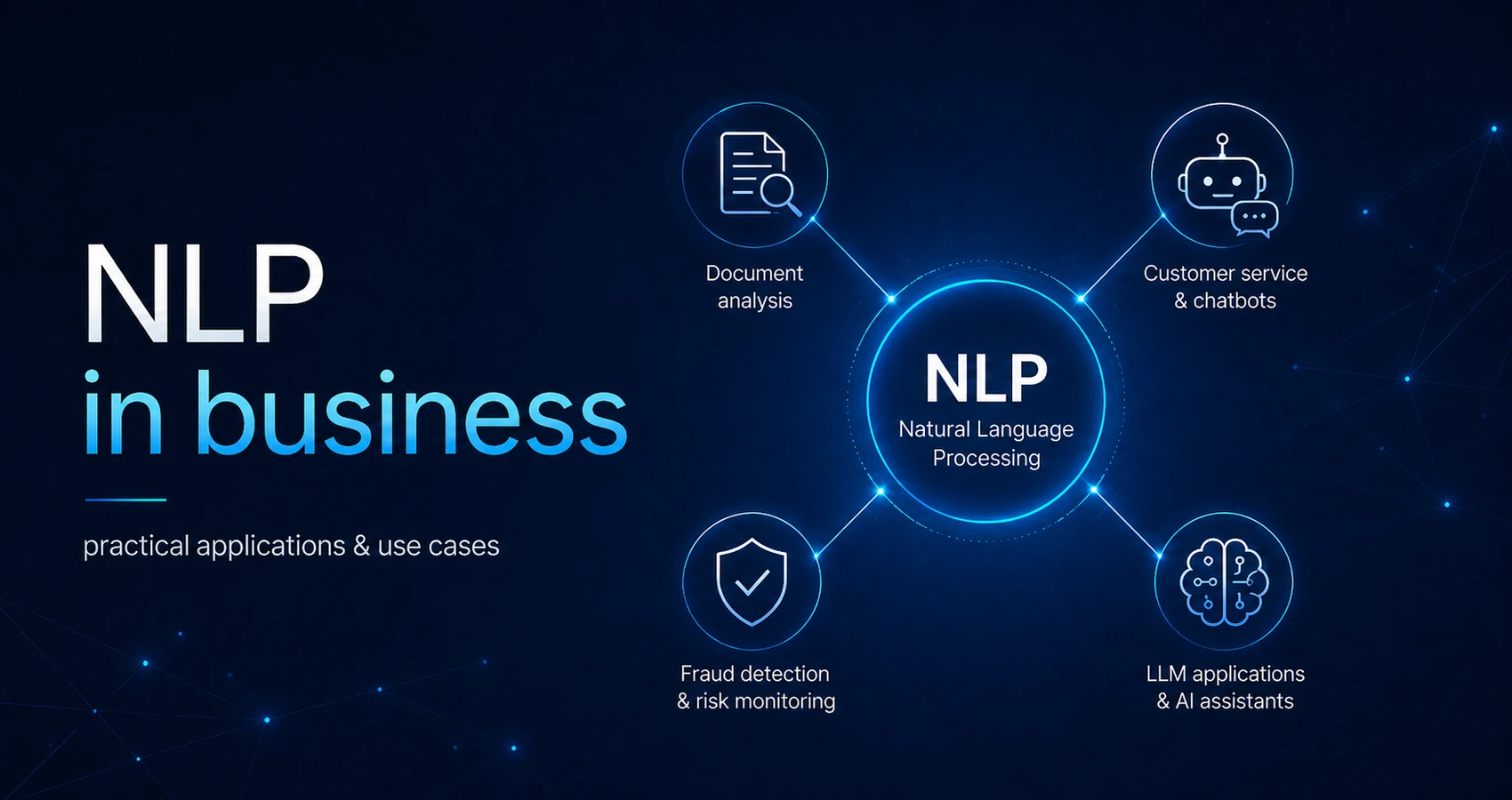
NLP in business: practical applications and use cases
Natural Language Processing (NLP) is the branch of AI that lets software read, analyze, and generate human language. Today, NLP increasingly runs on large language models, blurring the line with generative AI. This guide covers 8 practical business applications, from document analysis to customer service.
What is Natural Language Processing (NLP)?
Natural Language Processing (NLP) is a subfield of artificial intelligence that combines computational linguistics with machine learning to process human text and speech.
In a business context, NLP turns emails, documents, support tickets, call transcripts, customer reviews, and other forms of unstructured data into information that software can classify, search, summarize, or use within automated workflows.
Here, NLP refers to Natural Language Processing, not Neuro-Linguistic Programming. The two concepts share an acronym but belong to entirely different fields.
Natural Language Processing sits within a broader technology ecosystem:
- Artificial intelligence covers systems that perform tasks commonly associated with human intelligence.
- Machine learning enables systems to identify patterns and improve outputs based on data.
- Deep learning uses multilayer neural networks to process more complex language patterns and context.
- Data science provides the methods, infrastructure, and evaluation processes that turn an NLP model into a useful business solution.
Common NLP tasks include:
- classifying emails, documents, and customer requests
- extracting names, dates, amounts, products, and contractual clauses
- generating summaries, answers, and draft responses
- recognizing and transcribing speech
- detecting sentiment, intent, urgency, and topics
- translating content between languages
The relevance of NLP grows as companies accumulate more language data than teams can review manually. Contracts, knowledge bases, support conversations, reports, and internal communications often contain valuable information, but most of it does not arrive in structured database fields.
This is one reason more businesses are turning to data to improve decisions, automate processes, and make information more accessible across the organization.
The value of NLP does not come from language processing alone. It comes from connecting language to a business action. An extracted renewal date can trigger a notification. A classified support ticket can move to the right team. A detected compliance issue can enter a review workflow.
In that sense, NLP becomes a business capability when its outputs connect with the systems and decisions employees already rely on.
How does NLP actually work?
NLP works through a pipeline that converts raw language into machine-readable patterns, applies a model, and sends the result to a business application or workflow.
The exact architecture varies by use case, but most NLP systems include four core stages.
- Tokenization and preprocessing
The system divides text into smaller units, such as words, subwords, sentences, or paragraphs. It may also normalize spelling, remove irrelevant formatting, identify language, detect sentence boundaries, or mask personal information.
This stage creates a more consistent input for further analysis.
- Feature extraction and representation
Traditional NLP systems represented language through keyword counts, linguistic rules, or manually designed features. Modern systems often rely on embeddings, which convert words, sentences, or entire documents into numerical vectors.
These vectors help models compare meaning and context rather than relying only on exact keyword matches.
- Model training and evaluation
An NLP model may be trained for a specific task or built on a pretrained foundation model. During model training, the system learns from examples such as labeled support tickets, annotated contracts, or customer reviews.
Evaluation then measures how well the model performs in its intended environment. Relevant metrics may include accuracy, precision, recall, latency, consistency, and the business impact of incorrect predictions.
A model that performs well on a public benchmark may still struggle with company-specific terminology, abbreviations, document formats, or customer language.
- Deployment and integration
The model connects to an application, API, CRM, document repository, analytics platform, or workflow engine. Its output may classify an item, extract a field, generate a summary, or recommend an action.
Monitoring adds another layer because language, products, policies, and source data change over time.
NLP has evolved from rule-based systems to statistical models, deep learning, and Large Language Models. Rule-based systems remain effective when a task is narrow and its logic is stable. Machine learning fits patterns that are difficult to define manually. Deep learning and LLMs handle more varied language and broader context.
A detailed comparison of AI, machine learning, and deep learning explains how these technologies relate to one another.
Modern NLP solutions can also combine language generation with retrieval. Instead of producing an answer only from information stored in model parameters, a retrieval component finds relevant company documents and supplies them as context.
This approach, known as retrieval-augmented generation, can improve grounding and make answers more useful in enterprise applications.
In production, an accurate model is only one part of a reliable NLP system. Data governance, access controls, observability, fallback procedures, and clear error thresholds all influence how safely and effectively the system operates.
A wrong marketing classification may be inconvenient. A missed fraud indicator or incorrectly extracted contractual clause may create financial or legal risk. The consequences of each prediction therefore shape the architecture, validation process, and level of human review.
Is ChatGPT an example of NLP?
ChatGPT is a Large Language Model that performs NLP tasks, but not every NLP system is based on an LLM or works like ChatGPT.
ChatGPT can interpret prompts, generate text, answer questions, summarize documents, classify content, and maintain a conversation. These are all Natural Language Processing capabilities.
The key distinction is that NLP is the broader field, while Large Language Models are one category of technology used within that field.
Many business NLP applications do not depend on a general-purpose conversational model. A company may use a smaller classifier to route tickets, a named entity recognition model to extract contract fields, or a rule-based system to identify compliance phrases.
The main differences between classical NLP and LLM-powered NLP include:
- Scope: Classical NLP models are usually designed for a specific task. LLMs can perform many tasks through instructions.
- Generation: Traditional NLP often classifies or extracts information. LLMs can also produce fluent summaries, answers, and drafts.
- Predictability: Smaller, task-specific models often provide more consistent outputs in narrowly defined workflows.
- Context: LLMs process broader context and adapt to varied language more effectively.
- Cost: Classical models can be cheaper and faster to operate at scale.
- Risk: Generative models can produce plausible but inaccurate information, which increases the value of grounding and review.
The choice depends on the business problem rather than the popularity of a model category.
A deterministic classifier may fit a workflow that routes thousands of support requests. An LLM may bring more value when employees search or summarize complex documents. A hybrid system may combine both.
For example, a document can first pass through a small classification model. Named entity recognition can then extract important fields. An LLM can produce a concise summary for a human reviewer. This architecture uses flexible generation where it adds value while keeping predictable components for structured tasks.
Webellian provides a broader overview of how large language models are changing enterprises, including their role in knowledge access, automation, and decision support.
Companies considering LLM adoption also face the broader implications of Generative AI in the enterprise, including security, governance, integration, evaluation, and operating costs.
ChatGPT is therefore an example of an application that uses NLP, but it represents only one part of a much larger field.
How are businesses using NLP to analyze documents and text?
Businesses use NLP to extract entities, clauses, topics, and key data points from contracts, reports, claims, and compliance documents.
Document analysis is one of the most established NLP business applications because many critical processes still depend on employees reading large volumes of text manually.
Common document processing use cases include:
- Contract analysis: Identifying parties, dates, renewal terms, payment obligations, termination clauses, and unusual provisions.
- Claims processing: Extracting incident details, policy information, amounts, and supporting evidence from insurance claims.
- Report analysis: Identifying metrics, events, risks, organizations, and recurring themes across reports.
- Compliance review: Detecting prohibited language, missing disclosures, policy deviations, or content that may warrant escalation.
- Knowledge search: Finding relevant passages across technical documentation, internal policies, and knowledge bases.
- Document classification: Assigning documents to categories and directing them to the correct workflow.
A core NLP technique used in these systems is named entity recognition (NER). NER identifies structured elements such as people, companies, products, locations, dates, account numbers, and monetary values.
Other models may classify document types, compare clauses, detect topics, summarize content, or identify relationships between entities.
The output becomes more valuable when it connects directly to an operational process. Extracting a contract renewal date has limited impact if the result remains in a separate interface. Its value increases when the date updates a contract management system, triggers an alert, or starts an approval process.
The same principle applies to compliance. An NLP model may detect a potential issue, while the wider system creates a record, preserves the source passage, assigns the case, and provides a clear review path.
Document analysis can also support AI-powered business intelligence by transforming unstructured text into information that can be filtered, compared, and visualized.
For example, an organization can aggregate recurring risks from project reports, compare clauses across supplier contracts, or identify complaint themes across thousands of service tickets.
Production document processing also involves several practical variables:
- scanned documents and optical character recognition
- inconsistent layouts and formatting
- handwritten or low-quality source material
- domain-specific terminology
- multilingual documents
- missing or ambiguous information
- personal or confidential data
High-risk outputs often benefit from validation against source documents or business rules. The objective is not always to remove people from the process. In many cases, the stronger outcome is a reduction in repetitive reading and a sharper focus on cases that call for expert judgment.
How does NLP improve customer service and support?
NLP improves customer service by automating routine conversations, classifying requests, routing tickets, and giving agents faster access to relevant information.
Chatbots and virtual assistants are the most visible examples, but customer service NLP extends across the entire support workflow.
Businesses use NLP to:
- answer frequently asked questions
- classify requests by topic, urgency, or product
- route tickets to the correct team
- identify customer intent
- summarize long conversations
- transcribe and analyze phone calls
- recommend knowledge base articles
- draft responses for human agents
- detect frustration or escalation risk
- identify potential churn signals
A conversational AI assistant can handle routine requests such as password resets, delivery updates, appointment changes, and policy questions. When confidence drops, the conversation can move to a human agent together with its context.
This reduces repetition for the customer and gives the agent a more useful starting point.
Ticket routing is another practical NLP application. Manual triage can delay responses and create inconsistent categorization. An NLP classifier can read an incoming request, identify its subject, estimate urgency, assign labels, and send it to the correct queue.
This becomes especially useful when requests arrive through several channels, including email, chat, contact forms, and social media.
NLP can also assist employees during and after a conversation. A system may retrieve relevant procedures, suggest a response, summarize the interaction, or create follow-up notes.
In higher-risk situations, human review adds an important safeguard. Billing disputes, account access, contractual commitments, health, safety, and legal obligations often involve context that extends beyond a single model prediction.
Fluency alone does not determine whether a customer service NLP system is effective. Reliable implementations combine useful responses with approved information sources, personal data protection, decision logs, and clear escalation paths.
Relevant measures include:
- answer accuracy
- successful resolution rate
- transfer quality
- average handling time
- customer satisfaction
- correction rate
- policy compliance
- escalation accuracy
NLP can reduce repetitive work and shorten response times. Its impact is strongest when automation, traceability, reliable knowledge sources, and human oversight work as one operating model.
How is NLP used for sentiment analysis and customer feedback?
Sentiment analysis uses NLP to classify customer feedback and identify opinions, emotions, topics, and changes in brand perception.
A basic sentiment analysis model labels a text as positive, negative, or neutral. More advanced NLP systems can detect frustration, satisfaction, urgency, intent, and the specific product or service feature being discussed.
Common data sources include:
- customer reviews
- social media posts and comments
- support tickets
- chat conversations
- call center transcripts
- survey responses
- NPS comments
- app store feedback
- cancellation reasons
- sales notes
Sentiment analysis becomes more useful when it is combined with topic detection.
A report showing that negative sentiment increased may not provide enough context for a decision. A stronger system can reveal that complaints are concentrated around delayed deliveries, billing errors, a new interface, or a specific product release.
NLP can also help detect emerging brand reputation risks. If negative comments about the same issue increase quickly, the system can alert customer service, communications, or product teams.
Those teams can then review the source messages, confirm the cause, and decide whether the situation relates to operations, communication, or product priorities.
Context remains a major challenge. Language can contain sarcasm, mixed opinions, industry terminology, cultural references, and ambiguous expressions. A customer may praise a product while criticizing its delivery. The same phrase may also carry different meanings across industries or regions.
For this reason, performance on real company data offers a more useful indicator than a generic benchmark alone.
The results also gain value when they are communicated clearly. Senior leaders rarely benefit from a raw sentiment score in isolation. They gain more from understanding what changed, why it matters, which customer groups are affected, and what action may follow.
Effective data storytelling for technology leaders helps convert sentiment analysis into a decision-ready narrative.
A mature sentiment analysis program combines NLP with a well-defined taxonomy, human validation, trend analysis, and clear ownership. Marketing teams may monitor brand reputation, product teams may analyze feature feedback, and support leaders may use sentiment to identify escalation patterns.
How is NLP used in finance and fraud detection?
Financial organizations use NLP to analyze transactions, claims, reports, and communications for fraud indicators, compliance risks, and operational insights.
Financial services generate large amounts of language data through applications, customer correspondence, call transcripts, regulatory filings, internal communications, research reports, and insurance claims.
Common NLP applications in finance include:
- Fraud detection: Identifying suspicious wording, inconsistent explanations, repeated narratives, and links between communications and transaction patterns.
- Insurance claims analysis: Extracting incident details, damage descriptions, dates, amounts, and policy information.
- Regulatory compliance: Monitoring communications, reviewing disclosures, comparing documents with internal policies, and identifying content that may warrant investigation.
- Market analysis: Processing filings, earnings calls, research notes, and news to identify entities, risks, events, and changes in tone.
- Customer operations: Classifying requests, summarizing complaints, and helping agents handle complex financial products.
- Risk monitoring: Extracting risk signals from reports, correspondence, and third-party information.
NLP does not usually replace quantitative fraud detection models. It adds information from text that structured transaction data may not capture.
For example, a fraud detection system can combine payment behavior with claim descriptions, emails, application forms, and call transcripts. This broader view may reveal contradictions or repeated language patterns that are not visible in numerical fields alone.
Compliance applications place particular emphasis on auditability. Source passages, extracted evidence, decision logs, and access controls give analysts a way to verify how a result was produced.
A generated summary can help an analyst understand a case, while the original text remains available for validation.
Financial language is also highly specialized. Product names, abbreviations, legal terminology, and regional regulations can reduce the performance of general-purpose NLP models. Domain-specific evaluation and representative data often make the difference between a promising demonstration and a reliable production tool.
NLP becomes more valuable when its outputs connect with broader analytics. Text-derived indicators can enrich dashboards, customer profiles, fraud cases, and risk models.
Webellian explores this broader role of analytics in business intelligence for the financial sector.
The objective is not simply to automate document reading. It is to improve the speed, coverage, and consistency of financial decisions while preserving the controls expected in a regulated environment.
What other NLP applications should CTOs know about?
NLP also powers voice transcription, personalized marketing, multilingual support, recruitment workflows, social media monitoring, and text summarization.
These applications often reuse the same underlying capabilities, including speech recognition, classification, embeddings, translation, summarization, and language generation.
Voice recognition and transcription: turning calls into searchable data
Speech recognition converts audio into text. NLP then makes the transcript searchable and actionable.
Businesses use voice transcription to:
- create searchable call and meeting records
- generate automatic notes
- extract action items
- identify recurring customer questions
- review sales and service conversations
- detect compliance phrases
- support accessibility through captions
- summarize long conversations
The quality of the result depends on audio clarity, accents, technical vocabulary, overlapping speakers, and background noise.
Speaker identification and confidence scores become especially valuable when transcripts feed regulated or high-risk workflows.
Personalized marketing: using NLP to tailor campaigns at scale
NLP helps marketing teams understand what customers discuss, search for, request, and respond to.
Models can classify intent, detect interests, group feedback themes, analyze campaign responses, and adapt content for specific customer segments.
Practical applications include:
- matching messages to customer interests
- recommending relevant content
- identifying buying signals
- classifying campaign responses
- extracting themes from open-ended feedback
- adapting copy to different audiences
- generating initial content variations
Strong personalization combines relevance with privacy, consent, and clear limits on sensitive profiling. The objective is a more useful experience without weakening customer trust.
Multilingual support: serving global customers in their own language
Multilingual NLP allows organizations to classify, search, translate, and respond across different languages.
It can support:
- global customer service
- international document processing
- multilingual knowledge bases
- cross-market feedback analysis
- translation of internal documentation
- routing requests by language and region
A robust system preserves product terminology, legal meaning, tone, and local context.
Automatic translation may work well for low-risk internal content. Legal, medical, contractual, or safety-related communication often benefits from additional human validation.
NLP can also support recruitment by extracting skills and experience from CVs, classifying applications, and matching candidates with role requirements. Bias testing, transparency, and human involvement remain central when these systems influence employment decisions.
Social media monitoring tools use NLP to identify brand mentions, emerging topics, reputation risks, and customer questions. Text summarization helps employees process reports, meeting notes, research, and internal documentation more efficiently.
CTOs can evaluate these NLP applications through workflow value, risk, available data, integration requirements, and operating costs.
The most advanced model is not always the strongest fit. A focused system that solves a defined problem reliably can create more value than a broader model with unclear ownership or weak integration.
Companies assessing new use cases can follow broader AI and data technology trends to understand how language technologies and enterprise architectures continue to evolve.
What do you need for a successful NLP implementation?
A successful NLP implementation combines a clearly scoped use case, suitable data, measurable evaluation criteria, and reliable integration with existing systems.
Many NLP initiatives lose momentum when they begin with a model rather than a business problem.
A practical implementation plan usually covers:
- A clearly defined use case: The input, expected output, user, business action, and acceptable error rate.
- Data quality and availability: Access to representative documents, messages, transcripts, or labels.
- A measurable business objective: A clear connection to handling time, routing quality, extraction accuracy, or decision support.
- An evaluation framework: Technical and business metrics defined before implementation.
- Integration requirements: Connections with CRM, BI, document management, knowledge bases, and operational platforms.
- A build-versus-buy assessment: Comparison of ready-made APIs, open-source models, fine-tuned models, and custom solutions.
- Security and governance: Access controls, retention rules, human review, personal data handling, and auditability.
- Operational ownership: Responsibility for monitoring, feedback, updates, incidents, and model performance.
Data quality plays a particularly important role. An NLP model trained or evaluated on incomplete, inconsistent, or unrepresentative information may produce misleading results.
A useful dataset reflects the language, document types, edge cases, and terminology that appear after deployment.
For many organizations, a proof of concept offers a practical starting point. It reveals whether the available data supports the use case and whether the NLP solution can reach a realistic performance threshold.
The strongest proof of concept is narrow enough to evaluate efficiently but representative enough to expose data, integration, security, and governance challenges.
Webellian’s Data Science & AI services help companies scope, build, integrate, and evaluate NLP solutions within existing technology environments.
Organizations that are still identifying the most promising opportunity can begin with the AI Exploration Program. The program helps assess data readiness, identify practical use cases, and prioritize initiatives before a larger implementation begins.
Once a use case has been selected, a focused data science proof of concept can validate technical feasibility, model quality, integration requirements, and potential business value before full deployment.
The final architecture follows the economics and risk of the problem.
A small classifier may outperform an LLM for predictable ticket routing. An LLM supported by retrieval may fit complex knowledge access. A hybrid architecture may combine rules, classical NLP, and Generative AI.
The strongest solution is the one that delivers the required quality, latency, security, cost, scalability, and maintainability within the wider business process.
FAQ
What is a good example of NLP in business?
A good example is automated document processing. NLP can read a contract or insurance claim, extract names, dates, amounts, and clauses, and send the structured result to a workflow or human reviewer.
This reduces repetitive manual reading while keeping important decisions traceable.
What are some common applications of NLP?
Common NLP applications include document analysis, chatbots, ticket routing, sentiment analysis, speech transcription, translation, fraud detection, compliance monitoring, text summarization, and personalized marketing.
The most valuable application depends on the quality of the available language data and the business process connected to the model output.
What are the main challenges of using NLP in business?
The main challenges include inconsistent data quality, ambiguous language, domain-specific terminology, privacy requirements, bias, integration complexity, and model drift.
LLM-based systems also introduce the risk of inaccurate generated content. Testing on real company data and human review for high-risk decisions provide important safeguards.
What trends are shaping the future of NLP in business?
Important trends include wider use of Large Language Models, retrieval-augmented generation, smaller domain-specific models, and multimodal systems that combine text with audio or images.
Organizations are also placing greater emphasis on AI governance, evaluation, data security, and integrating NLP into measurable operational workflows.